IOSG; Making probabilities assets, forecasting market intelligence agents' insights
Author: Jacob Zhao @IOSG
In previous Crypto AI series reports, we consistently emphasized the following point: the most practically valuable scenarios in the current crypto space mainly focus on stablecoin payments and DeFi, with Agents serving as the key user interface for AI industries. Therefore, within the trend of integrating Crypto and AI, the two most valuable paths are: short-term AgentFi based on existing mature DeFi protocols (such as lending, liquidity mining, and advanced strategies like Swap, Pendle PT, and funding rate arbitrage), and medium- to long-term Agent Payment centered around stablecoin settlement, relying on protocols like ACP/AP2/x402/ERC-8004.
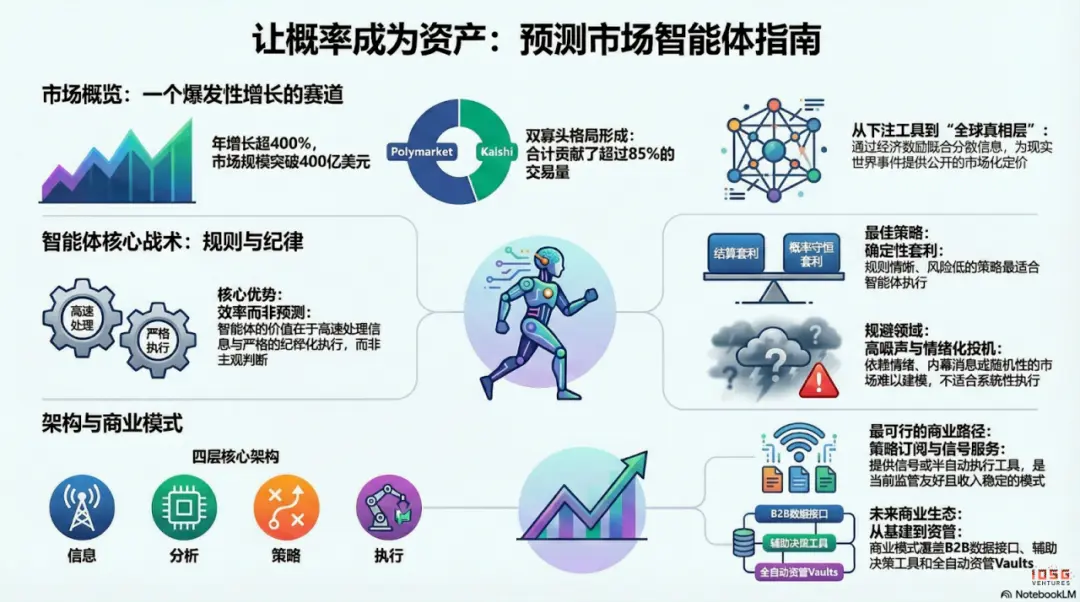
Forecast markets are expected to become a significant industry trend by 2025, with annual total trading volume skyrocketing from about $9 billion in 2024 to over $40 billion in 2025, representing over 400% year-over-year growth. This remarkable increase is driven by multiple factors: macro-political uncertainties increasing demand, infrastructure and trading model maturation, and regulatory breakthroughs (Kalshi’s victory in court and Polymarket’s return to the US). Prediction Market Agents are expected to emerge in early 2026, potentially becoming a new product form in the AI domain within the next year.
1. Prediction Markets: From Betting Tools to “Global Truth Layer”
Prediction markets are financial mechanisms that facilitate trading based on future event outcomes, with contract prices essentially reflecting the collective judgment of the market on the probability of events. Their effectiveness stems from the combination of crowd wisdom and economic incentives: in environments of anonymous, real-money betting, dispersed information is rapidly integrated into price signals weighted by capital commitment, significantly reducing noise and false judgments.
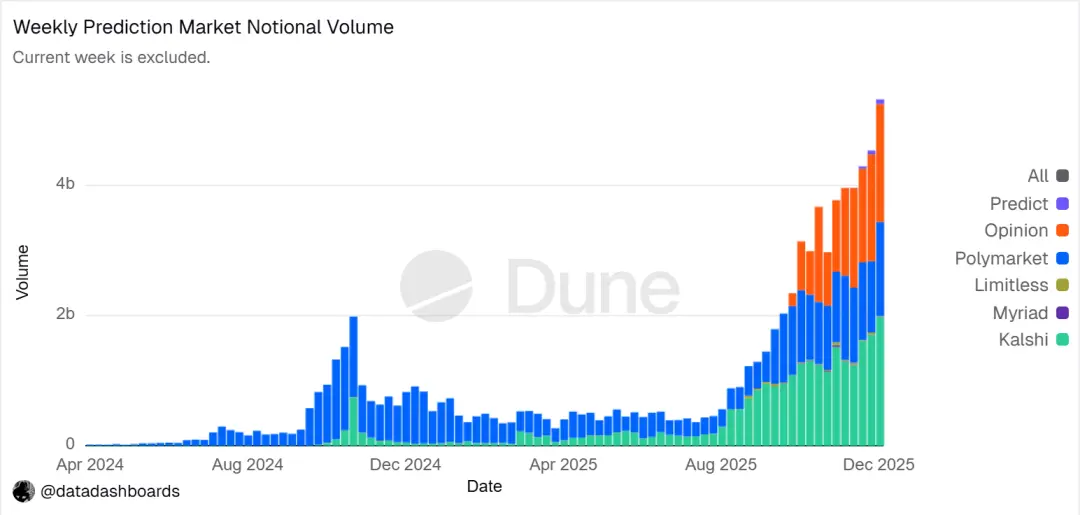
▲ Prediction Market Nominal Trading Volume Trend Chart Data Source: Dune Analytics (Query ID: 5753743)
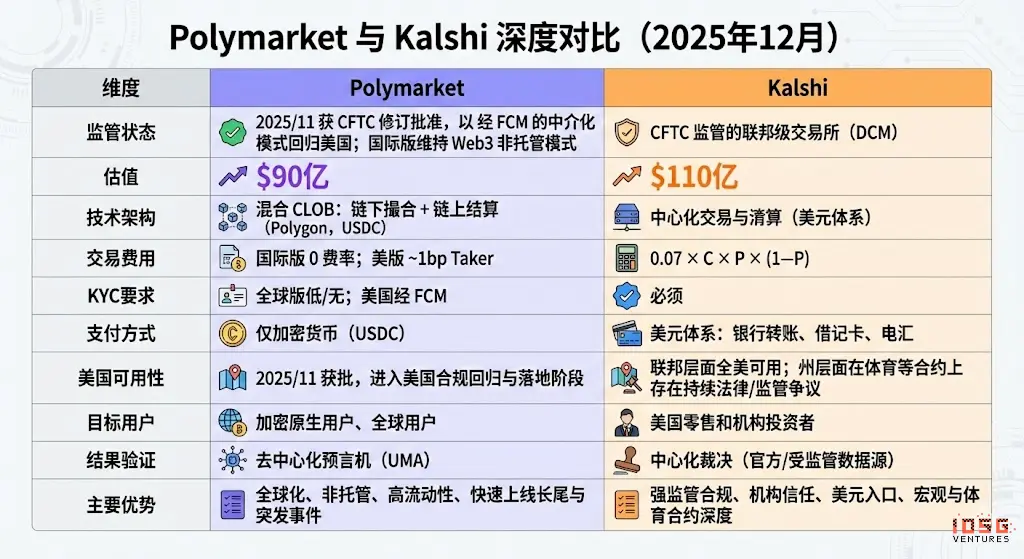
By the end of 2025, prediction markets will have largely formed a duopoly dominated by Polymarket and Kalshi. According to Forbes, total trading volume in 2025 is about $44 billion, with Polymarket contributing approximately $21.5 billion and Kalshi about $17.1 billion. Data from February 2026 shows Kalshi’s trading volume ($25.9B) surpassing Polymarket ($18.3B), approaching 50% market share. Kalshi’s rapid expansion is attributed to its legal victory over election contracts, its early-mover advantage in US sports prediction markets, and clearer regulatory expectations. Currently, their development paths are clearly diverging:
- Polymarket adopts a hybrid off-chain matching and on-chain settlement architecture with decentralized clearing, building a global, non-custodial, highly liquid market. After re-entering US compliance, it operates a dual onshore + offshore model.
- Kalshi integrates into traditional finance via API connections to mainstream retail brokers, attracting deep participation from Wall Street market makers in macro and data-based contracts. Its products are constrained by traditional regulatory processes, with long-tail demand and sudden events lagging.
Besides Polymarket and Kalshi, other competitive players in prediction markets mainly develop along two paths:
- Compliance distribution: embedding event contracts into existing brokerage or large platform accounts and clearing systems, leveraging channel coverage, regulatory credentials, and institutional trust (e.g., Interactive Brokers × ForecastEx’s ForecastTrader, FanDuel × CME Group’s FanDuel Predicts). This path has significant compliance and resource advantages but is still early in product and user scale.
- Crypto-native on-chain path: represented by Opinion.trade, Limitless, Myriad, leveraging token mining, short-term contracts, and media distribution for rapid growth, emphasizing performance and capital efficiency. Long-term sustainability and risk control robustness remain to be validated.
The combination of traditional financial compliance entry points and native crypto performance advantages forms a diverse competitive landscape for prediction markets.
On the surface, prediction markets resemble gambling, but fundamentally they are zero-sum games. The core difference lies in whether they generate positive externalities: by aggregating dispersed information through real-money trading to publicly price real-world events, forming valuable signals. The trend is shifting from mere betting to a “Global Truth Layer”—with institutions like CME and Bloomberg participating, event probabilities are becoming decision-making metadata that can be directly queried by financial and corporate systems, providing more timely and quantifiable market-based truths.
Globally, prediction market regulation is highly fragmented. The US is the only major economy explicitly regulating prediction markets as financial derivatives. Europe, the UK, Australia, Singapore tend to view them as gambling and tighten regulation. China and India prohibit them outright. Future global expansion depends heavily on each country’s regulatory framework.
2. Architecture Design of Prediction Market Agents
Currently, Prediction Market Agents are in early practice stages. Their value isn’t about “more accurate AI predictions,” but about amplifying information processing and execution efficiency within prediction markets. Prediction markets are fundamentally information aggregation mechanisms, with prices reflecting collective probability judgments. Market inefficiencies mainly stem from information asymmetry, liquidity, and attention constraints. The ideal role of prediction market agents is Executable Probabilistic Portfolio Management: converting news, rule texts, and on-chain data into verifiable pricing deviations, executing strategies faster, more disciplined, and at lower costs, capturing structural opportunities through cross-platform arbitrage and portfolio risk management.
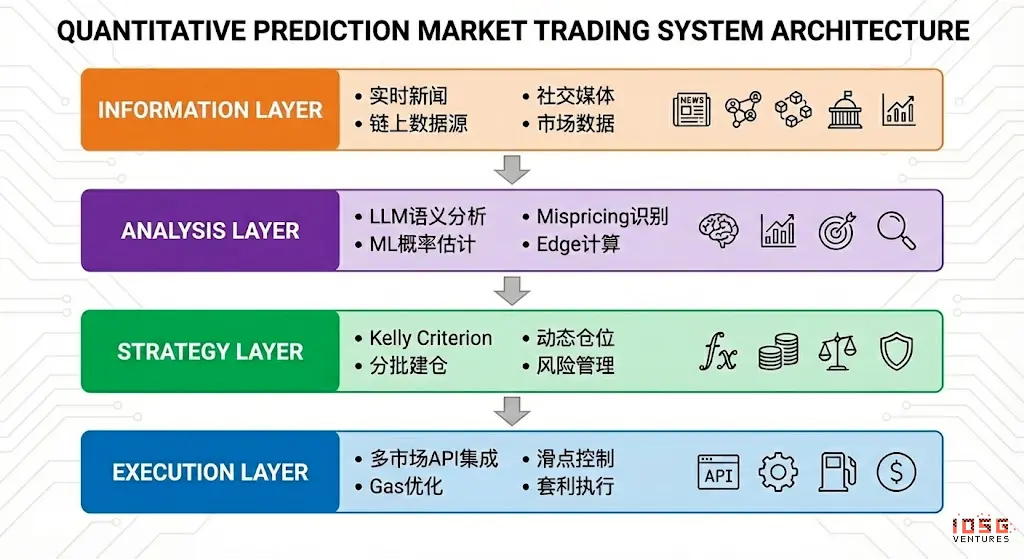
An ideal prediction market agent can be abstracted into four layers:
- Information Layer: aggregating news, social data, on-chain and official data;
- Analysis Layer: using LLMs and ML to identify mispricings and compute edges;
- Strategy Layer: translating edges into positions via Kelly, batch sizing, and risk controls;
- Execution Layer: completing multi-market orders, slippage and gas optimization, and arbitrage execution, forming an efficient automated closed loop.
3. Strategy Framework of Prediction Market Agents
Unlike traditional trading, prediction markets differ significantly in settlement mechanisms, liquidity, and information distribution. Not all markets and strategies are suitable for automation. The core of prediction market agents is whether they are deployed in scenarios with clear, codable rules and structural advantages. The following analyzes from three levels: underlying asset selection, position management, and strategy structure.
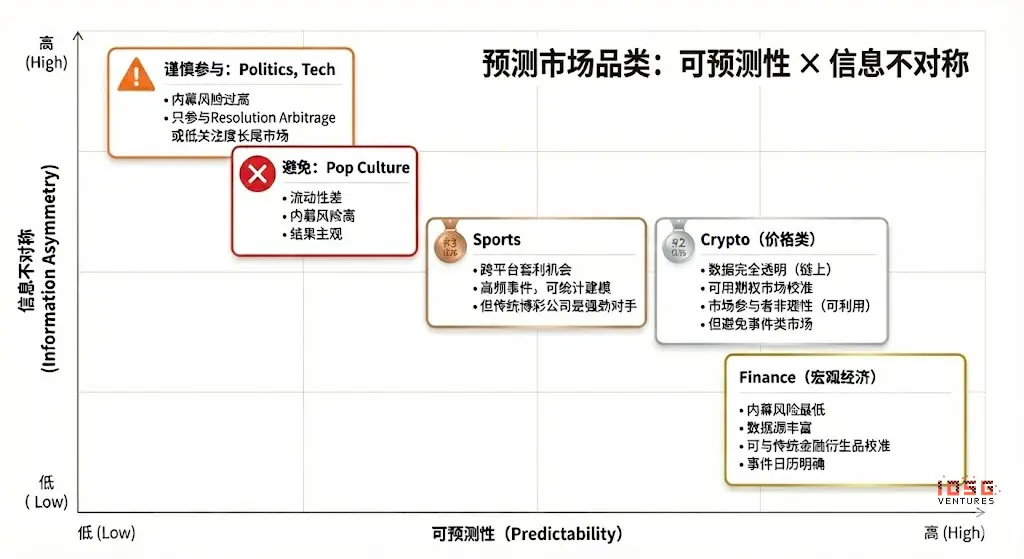
Prediction Market Asset Selection
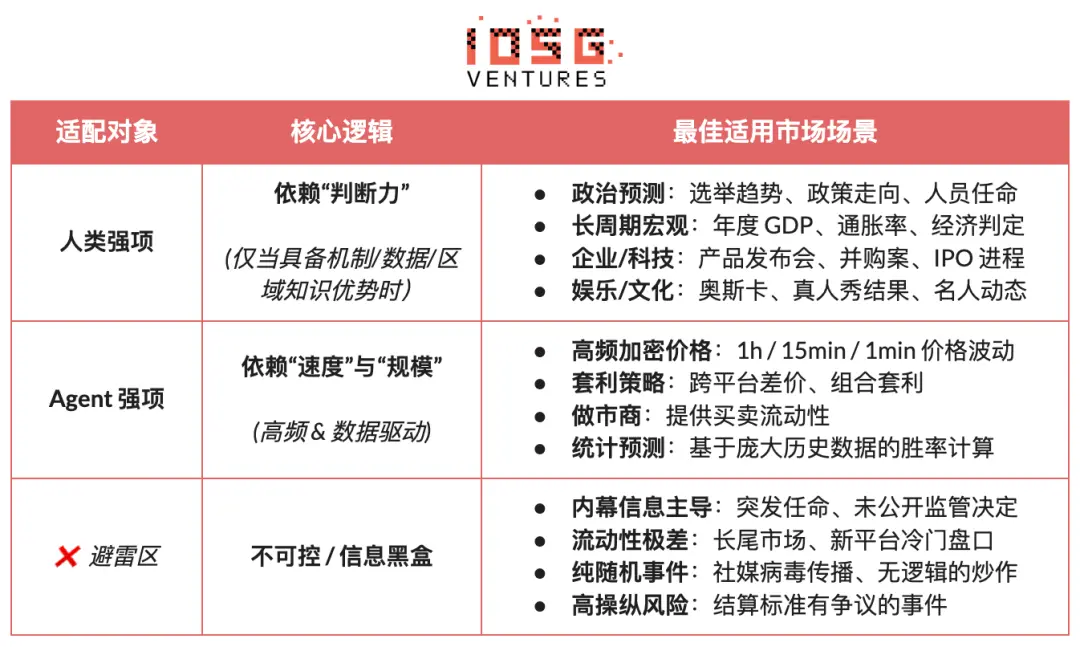
Not all prediction markets have tradable value. Participation value depends on: clarity of settlement (rules and data sources), quality of liquidity (depth, spreads, volume), insider risk (information asymmetry), time structure (expiration and event rhythm), and traders’ informational advantage and expertise. Only when most dimensions meet basic requirements does the prediction market have a foundation for participation. Participants should match their strengths and market characteristics:
- Human core advantages: rely on expertise, judgment, and integrating fuzzy information, with relatively wide decision windows (days/weeks). Typical scenarios include political elections, macro trends, and corporate milestones.
- AI Agent core advantages: rely on data processing, pattern recognition, and rapid execution, with very short decision windows (seconds/minutes). Typical scenarios include high-frequency crypto prices, cross-market arbitrage, and automated market making.
- Unsuitable areas: markets dominated by insider information or purely random/manipulable, offering no advantage to any participant.
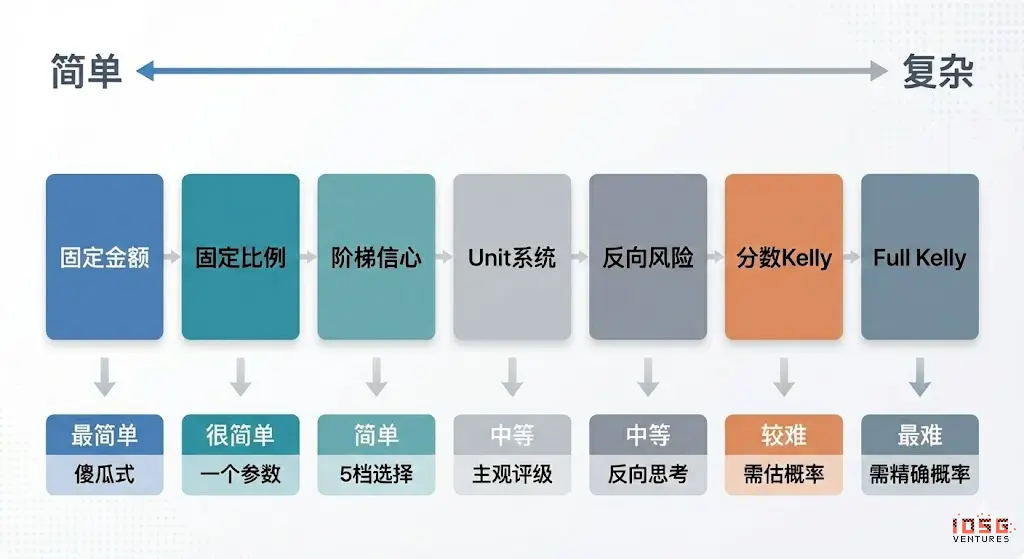
Position Management in Prediction Markets
The Kelly Criterion is a well-known capital management theory for repeated games. Its goal isn’t to maximize single-trade profit but to maximize long-term compound growth rate of capital. Based on estimates of win probability and odds, it calculates the optimal betting proportion to improve capital growth when the expected value is positive. Widely used in quantitative investing, professional betting, poker, and asset management.
- Classic form: f* = (bp - q) / b
- where f* is the optimal stake proportion, b is net odds, p is win probability, q=1−p
- Simplified for prediction markets: f* = (p - market_price) / (1 - market_price)
- where p is subjective true probability, market_price is implied probability
The effectiveness of Kelly depends heavily on accurate estimates of true probability and odds. In practice, traders find it difficult to consistently estimate true probabilities accurately. Therefore, professional bettors and prediction market participants tend to prefer rule-based strategies with higher implementability and lower reliance on probability estimates:
- Unit System: dividing capital into fixed units (e.g., 1%), betting different units based on confidence, with an upper limit on units to constrain risk—most common practical method.
- Flat Betting: betting a fixed proportion each time, emphasizing discipline and stability, suitable for risk-averse or low-confidence environments.
- Confidence Tiers: pre-setting discrete position levels with absolute caps to reduce decision complexity and avoid the pseudo-precision issues of Kelly.
- Inverted Risk Approach: starting from maximum tolerable loss and working backward to determine position size, based on risk constraints rather than expected returns.
For prediction market agents, strategy design should prioritize implementability and stability over theoretical optimality. Clear rules, simple parameters, and fault tolerance to judgment errors are key. Under these constraints, the tiered confidence method combined with fixed position caps is most suitable. This approach does not rely on precise probability estimates but classifies signals into limited tiers with corresponding fixed positions; even in high-confidence scenarios, risk is controlled with explicit caps.
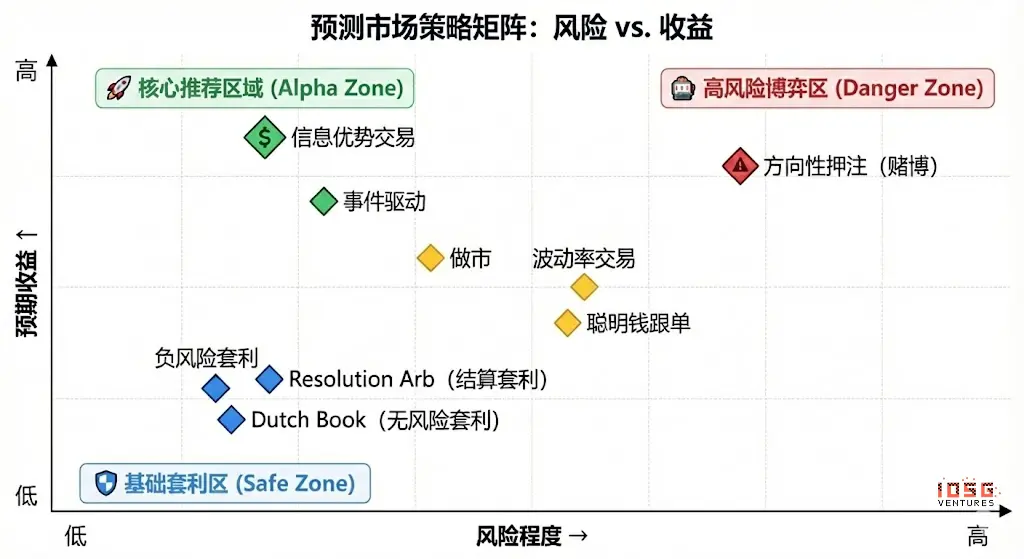
Prediction Market Strategy Selection
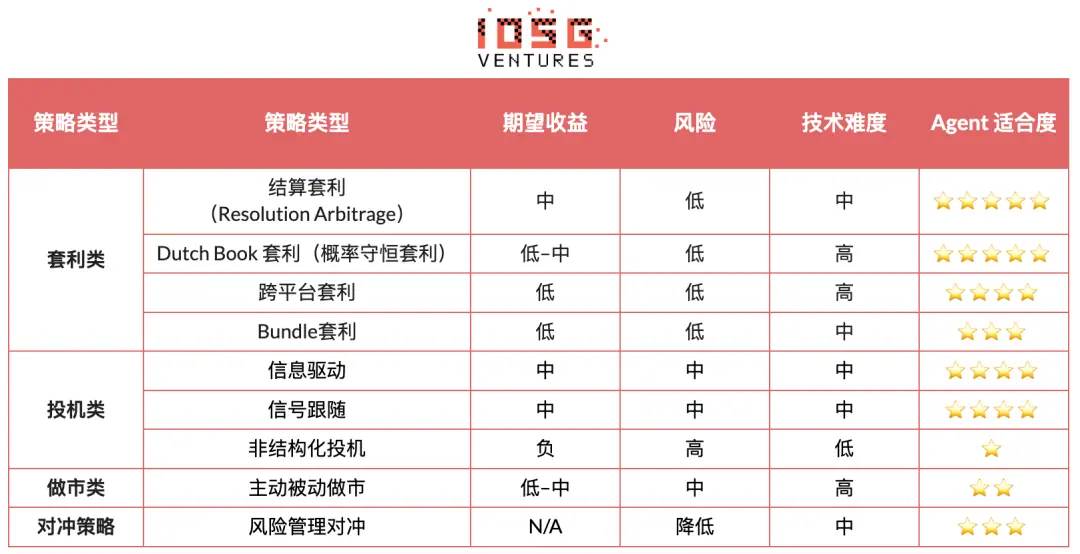
From a strategic perspective, prediction markets mainly fall into two categories: deterministic arbitrage strategies characterized by clear, codable rules (Arbitrage), and directional speculative strategies relying on information interpretation and trend judgment (Speculative). Additionally, there are market-making and hedging strategies mainly used by professional institutions, requiring significant capital and infrastructure.
Deterministic Arbitrage Strategies
- Resolution Arbitrage: occurs when event outcomes are nearly certain but markets have not fully priced them yet. Gains mainly come from information synchronization and execution speed. This strategy has clear rules, low risk, and can be fully codified, making it ideal for agent automation.
- Dutch Book Arbitrage: exploits the imbalance when the sum of prices for mutually exclusive and complete events deviates from probability conservation (∑P ≠ 1). By constructing a portfolio, it locks in riskless profit. It relies solely on rules and price relationships, with low risk and high rule-based automation suitability.
- Cross-Platform Arbitrage: profits from price discrepancies of the same event across different markets. Low risk but requires low latency and parallel monitoring. Suitable for infrastructure-advantaged agents, but margins diminish as competition intensifies.
- Bundle Arbitrage: trades based on pricing inconsistencies among related contracts. Clear logic but limited opportunities. Can be executed by agents but requires engineering for rule parsing and portfolio constraints.
Speculative Directional Strategies
- Information-Driven Trading: based on explicit events or structured information, such as official data releases, announcements, or rulings. As long as sources are clear and trigger conditions definable, agents can leverage speed and discipline; when information becomes semantic or contextual, human judgment may be needed.
- Signal Following: follows historically well-performing accounts or funds to gain profits. Simple rules, automatable, but risks include signal degradation and reverse exploitation. Suitable as an auxiliary strategy for agents.
- Unstructured / Noisy Strategies: rely on sentiment, randomness, or participant behavior, lacking stable edges. Long-term expected value is unstable. Due to difficulty modeling and high risk, these are unsuitable for systematic agent deployment and not recommended as long-term strategies.
High-frequency price and liquidity strategies (Market Microstructure): depend on ultra-short decision windows, continuous quoting, or high-frequency trading, with high requirements for latency, modeling, and capital. While theoretically suitable for agents, in prediction markets they are often limited by liquidity and intense competition, suitable only for a few with significant infrastructure.
Risk management and hedging strategies: do not directly seek profit but aim to reduce overall risk exposure. Clear rules and objectives, suitable as long-term risk control modules.
Overall, suitable prediction market strategies for agents are those with clear, codable rules and weak subjective judgment. Deterministic arbitrage should be the main profit source, supplemented by structured information and signal-following strategies. Noisy and sentiment-driven trading should be systematically excluded. The long-term advantage of agents lies in disciplined, high-speed execution and risk control.
4. Business Models and Product Forms of Prediction Market Agents
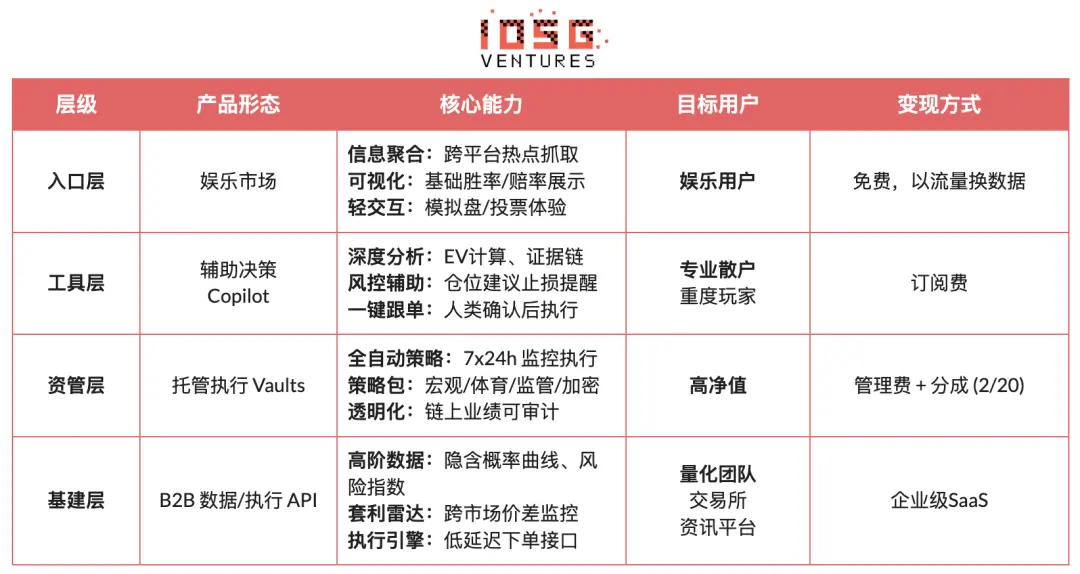
The ideal commercial model for prediction market agents can explore different directions at various levels:
- Infrastructure Layer: providing multi-source real-time data aggregation, Smart Money address databases, unified prediction market execution engines, and backtesting tools. Revenue mainly from B2B, stable regardless of prediction accuracy.
- Strategy Layer: integrating community and third-party strategies, building reusable and evaluable strategy ecosystems, capturing value via calls, weights, or performance sharing—reducing dependence on single Alpha.
- Agent / Vault Layer: agents act as trustees, directly participating in live trading, with transparent on-chain records and strict risk controls, earning management and performance fees.
Corresponding product forms include:
- Entertainment / Gamification: intuitive interfaces like Tinder to lower participation barriers, with strong user growth and market education potential. Ideal for breaking out of niche but needs to transition to subscription or execution-based monetization.
- Strategy Subscription / Signal: no fund custody, regulation-friendly, with clear rights and responsibilities, offering stable SaaS revenue. Currently the most feasible commercial path. Limitations include strategy copying, execution slippage, and capped long-term revenue; can be improved with semi-automated “signal + one-click execution.”
- Vault Custody: scalable and efficient, similar to asset management products, but faces licensing, trust, and centralization risks. Business highly dependent on market environment and profitability. Not suitable as a primary path unless backed by long-term performance and institutional trust.
Overall, a “Infrastructure monetization + strategy ecosystem + performance participation” diversified revenue approach reduces reliance on the single assumption of “AI continuously beating the market.” Even as Alpha converges with market maturity, underlying capabilities like execution, risk control, and settlement retain long-term value, enabling a sustainable business cycle.
5. Examples of Prediction Market Projects
Currently, prediction market agents are still in early exploration. While many foundational frameworks and upper-layer tools have emerged, no mature, standardized product exists that covers strategy generation, execution efficiency, risk management, and business closure comprehensively.
The ecosystem can be divided into three levels: Infrastructure, Autonomous Agents, and Prediction Market Tools.
Infrastructure
Polymarket Agents Framework
Polymarket Agents: Official developer framework aimed at standardizing “connection and interaction.” It encapsulates market data retrieval, order construction, and basic LLM calls. It addresses “how to place orders via code” but leaves core trading capabilities—strategy generation, probability calibration, dynamic position management, backtesting—largely unimplemented. More like an official “access protocol” than a profit-generating product. Commercial agents still need to build complete research and risk control cores on top.
Gnosis Prediction Market Tools
Gnosis Prediction Market Agent Tooling (PMAT): provides full read/write support for Omen/AIOmen and Manifold, but only read access to Polymarket, with clear ecosystem barriers. Suitable as a development foundation within Gnosis but limited for developers focusing on Polymarket.
Polymarket and Gnosis are currently the only prediction market ecosystems with official “agent development” products. Others like Kalshi mainly provide APIs and Python SDKs, requiring developers to build their own strategy, risk, operation, and monitoring systems.
Autonomous Trading Agents
Most existing “prediction market AI Agents” are still early-stage, with capabilities far from fully automated, closed-loop trading. They generally lack independent, systematic risk controls, and do not incorporate position management, stop-loss, hedging, or expectation constraints into decision-making. Overall product maturity is low, and no long-term operational system has yet emerged.
Olas Predict
Olas Predict is among the most mature prediction market agent ecosystems. Its core product, Omenstrat, is built on Gnosis’s Omen, using FPMM and decentralized arbitration, supporting small-scale high-frequency interactions but limited by Omen’s liquidity. Its “AI predictions” mainly rely on general LLMs, lacking real-time data and systematic risk controls. Historical success rates vary significantly across categories. In February 2026, Olas launched Polystrat, extending agent capabilities to Polymarket—users can set strategies in natural language, with agents automatically identifying probability deviations in markets settling within 4 days and executing trades. The system runs locally via Pearl, with self-hosted Safe accounts and hardcoded risk limits, making it the first consumer-grade autonomous trading agent targeting Polymarket.
UnifAI Network Polymarket Strategy
Provides Polymarket automation trading agents focused on tail risk: scanning for near-expiry contracts with implied probabilities >95%, buying to capture 3–5% spreads. On-chain data shows near 95% success rate, but returns vary across categories, heavily dependent on execution frequency and category choice.
NOYA.ai
Aims to integrate “research—judgment—execution—monitoring” into a closed loop, covering intelligence, abstraction, and execution layers. Has delivered Omnichain Vaults; Prediction Market Agent is still in development, not yet a complete mainnet loop, in the proof-of-concept stage.
Prediction Market Tools
Current prediction market analysis tools are insufficient to form a complete “prediction market agent.” Their value mainly lies in the information and analysis layers, with trading, position management, and risk control left to traders. Product-wise, they are more aligned with “strategy subscription / signal assistance / research enhancement,” representing early prototypes of prediction market agents.
Based on a systematic review and empirical filtering of projects in Awesome-Prediction-Market-Tools, this report highlights representative projects with initial product forms and use cases, focusing on four directions: analysis and signals, whale alert systems, arbitrage detection tools, and trading terminals with aggregation execution.
Market Analysis Tools
- Polyseer: research-oriented prediction tool using multi-agent architecture (Planner / Researcher / Critic / Analyst / Reporter) for evidence collection and Bayesian probability aggregation, producing structured reports. Transparent methodology, engineering process, fully open-source and auditable.
- Oddpool: positioned as “Bloomberg terminal for prediction markets,” offering cross-platform aggregation, arbitrage scanning, and real-time dashboards for Polymarket, Kalshi, CME, etc.
- Polymarket Analytics: global Polymarket data analysis platform, systematically displaying trader, market, position, and transaction data. Clear, intuitive, suitable for research and reference.
- Hashdive: trader-focused data tool using Smart Score and multi-dimensional screener to identify smart money and follow trades, practical for real-time decision-making.
- Polyfactual: AI-driven market intelligence and sentiment/risk analysis, embedded into trading interfaces via Chrome extension, targeting B2B and institutional users.
- Predly: AI-based mispricing detection platform comparing market prices and AI-calculated probabilities, claiming 89% alert accuracy, for signal discovery and opportunity filtering.
- Polysights: covers 30+ markets and on-chain indicators, tracking anomalies like new wallets and large bets, suitable for daily monitoring and signals.
- PolyRadar: multi-model analysis platform providing real-time event interpretation, timeline evolution, confidence scoring, and source transparency, emphasizing cross-AI validation.
- Alphascope: AI-powered prediction market intelligence engine offering real-time signals, research summaries, and probability change monitoring, still early-stage, focused on research and signals.
Alerts / Whale Tracking
- Stand: dedicated to whale follow and high-confidence action alerts.
- Whale Tracker Livid: productized whale position change tracking.
Arbitrage Detection Tools
- ArbBets: AI-driven arbitrage detection focusing on Polymarket, Kalshi, and sports betting markets, identifying cross-platform arbitrage and +EV opportunities, targeting high-frequency scanning.
- PolyScalping: real-time arbitrage and scalp analysis for Polymarket, supporting 60-second scans, ROI calculation, and Telegram alerts, suitable for active traders.
- Eventarb: lightweight cross-platform arbitrage calculator and alert tool covering Polymarket, Kalshi, Robinhood, with focused features, free to use.
- Prediction Hunt: cross-exchange prediction market aggregation and comparison, providing real-time price comparisons and arbitrage detection (about 5-minute refresh), aimed at information symmetry and inefficiency discovery.
Trading Terminals / Aggregated Execution
- Verso: YC Fall 2024-backed institutional prediction market trading terminal, with Bloomberg-style interface, tracking 15,000+ contracts in real-time, deep data analysis, and AI news intelligence, targeting professional and institutional traders.
- Matchr: cross-platform prediction market aggregator and execution tool, covering 1,500+ markets, with smart routing for optimal prices, planning automated strategies around high-probability events, cross-market arbitrage, and event-driven yield, focused on execution and capital efficiency.
- TradeFox: supported by Alliance DAO and CMT Digital, a professional prediction market aggregator and prime brokerage platform, offering advanced order types (limit, stop-loss, TWAP), self-custody trading, and multi-platform routing, targeting institutional traders, with plans to expand to Kalshi, Limitless, SxBet, and others.
6. Summary and Outlook
Currently, prediction market agents are in early exploratory stages.
- Market foundation and evolution: Polymarket and Kalshi have formed a duopoly, providing sufficient liquidity and scenario basis for building agents. The core difference from gambling is the positive externality—aggregating dispersed information through real trading to publicly price real-world events—gradually evolving into a “Global Truth Layer.”
- Core positioning: Prediction market agents should be viewed as executable probabilistic asset management tools. Their main task is transforming news, rule texts, and on-chain data into verifiable pricing deviations, executing strategies with higher discipline, lower costs, and cross-market capabilities. The ideal architecture involves four layers: information, analysis, strategy, and execution. Practical tradability heavily depends on clear settlement, liquidity quality, and structured information.
- Strategy and risk logic: deterministic arbitrage (including settlement arbitrage, probability conservation arbitrage, and cross-market spreads) is most suitable for automation, while directional speculation is supplementary. Position management should prioritize implementability and fault tolerance, with tiered confidence and fixed caps being most appropriate.
- Business models and future: main approaches include infrastructure monetization, third-party strategy ecosystems, and performance participation via Vaults. These reduce reliance on “AI continuously beating the market.” Even as Alpha converges with market maturity, underlying capabilities like execution, risk control, and settlement retain long-term value, enabling sustainable business cycles.
Despite the emergence of diverse foundational frameworks and tools, mature, standardized prediction market agents covering strategy, execution, risk, and business closure are still lacking. We look forward to future iterations and evolutions of prediction market agents.