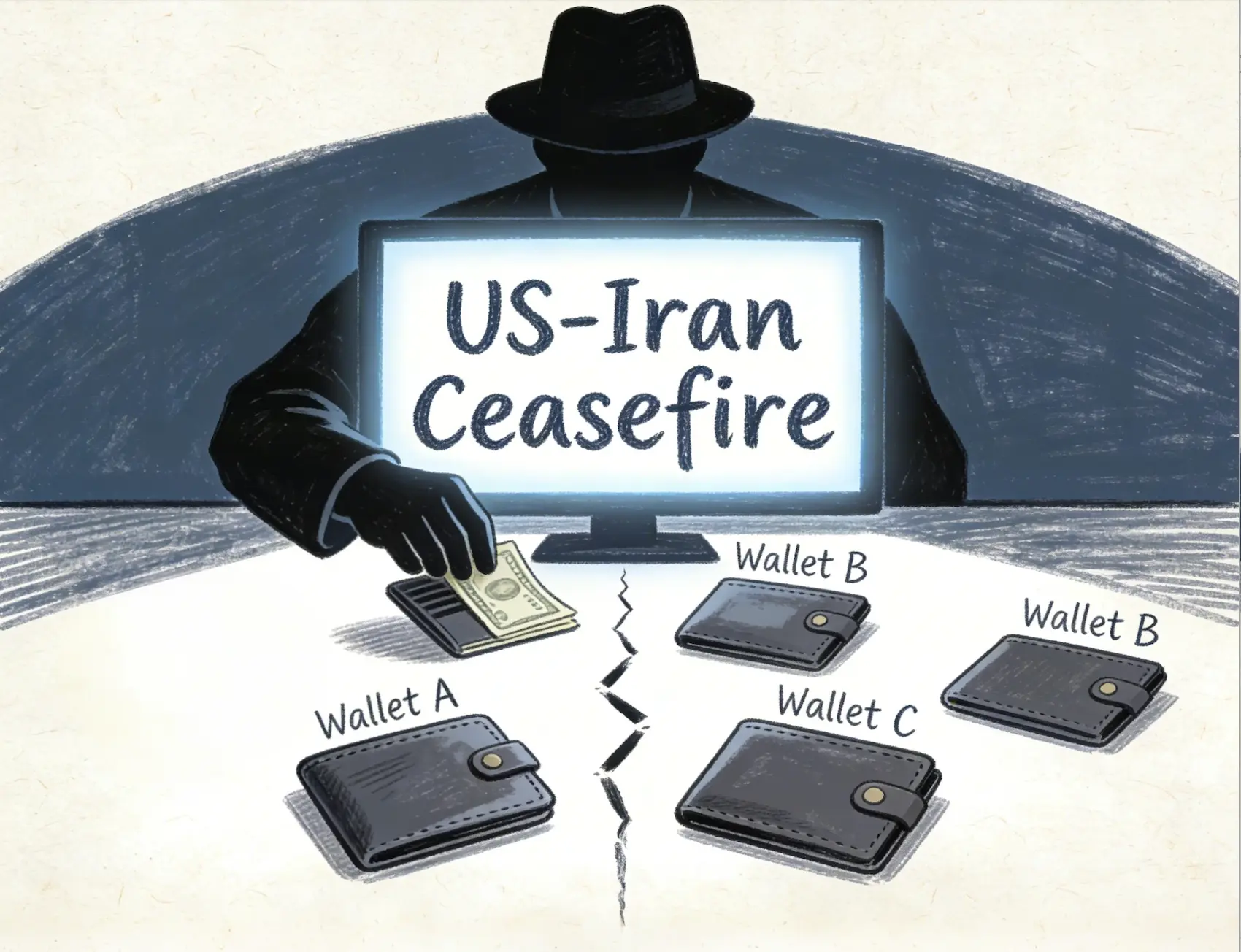
 A cluster of six Polymarket wallets that accurately predicted the February 28, 2026, U.S. strike on Iran—collectively profiting approximately $1.2 million—have placed coordinated bets totaling around $100,000 on a US-Iran ceasefire by March 31, according to on-chain data reviewed by analysts.
The same wallets, which were funded roughly 24 hours before the February 28 strike and subsequently placed successful bets on Iranian nuclear facility strikes, have now taken positions on a ceasefire outcome as conflicting signals emerge between Washington and Tehran. The precision of the trades has raised concerns about potential information advantage, though no confirmed evidence of insider trading has been presented.
The activity comes as prediction market platforms face increased scrutiny over suspiciously timed trades tied to geopolitical events, with a separate analysis showing a trader netted nearly $967,000 from dozens of well-timed bets on U.S. and Israeli military actions against Iran between 2024 and 2026.
Suspicious Trading Patterns and Insider Concerns
Coordinated Bets on Military Actions
On-chain data reveals that six wallets, newly funded approximately 24 hours before the February 28 U.S. strike on Iran, placed large “Yes” bets on the outcome “US strikes Iran by Feb 28.” The wallets later generated an estimated $1.2 million in profit. The same addresses subsequently placed successful bets on Iranian nuclear facility strikes, further raising questions about timing and potential information advantage.
Ceasefire Bets
Recent activity shows the same wallets placing coordinated bets of approximately $100,000 on a new outcome: a US-Iran ceasefire by March 31, with additional positions extending into April. The timing coincides with U.S. President Donald Trump’s claims of “productive discussions” with Iran, though Tehran has publicly denied such talks.
Analysis of a High-Win-Rate Trader
A separate analysis by blockchain analytics company Bubblemaps identified a trader who placed dozens of well-timed bets on U.S. and Israeli military actions against Iran, achieving an overall win rate of 83% and a 93% win rate for trades over $10,000. The trader netted nearly $967,000 since 2024. The bets were placed hours before unannounced military operations, including Israeli strikes in October 2024, U.S. airstrikes against Iranian nuclear facilities in June 2025, and the joint U.S.-Israeli surprise attack that began the current war in February 2026.
Bubblemaps CEO Nick Vaiman stated: “All of this is strong signaling of insider activity, based on the amount they made, the markets they bet on, the timing of their trades, the success rates of these trades, and the fact that they are connected on-chain. This is pretty suspicious in my book.”
Platform Responses and New Rules
Polymarket Rule Updates
On March 23, 2026, Polymarket announced updated market integrity rules across its international platform and CFTC-regulated U.S. exchange, clarifying three core categories of prohibited conduct:
Polymarket Chief Legal Officer Neal Kumar stated: “These rule enhancements make our expectations abundantly clear for every participant across both platforms and highlight the compliance infrastructure we have already built.”
Kalshi Guardrails
Competitor Kalshi also announced new guardrails against insider trading on March 23, including extra screenings for athletes and politicians who use the platform.
Regulatory and Legislative Responses
CFTC Oversight
The Commodity Futures Trading Commission (CFTC), which regulates prediction markets, has issued guidance reminding approved operators that insider trading is illegal and that the agency can “investigate and bring civil enforcement actions related to any such activity.” The CFTC approved Polymarket to offer trades for U.S. customers in 2025, though its U.S.-facing site is not yet fully operational.
Legislative Proposals
A bipartisan group of U.S. lawmakers has proposed legislation that would ban federal officials from using non-public information to bet on prediction platforms. The move follows a growing pattern of suspiciously timed trades on platforms such as Polymarket ahead of major geopolitical events.
Previous Enforcement Actions
Investigators in Israel have indicted two individuals, including a military reservist, for allegedly using classified material to bet on Polymarket during the country’s war against Iran, according to local reports.
Expert Perspectives
Insider Trading Concerns
Todd Phillips, a finance professor at Georgia State University who previously served on a CFTC advisory board, said the Iran trades flagged by Bubblemaps raised red flags. “It sure seems like this person either has incredible luck, or was insider trading,” Phillips said. “Having win rates in the 80% to 90% range is just too good to be true. I look at this, and I think something fishy is going on.”
Defining the Red Line
Jason Trost, CEO of regulated prediction site Smarkets, noted that while valuable information that is difficult to find but theoretically available to everyone is not insider activity, “if there’s something you know about, that is about to happen, and it is materially non-public information, then that, I think, is the red line.”
Frequently Asked Questions
What suspicious trading activity was identified on Polymarket?
A cluster of six wallets accurately predicted the February 28 U.S. strike on Iran, profiting approximately $1.2 million, and have now placed coordinated bets on a US-Iran ceasefire by March 31. A separate analysis identified a trader who netted nearly $967,000 from dozens of well-timed bets on U.S. and Israeli military actions against Iran with an 83% overall win rate.
How have prediction market platforms responded to insider trading concerns?
Polymarket announced new market integrity rules on March 23, 2026, prohibiting trading on stolen confidential information, illegal tips, and trading by individuals who can influence event outcomes. Kalshi also announced new guardrails against insider trading, including extra screenings for athletes and politicians.
What regulatory actions are being taken?
The CFTC has reminded approved operators that insider trading is illegal and can lead to civil enforcement actions. A bipartisan group of U.S. lawmakers has proposed legislation to ban federal officials from using non-public information to bet on prediction platforms.
Disclaimer: The information on this page may come from third parties and does not represent the views or opinions of Gate. The content displayed on this page is for reference only and does not constitute any financial, investment, or legal advice. Gate does not guarantee the accuracy or completeness of the information and shall not be liable for any losses arising from the use of this information. Virtual asset investments carry high risks and are subject to significant price volatility. You may lose all of your invested principal. Please fully understand the relevant risks and make prudent decisions based on your own financial situation and risk tolerance. For details, please refer to
Disclaimer.


