Base was once seen by many as the Layer2 with the greatest potential to achieve large-scale on-chain adoption. Backed by Coinbase, it boasts a distribution capability that other public blockchains can hardly match, and it serves as a natural gateway for centralized exchange users to enter the on-chain world. For Ethereum’s long-standing challenge—an abundance of infrastructure but a lack of real users—Base once appeared to be the project most likely to deliver a solution.
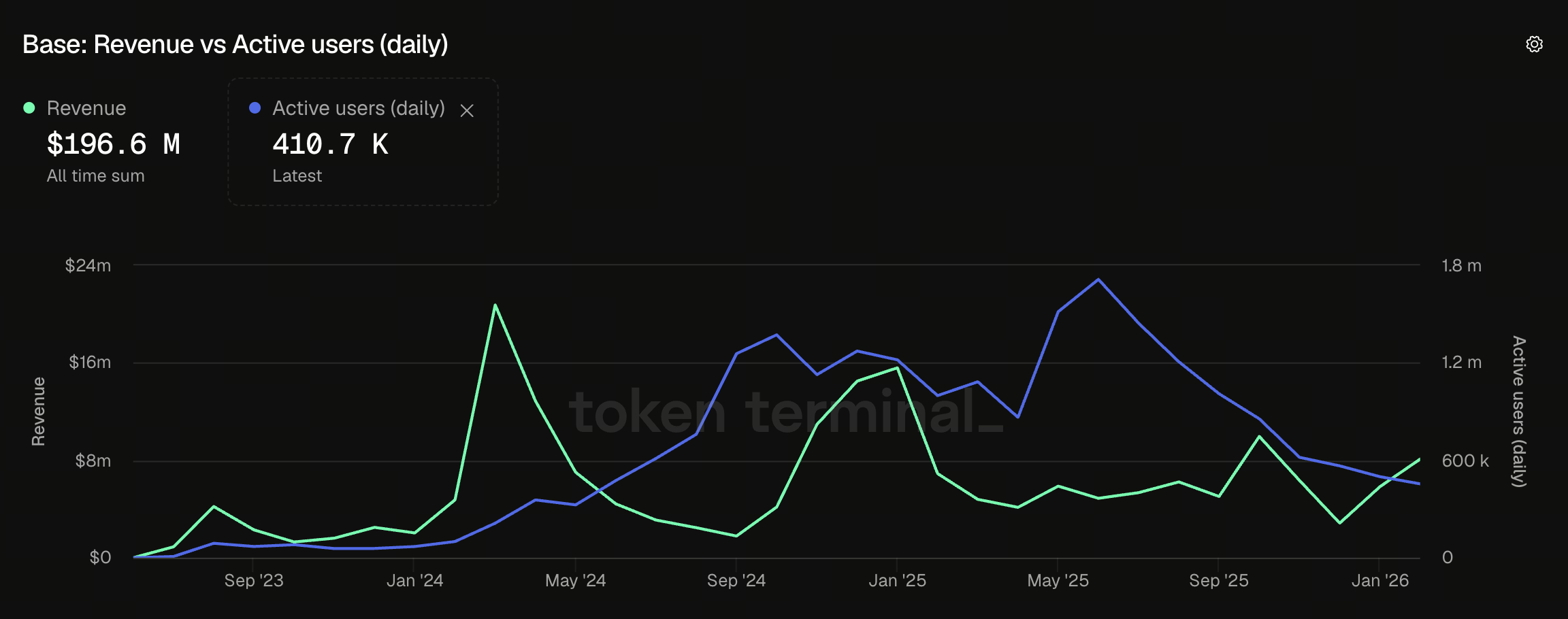 Image source: Token Terminal
Yet reality diverged from expectations. After its launch, Base saw rapid growth with impressive numbers in active addresses, fee income, and TVL. However, as time passed, user activity declined, speculative capital withdrew, and neither creator nor social narratives managed to foster lasting engagement. The issue became clear: Base did not fail to attract users—it failed to give them a compelling reason to stay.
This is the core of Base’s growth dilemma.
Base’s Challenge: Not Growth, But Retention
If we focus solely on the growth phase, Base’s performance was strong. As a Coinbase-backed Layer2, Base held inherent advantages in brand recognition, user access, and asset onboarding. Compared to new chains that must educate the market from scratch, Base started from a much higher baseline. It could attract attention at lower cost, activate users more efficiently, and more easily draw in projects and capital.
However, growth and retention are fundamentally different. In crypto, many platforms excel at getting users to try them once, but struggle to bring users back repeatedly. Airdrop expectations, subsidies, trending assets, and low trading fees can indeed generate traffic spikes, but these are short-term stimuli—not the foundation for lasting relationships. Users come for returns, and they leave when those returns disappear.
Base’s dilemma highlights a key truth: Strong distribution solves user acquisition, but it doesn’t automatically solve retention.
Coinbase has a massive user base, but exchange users are not inherently on-chain natives. The former value security, convenience, and low barriers to entry, while the latter need stronger participation incentives—such as on-chain identity, social relationships, creative expression, asset accumulation, or a robust developer ecosystem. Base overestimated the natural conversion rate from “traffic” to “settlement,” which is a major reason for its subsequent growth pressures.
Why Didn’t Base’s Traffic Advantage Turn Into an Ecosystem Advantage?
Base’s greatest promise stemmed from a simple logic: Coinbase has a huge user base, so bringing those users on-chain should create the strongest Layer2 ecosystem.
This sounds reasonable, but in reality, it misses a vital step:
Users entering an ecosystem doesn’t mean the ecosystem will form automatically.
For an ecosystem to truly take shape, it must offer at least one of these long-term values:
- Users hold assets unavailable elsewhere
- Users build relationships that can’t be replicated elsewhere
- Users develop repeat usage habits
- Users can accomplish things not possible on other platforms
If these values aren’t strong enough, even the largest influx of users can only generate short-term activity—not long-term retention.
Here lies Base’s problem. It enables users to enter the on-chain world at low cost, but once inside, users don’t find a compelling reason to stay. Many activities are replaceable, many projects are portable, and few experiences are exclusive. When other chains offer similar incentives, assets, and engagement models, user attrition becomes inevitable.
In short, Base has an entry advantage—but hasn’t transformed it into a defensible ecosystem moat.
Financial Incentives Can Attract, but Rarely Build Lasting Stickiness
In recent years, crypto’s most familiar growth strategy has been incentives.
Airdrops, subsidies, quests, trading campaigns, and hype are all effective for cold starts, as they quickly attract attention and generate impressive short-term metrics. But at their core, incentives buy behavior—they don’t build relationships.
When users come for profit, they’ll leave for greater profit.
That’s why activity on many chains plummets once incentive cycles end. Platforms see “user numbers drop,” but in reality, those who never truly belonged simply leave after completing their tasks.
Base’s experience is a microcosm of a broader industry pattern.
Incentives can drive trading, visits, and short-term booms—but rarely build stable, long-term retention. True retention usually stems from deeper factors, such as:
- Users investing in on-chain identity
- Users building trust relationships
- Users developing high-frequency habits
- Users accumulating switching costs
These can’t be bought with a single airdrop.
Is Base’s Shift Toward Trading Apps a Failure or a Realistic Pivot?
Some see Base’s later focus on trading and self-custody as a retreat from its original narrative. Ideally, this does mean it’s moving further from grander visions like “on-chain social platforms,” “creator economy infrastructure,” or “identity and relationship networks.” But from a product perspective, this isn’t necessarily bad. In fact, it’s more of a PMF (Product-Market Fit) correction.
A mature product’s key question isn’t “What do I want to become?” but rather “Why will users keep coming back?” If Base’s clearest, most practical advantage is serving Coinbase users’ on-chain trading needs, then perfecting that use case is a rational choice.
The real issue isn’t whether focusing on trading apps is wrong, but rather: If Base ends up as just a faster, smoother on-chain trading gateway, how different is it from similar products?
That’s the crucial challenge. Trading can be profitable, but without unique experiences, assets, or brand positioning, trading platforms easily become commoditized. Once the market is saturated with similar products, even Coinbase’s backing won’t guarantee Base a lasting moat.
What Does Base’s Growth Dilemma Mean for Layer2 as a Whole?
Base’s problems aren’t unique.
They reflect a structural misjudgment common in the Layer2 sector: Many projects assume that lowering transaction costs, boosting efficiency, and improving user experience will naturally lead to retention and ecosystem growth.
But in reality, technical upgrades only answer “Can users get in?”—not “Why would they stay?”
This is a shared dilemma for many L2s today. More chains now offer similar performance, cost structures, and tool stacks, with differences shrinking over time. As infrastructure converges, users compare more than just speed and fees—they look for harder-to-replicate qualities like culture, assets, liquidity depth, developer mindshare, and native app quality.
From this perspective, Layer2 competition has entered a new phase: It’s not about who’s cheaper, but who’s worth staying with long-term.
If an L2 can only maintain momentum through periodic incentives, its growth will likely be sporadic—not sustainable. Base is just the most visible and representative example.
What Base Truly Lacks Isn’t Traffic, But Reasons for Repeat Usage
Many summarize Base’s issue as “user attrition,” but more precisely, Base hasn’t built strong enough reasons for repeat usage.
Users don’t have to identify with a chain’s culture to stay, but they need a clear reason to return. That motivation could be efficiency, habit, returns, identity, or relationships—but it must be stable, unique, and hard to replace.
If Base wants to overcome its growth dilemma, the real challenge isn’t triggering another traffic surge, but answering these questions:
- Why will users return after their first use?
- Why should projects settle their core assets and users on Base?
- Why should developers build their most important products on Base instead of another L2?
- What do users truly lose if they leave Base?
As long as these questions remain unanswered, growth will struggle to translate into a robust ecosystem.
Conclusion
Base isn’t a case of “doing everything right and still failing.” More accurately, it excelled at user acquisition, but underestimated the difficulty of retention.
Coinbase’s traffic funnel gave Base a tremendous head start, but a high starting point doesn’t guarantee a strong moat. Users can be guided in, but won’t stay just because the entry point is strong. For any Layer2, long-term value is defined not by temporary data spikes, but by whether it can create irreplaceable, lasting reasons for users, developers, and projects to remain.
Base’s growth dilemma isn’t a philosophical question—it’s a product one. It’s not “Why did users come?” but “Why will they come back?”
If this question goes unanswered, even the strongest distribution might only bring more people to the door—just to watch them leave.







