As AI Agents continue to develop rapidly, an increasing number of automated systems are beginning to independently call APIs, access data services, and perform complex tasks. However, an important challenge is emerging: when these programs rely on paid APIs, how should they handle payment?
Traditional API billing models typically depend on account registration, subscription plans, or credit card payments. These approaches usually require human management, making them unsuitable for autonomous software agents that operate continuously without manual oversight. In response to this limitation, the x402 protocol was introduced as a payment mechanism designed specifically for machine environments.
Within the Gate for AI ecosystem, GateRouter integrates support for the x402 protocol. This allows applications or AI agents to automatically detect the price of a service and complete payments in real time. The model improves transaction security while enabling flexible pay as you go usage. It also removes the complexity associated with traditional prepaid systems, such as account funding and manual balance management.
What Is The x402 Protocol?
The x402 protocol is a Web3 payment standard that allows programs to automatically complete payments when calling APIs. Its core idea is to extend the HTTP 402 Payment Required status code so that when an API returns this response, it can include payment information such as the required price or the payment address. After receiving this response, the client program, such as an AI agent, can automatically complete the payment and continue accessing the service.
In the traditional internet architecture, the HTTP 402 status code has rarely been used in practice. The x402 protocol repurposes this mechanism by linking API requests directly with payment instructions. This design creates an automated cycle in which an API request triggers a payment requirement, the payment is executed, and the service response is returned.
In simple terms, the x402 protocol can be understood as a process that combines an API request with automated payment and service access without human intervention.
By enabling this mechanism, x402 transforms API services into directly purchasable digital goods. This approach provides a new payment framework for the emerging machine to machine economy, where automated systems can exchange services and payments without relying on traditional manual billing processes.
Background And Development Of The x402 Protocol
The emergence of the x402 protocol is closely connected to the rapid growth of AI Agents and the broader development of the machine economy. In recent years, AI systems have evolved from simple chat interfaces into intelligent agents capable of executing tasks independently. These systems can search for information, call multiple APIs, and complete complex workflows. For example, an AI research agent may retrieve information from data APIs, analyze the results using AI models, and then generate structured reports.
As automated programs become increasingly important API users, the consumption model of internet services is also shifting. Instead of being dominated by human developers, more services are now being accessed by machine programs and automated agents. In such environments, service requests occur more frequently, and the demand for instant payment mechanisms becomes more significant.
Limitations Of Traditional API Billing
Most internet APIs today rely on subscription models or account balance systems for billing. Developers typically need to create an account, connect a payment method, obtain an API key, and then use the service according to a subscription plan or prepaid credits. This model became common during the SaaS era, but it depends heavily on human managed accounts and payment information, making it less suitable for fully automated systems.
For AI Agents, the requirement to manage separate accounts for each API service introduces operational complexity. When agents need to switch between different services, maintaining multiple authentication systems can become inefficient. In addition, traditional payment methods such as credit cards cannot be easily used by autonomous software agents, which limits the practicality of conventional billing systems in a machine driven environment.
The Solution Provided By x402
The x402 protocol addresses these challenges by repurposing the HTTP 402 Payment Required status code to enable pay per request API billing. When a client sends a request to an API that requires payment, the server can respond with a 402 status code that includes pricing and payment instructions. The client can then complete the transaction through a cryptocurrency based payment and resend the request to obtain the service.
This mechanism transforms API usage into an instantly settled service transaction. Instead of registering accounts or purchasing subscription packages in advance, AI Agents can pay for individual requests only when they need them. This model aligns more closely with the operational behavior of automated systems and supports more flexible usage in machine driven environments.
How The x402 Protocol Works
The core logic of the x402 protocol is to embed the payment process directly into the request and response flow of an API. This allows service calls to automatically trigger payment procedures when required. When a client, such as an AI agent, sends a request to an API that requires payment, the server can respond with the HTTP 402 Payment Required status code and include payment information such as the price, payment address, or supported blockchain network.
After receiving this response, the client can complete the payment through an on chain transaction or another form of cryptocurrency payment. Once the payment has been made, the client sends the request again. The server then verifies the payment and returns the requested data or service result. Through this process, the API request and payment settlement occur within the same interaction cycle.
Core Components And Characteristics
In a typical implementation, the x402 protocol includes several key components.
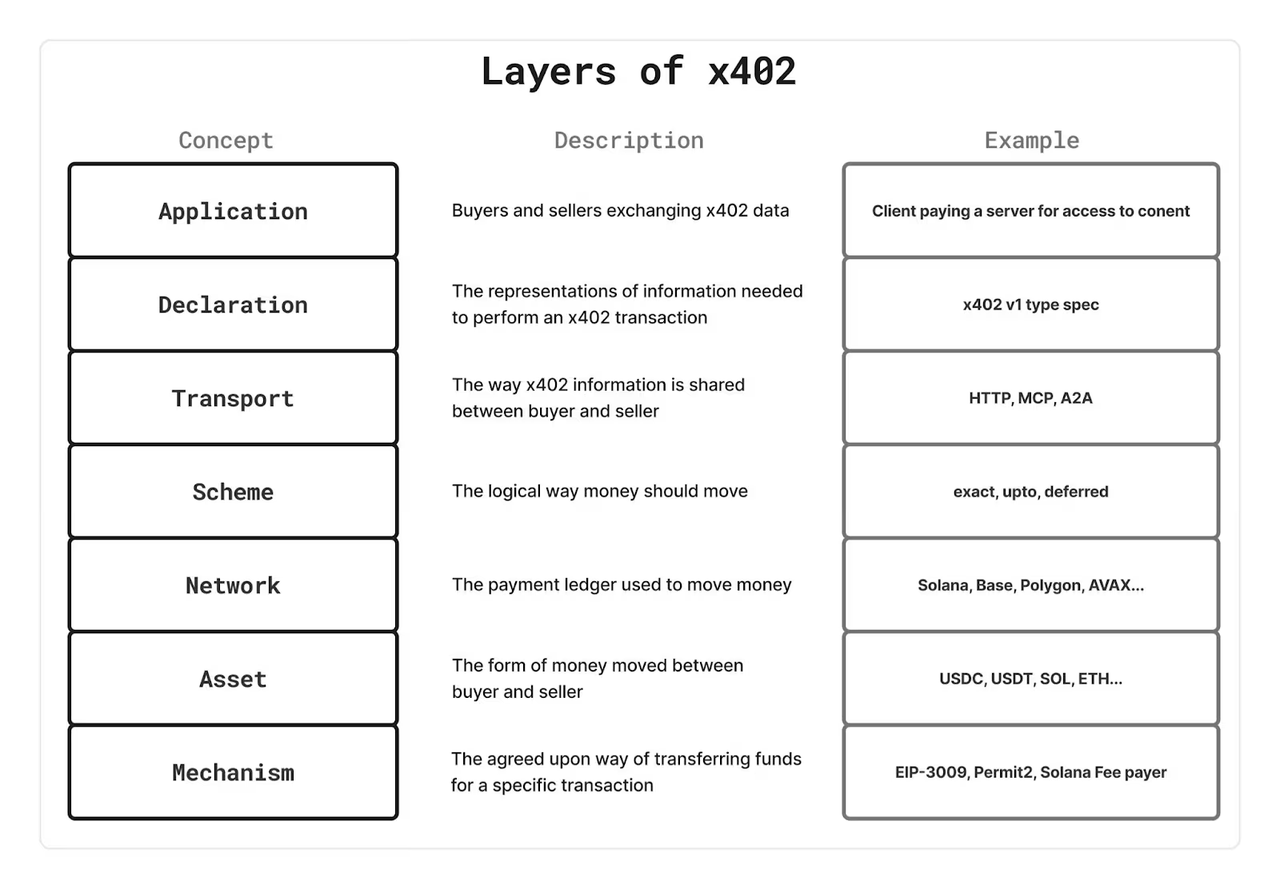
Image source: x402
First is the payment processing mechanism, which verifies whether the client has completed the required payment and grants access to the service once the transaction is confirmed.
Second is the HTTP 402 response mechanism. API services use the standardized 402 status code to inform the client that payment is required before the request can be fulfilled.
Finally, there is the proof of payment mechanism. After completing the transaction, the client provides a payment proof that allows the server to verify the validity of the payment and unlock access to the requested service.
Together, these mechanisms allow the x402 protocol to enable automated billing and access control for API services without relying on traditional account based systems.
x402 Compared With Traditional API Payment Methods
Traditional internet API pricing models are typically built around account based systems. Developers usually need to register an account, connect a payment method, obtain an API key, and use services based on subscription plans or prepaid credits. In contrast, the x402 protocol follows a model closer to pay per call services.
Under the x402 model, an API can return pricing information directly when a request is made. The client program can then complete payment for that specific request and gain access to the service. Because this payment process can be automated, the approach is more suitable for automated systems such as AI Agents that frequently interact with external APIs.
The Relationship Between x402 And GateRouter
From an AI infrastructure perspective, x402 and GateRouter operate at different layers of the technology stack and are largely complementary rather than overlapping components. The x402 protocol focuses on solving the problem of automated payments for API services, while GateRouter is designed to manage routing and access across multiple AI models and API services.
In practical applications, GateRouter can act as an intermediary layer between AI Agents and various AI services. When an agent needs to access models or data services, GateRouter can route requests dynamically based on factors such as cost, performance, or service availability.
If these services adopt the x402 protocol for billing, the payment process can occur automatically during the request. In this setup, AI Agents can both route requests across multiple services and complete payments automatically, creating a more automated and efficient AI service infrastructure.
Typical Use Cases Of The x402 Protocol
The main purpose of the x402 protocol is to enable APIs to be directly purchased and consumed by programs. As a result, its most relevant use cases appear in environments where automated systems need to access digital services.
AI Agents Calling API Services
In automated workflows, AI Agents may need to access multiple external services, such as data APIs, search services, or AI inference endpoints. If these services support the x402 protocol, the agent can complete payment during the API request process and immediately receive the response without needing to register accounts or preload balances.
AI Model Inference Services
With the growth of generative AI, many platforms now provide model inference services that charge based on usage. Through the x402 protocol, service providers can charge based on the number of requests or the amount of computational resources used, enabling flexible access to AI models.
Web3 Data Services
The same mechanism can also apply to Web3 infrastructure services. Blockchain data APIs, distributed compute nodes, or AI service nodes could provide capabilities through APIs and receive automated payments for each request. This model supports the development of machine to machine service transactions within decentralized networks.
Advantages And Limitations Of The x402 Protocol
The x402 protocol introduces a new method for paying for API services that is designed specifically for AI Agents and automated programs. One of its main advantages is that it allows machines to complete payments automatically. In traditional internet models, API usage often depends on account registration and subscription systems, processes that typically require human involvement. By embedding the payment mechanism directly into the API request flow, x402 enables programs to complete payment at the moment they call a service, making it more suitable for automated environments.
Another important advantage is the flexibility of a pay per call model. Service providers can charge users based on each request instead of relying on complex subscription plans. This approach lowers the barrier to accessing APIs and allows AI Agents to dynamically select services across different providers depending on their needs.
However, the x402 protocol is still in an early stage of development. At present, the number of API services that support the protocol remains limited, and the surrounding ecosystem is still evolving. In addition, if payments rely on blockchain transactions, network fees or confirmation times may affect the user experience for very small payments. As a result, further improvements in protocol standardization and developer tooling will likely be necessary.
Future Development Trends
As AI Agents and automated programs become more common, the way internet services are consumed is beginning to change. Increasingly, software systems are capable of executing tasks independently, retrieving data, and calling external APIs. In the future, the primary consumers of digital services may not be only human developers but also a large number of autonomous programs.
In this context, protocols such as x402 could play a more important role in AI service markets and automated infrastructure. If APIs can support pay per request pricing with automatic settlement, AI Agents could independently select and pay for services without requiring human involvement.
With the continued development of Web3 payment networks, stablecoins, and micro payment technologies, mechanisms like x402 may gradually integrate into broader internet infrastructure. This could support a more automated model of digital service transactions where machines interact with services directly.
Conclusion
The x402 protocol is a Web3 API payment standard designed for AI Agents that addresses the challenge of paying for API services in automated environments. By extending the HTTP 402 Payment Required status code and combining it with cryptocurrency based payment mechanisms, the protocol enables automatic payment and instant settlement during API requests.
From a broader perspective, x402 reflects a potential shift in how internet services are consumed. As AI systems and automated agents become more widespread, an increasing share of service consumption may be performed directly by software programs. In such an environment, APIs, data services, and computational resources could become digital goods that machines purchase and use autonomously, with protocols like x402 providing the payment infrastructure that supports this model.
FAQs
What Is The x402 Protocol?
The x402 protocol is a Web3 API payment standard that allows AI agents and automated programs to automatically complete payments when calling APIs. It extends the HTTP 402 Payment Required status code to enable real time payment and settlement during API requests.
How Is x402 Different From Traditional API Billing?
Traditional APIs usually rely on subscription plans or account balance systems for billing. In contrast, x402 supports a pay per call model where each API request can include payment information. This allows programs to automatically complete payments without requiring manual account management.
AI agents frequently call APIs when performing tasks such as data retrieval, analysis, or automated decision making. The x402 protocol provides a payment mechanism that allows these agents to automatically pay for services during API requests, making it more suitable for machine driven environments.
Does x402 Require Blockchain?
Many implementations of x402 use blockchain based payment systems to enable verifiable and automated settlement. However, the exact implementation may vary depending on the platform or service provider.
Will x402 Become A Standard For AI APIs?
The protocol is still at an early stage of development. However, as AI agents and machine driven economic systems continue to expand, payment mechanisms similar to x402 may gain wider adoption in future AI service infrastructures.