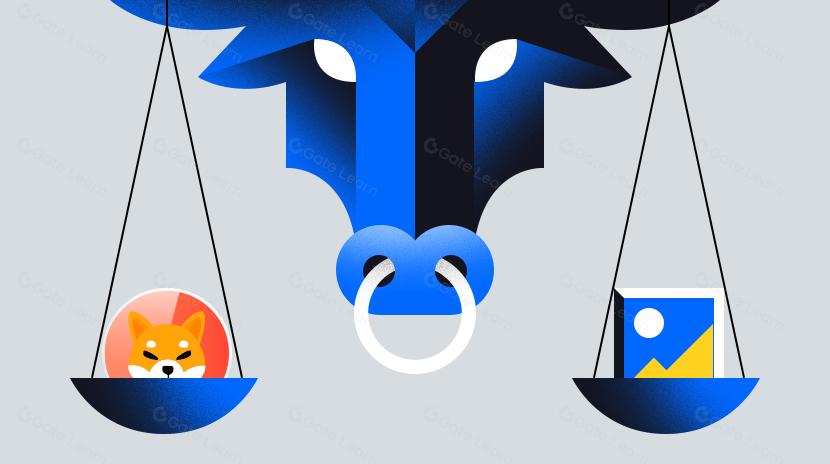
Pudgy Penguins and Bored Ape Yacht Club (BAYC) are both NFT-based projects, yet they diverge significantly in brand positioning, ecosystem structure, and development trajectory. Pudgy Penguins places greater emphasis on brand expansion and mass appeal, while BAYC focuses more on community culture and on-chain ecosystem building. Understanding these differences helps form a clearer, more structured view of how NFT projects can evolve along different paths.
As the NFT market has developed, these two projects have come to represent distinct strategic directions. One leans toward turning NFTs into widely recognizable brand IP, while the other builds a more closed, culturally driven ecosystem centered on community and on-chain assets. From a blockchain and digital asset perspective, this contrast reflects how different projects prioritize the balance between assets, community, and brand.
Overview of Pudgy Penguins and BAYC
Pudgy Penguins began as a profile picture NFT project built around penguin imagery and has gradually expanded toward branding and IP development. Its core approach treats NFTs as entry points, using community engagement and content distribution to grow the brand, while exploring integration between on-chain and off-chain applications.
BAYC (Bored Ape Yacht Club) is also a PFP NFT project, centered on ape-themed characters. Its development path leans more heavily toward community-driven growth and on-chain ecosystem construction, forming a strong social network among NFT holders and expanding applications and asset systems around that base.
Although both projects started from similar origins, their trajectories have diverged over time.
Core Differences in Operations and Brand Strategy
In terms of operations, Pudgy Penguins prioritizes brand communication and content reach. Its visual design and distribution strategy aim to lower barriers to understanding, making it easier to spread across a broader audience. This approach resembles traditional IP development, where visual identity and content are key to audience engagement.
In contrast, BAYC places greater emphasis on building community culture. Its value is closely tied to membership identity and collective recognition, forming a relatively closed group through NFT ownership and cultivating shared culture and consensus within that circle.
From a branding perspective, Pudgy Penguins follows a more outward-facing model, targeting wider audiences, while BAYC adopts a more inward-focused approach centered on community identity and cohesion.
Differences in Commercialization Paths and Revenue Models
Pudgy Penguins tends to extend value through IP licensing and physical products. Its NFT characters are used in real-world merchandise and brand collaborations, creating a bridge between on-chain assets and off-chain products.
BAYC, on the other hand, focuses more on internal ecosystem expansion. It builds additional applications, events, and asset systems around NFT holders, emphasizing the creation of new use cases within its on-chain environment.
From a revenue perspective, Pudgy Penguins relies more on brand expansion and external partnerships, while BAYC emphasizes sustained value generation within its own ecosystem.
Differences in Community Participation and User Roles
Pudgy Penguins adopt a relatively open community structure. Its ecosystem includes not only NFT holders but also a wider audience of content consumers and brand followers. This openness helps expand its user base, though it results in less clearly defined community boundaries.
BAYC’s community, by contrast, is more centered around NFT holders. Holders are typically considered core members, with participation and benefits concentrated within this group. This strengthens community cohesion but also raises the barrier to entry.
In terms of user roles, Pudgy Penguins emphasizes participants and content spreaders, while BAYC focuses more on members and holders as identity-driven roles.
Comparison of Token Design, Ecosystem Structure, and Expansion Strategies: BAYC vs Pudgy Penguins
The two projects also differ in token design and ecosystem expansion.
Pudgy Penguins’ token design, such as PENGU, is primarily used to connect brand, community, and application scenarios. It helps channel external attention into internal engagement, emphasizing connectivity and expansion.
BAYC, through its related tokens and ecosystem development, builds a more comprehensive on-chain system that supports community activities and applications. This approach focuses on deepening the ecosystem within its existing user base.
Overall, Pudgy Penguins follows a path of expanding from outside to inside, while BAYC grows from inside to outside.
Pudgy Penguins vs BAYC: Multi-Dimensional Comparison Table
| Comparison Dimension |
Pudgy Penguins |
BAYC |
| Core Positioning |
NFT + Brand IP |
NFT + Community Culture |
| Development Path |
Expansion toward branding and mass reach |
Deepening on-chain ecosystem |
| Brand Strategy |
Outward-facing, broad audience |
Inward-focused, community identity |
| Commercialization |
IP licensing, physical products |
Ecosystem expansion, on-chain applications |
| Community Structure |
Open community plus broader audience |
Holder-driven core community |
| User Roles |
Participants and content spreaders |
Members and holders |
| Token Function |
Connect ecosystem and convert traffic |
Support ecosystem and community activity |
This comparison shows that the primary difference lies in brand-oriented versus community-oriented strategies. These differences do not imply superiority, but rather reflect how NFT projects diverge based on their goals and stages of development.
Conclusion
Although both Pudgy Penguins and BAYC are NFT projects, they differ significantly in ecosystem structure and development approach. Pudgy Penguins emphasizes brand and IP expansion, reaching broader audiences through content and distribution. BAYC, by contrast, focuses on community and on-chain ecosystems, building strong network effects among holders.
From a conceptual standpoint, they can be seen as two distinct models: a brand-driven NFT project and a community-driven NFT project. This comparison provides a clearer framework for understanding the diverse evolution paths within the NFT space.
FAQ
-
Which project is closer to a traditional brand, Pudgy Penguins or BAYC?
Pudgy Penguins is closer to a traditional brand model, with a strong focus on IP and mass communication.
-
What is BAYC’s core strength?
Its main strength lies in strong community cohesion and its ability to build a robust on-chain ecosystem.
-
Are both projects PFP NFTs?
Yes, both originated as profile picture NFT projects.
-
Does Pudgy Penguins lean more toward off-chain development?
Yes, it includes significant off-chain expansion, such as merchandise and brand collaborations.
-
Why are these two projects often compared?
Because they share similar origins but have taken distinctly different development paths, making them representative case studies.