JPMorgan Launches MONY, the First Tokenized Money Market Fund on Ethereum: A New Era of On-Chain Finance

Image: https://www.jpmorgan.com/global
JPMorgan Launches First Tokenized Money Market Fund, MONY, on Ethereum—Traditional Finance Moves On-Chain
On December 15, 2025, JPMorgan Chase & Co. officially announced the launch of its first tokenized money market fund—My OnChain Net Yield Fund (MONY)—on the Ethereum blockchain. This marks the first time a globally systemically important bank has fully deployed a money market fund on a public blockchain. The event is widely viewed as a milestone in the genuine tokenization of traditional financial assets.
JPMorgan’s Long-Term Commitment to Blockchain Finance
JPMorgan’s position in the crypto asset sector has long attracted attention. While senior executives have often voiced caution or even criticism toward decentralized assets like Bitcoin, the institution has consistently pursued research and applications in blockchain technology.
From early blockchain-based settlement networks and institutional-grade custody and clearing pilots to today’s direct issuance of on-chain financial products, the launch of MONY makes clear that JPMorgan’s approach to blockchain has evolved from “technology validation” to the real-world operation of actual assets and capital.
What Is MONY? Core Mechanism of the Tokenized Money Market Fund
MONY is a tokenized money market fund built on Ethereum, issued by JPMorgan’s asset management division and seeded with approximately $100 million of the bank’s own capital.
The fund targets qualified investors and sets a high minimum investment threshold to comply with private fund regulations. Investors can subscribe using fiat currency or stablecoins such as USDC. Returns are settled daily, and all investment shares and rights are recorded as tokens on-chain.
This structure maintains the low volatility and stable returns of traditional money market funds, while leveraging blockchain’s real-time auditability, 24/7 settlement, and on-chain transparency. It effectively overcomes the T+1 or T+2 clearing limitations of legacy financial systems.
Why Ethereum Is the Foundation for MONY
As the world’s most advanced smart contract platform, Ethereum offers distinct advantages for asset tokenization. Its standardized token protocols, decentralized validation network, and robust developer ecosystem make it the top choice for institutional asset tokenization.
Ongoing Ethereum network upgrades and the increasing presence of institutional service providers—offering compliant custody, auditing, node operation, and risk management—deliver the compliance and security needed for tokenized funds. This is a key reason why traditional financial institutions select Ethereum as their core public blockchain.
MONY’s Capital Scale and Investment Structure
Disclosures indicate that MONY’s initial assets under management total approximately $100 million, with a primary focus on institutional investors and high-net-worth clients. Investors can participate in either USD or USDC, accommodating diverse clearing and cash management needs.
This hybrid “fiat + stablecoin” model ensures compliance and capital security while providing a bridge for traditional investors to experience on-chain financial processes. It also builds practical experience for future large-scale on-chain asset issuance.
ETH Price Action and Market Response
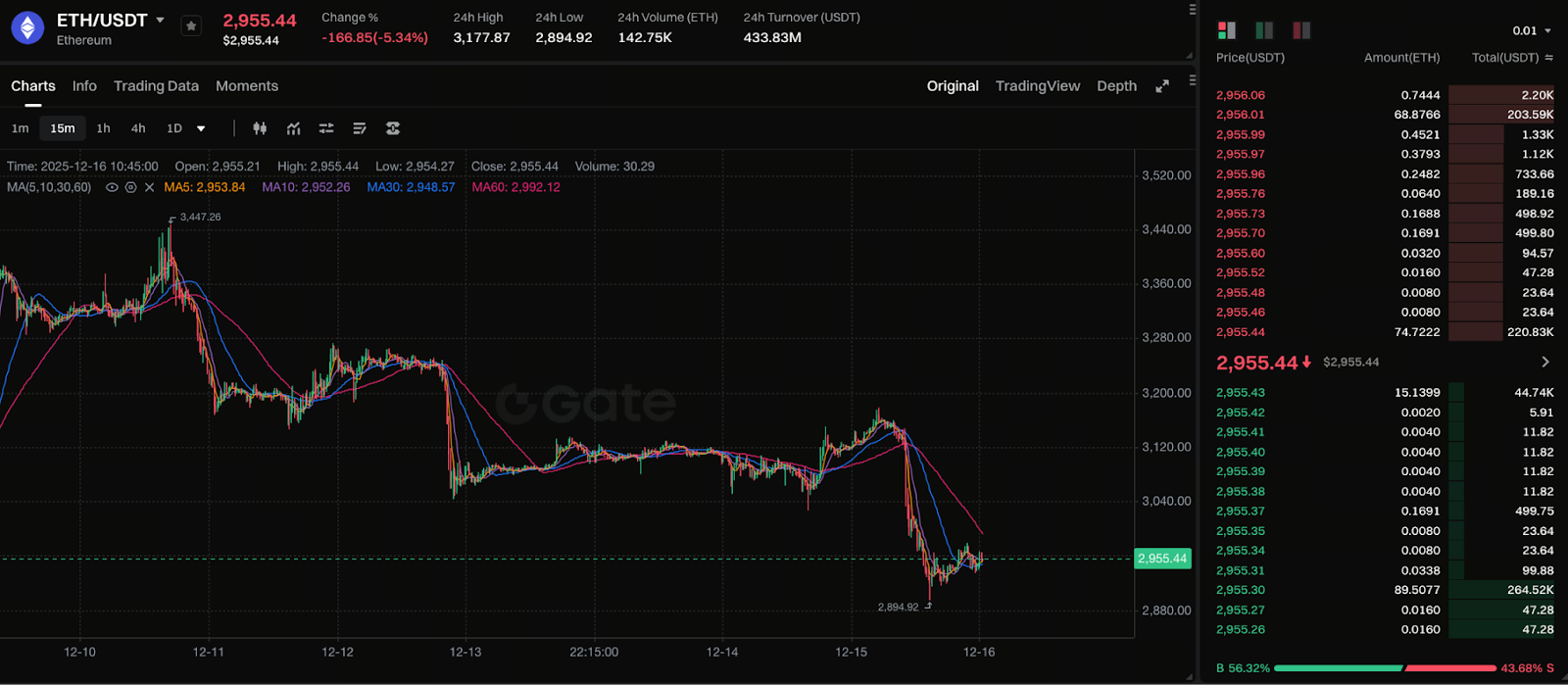
Image: https://www.gate.com/trade/ETH_USDT
On MONY’s launch day, Ethereum (ETH) attracted significant market attention. On-chain data showed ETH trading around $3,000, gradually stabilizing after a brief pullback.
While a single institutional product is unlikely to dictate price direction, the steady rollout of on-chain asset offerings by major financial institutions has amplified the narrative of Ethereum as a “financial-grade public blockchain.” That said, ETH’s short-term price action remains shaped by macro factors, risk sentiment, and the broader crypto market mood.
The Impact of Tokenized Assets on Traditional Finance
MONY’s launch is recognized as a major milestone in the genuine embrace of on-chain assets by traditional financial institutions. Compared to conventional money market funds, tokenized funds deliver clear advantages in transparency, settlement efficiency, and global accessibility—especially for cross-border cash management and institutional liquidity allocation.
Beyond JPMorgan, several leading European asset managers are also actively exploring tokenized money market funds and real-world asset tokenization, signaling the sector’s move from concept to large-scale implementation.
Risk Considerations and Future Outlook
Despite their structural benefits, tokenized funds still face regulatory uncertainty, technical risks, and liquidity management challenges. Developments in stablecoin compliance, Ethereum network upgrades, and evolving regulatory policies worldwide will directly influence the growth and adoption of these products.
Looking ahead, as global financial institutions continue to expand their presence in on-chain assets, tokenized money market funds are positioned to become a vital link between traditional finance and the Web3 ecosystem—driving deep transformation in asset securitization, settlement, and liquidity management.
Share
Content
JPMorgan Launches First Tokenized Money Market Fund, MONY, on Ethereum—Traditional Finance Moves On-Chain
JPMorgan’s Long-Term Commitment to Blockchain Finance
What Is MONY? Core Mechanism of the Tokenized Money Market Fund
Why Ethereum Is the Foundation for MONY
MONY’s Capital Scale and Investment Structure
ETH Price Action and Market Response
The Impact of Tokenized Assets on Traditional Finance
Risk Considerations and Future Outlook


Related Articles

2025 BTC Price Prediction: BTC Trend Forecast Based on Technical and Macroeconomic Data

Flare Crypto Explained: What Is Flare Network and Why It Matters in 2025

Pi Coin Transaction Guide: How to Transfer to Gate.com

How to Use a Crypto Whale Tracker: Top Tool Recommendation for 2025 to Follow Whale Moves

What is N2: An AI-Driven Layer 2 Solution