Is the Golden Age of Crypto Approaching? Tom Lee Leads BitMine Immersion’s $320 Million ETH Acquisition and the Emerging Value Thesis
Cryptocurrency Reignites Global Interest: Institutions Boost Ethereum Holdings
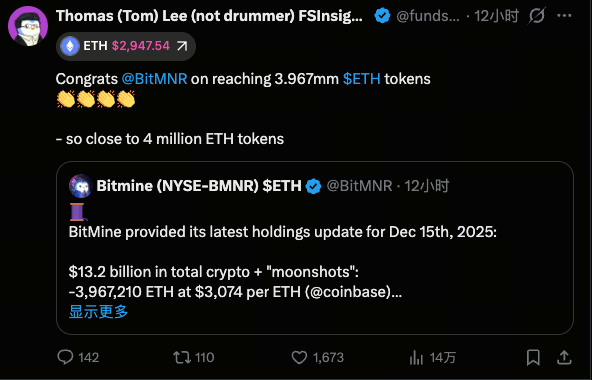
Image source: https://x.com/fundstrat/status/2000575983657644075
By the end of 2025, the cryptocurrency market has once again captured the attention of global investors. Institutional capital continues to flow into mainstream asset allocations, with BitMine Immersion Technologies (BMNR), led by Tom Lee, making aggressive moves to acquire Ethereum. Recent reports indicate the company completed a purchase of approximately $320 million in Ether (ETH), bringing total holdings to over 3.96 million ETH—more than 3.2% of the circulating supply.
This wave of institutional buying is closely linked to a renewed market evaluation of the long-term value of digital assets. As the Ethereum ecosystem advances and activity in smart contracts and decentralized finance (DeFi) accelerates, ETH has evolved beyond a mere trading medium to serve as the essential fuel powering the entire Web3 ecosystem.
Latest Developments in BitMine Immersion’s Acquisitions
BitMine, a publicly traded Ethereum treasury company, has drawn significant market attention for its ETH holding strategy. According to Decrypt, BitMine recently acquired about 102,259 ETH, worth roughly $320 million, and reportedly remains committed to its “Alchemy of 5%” long-term goal—aiming to hold 5% of the world’s circulating ETH.
This latest accumulation is part of BitMine’s ongoing strategic build-up rather than a one-off event. The company continues to buy during price dips and enhances portfolio flexibility through disciplined capital management and robust cash reserves. Beyond ETH, BitMine also holds a small allocation of BTC and a sizable cash reserve.
Tom Lee’s Market Insights and Long-Term Strategy
Tom Lee, co-founder of Fundstrat and chairman of BitMine, has maintained a positive outlook on the crypto market. He asserts that Ethereum is built on strong long-term fundamentals, including its decentralized application ecosystem, widespread smart contract adoption, and the efficiency of its proof-of-stake network. Lee also views current price volatility as a strategic opportunity for accumulation.
He further highlights that regulatory progress, rising institutional participation, and the global financial system’s growing focus on on-chain assets are ushering in a new market cycle. Lee describes these shifts as structural forces driving the emergence of a “Golden Age of Cryptocurrency.”
Ethereum Network and Market Landscape
Ethereum stands as the largest smart contract platform, supporting a diverse ecosystem that spans NFTs, decentralized exchanges, DeFi, Layer2 scaling, and more—securing its unique market position. Since mid-2025, however, Ethereum has faced price corrections and volatility, with short-term liquidity constraints and macroeconomic uncertainty weighing on the market.
Despite these challenges, the long-term expansion of the Ethereum ecosystem continues to underpin its price potential. Factors such as staking rewards, network upgrades, and enhanced security drive institutional forecasts for further price appreciation.
Price Trends: Balancing Risk and Opportunity
While significant institutional inflows send strong market signals, short-term price volatility remains a critical factor. The ETH market experienced declines and technical corrections during parts of 2025, reflecting ongoing swings in market sentiment. Institutional accumulation may tighten supply-demand dynamics, but immediate price rebounds depend on liquidity and overall market participation.
For individual investors, understanding the interplay between structural accumulation and short-term price fluctuations is essential. The high volatility of crypto assets presents both substantial opportunities and inherent risks.
Conclusion: Assessing the Potential for a Cryptocurrency Golden Age
Institutional accumulation, strategic market positioning, and the expansion of fundamental blockchain ecosystems all lend credibility to the view that a “Golden Age of Cryptocurrency” may be on the horizon. However, this does not guarantee perpetual price increases. The market’s trajectory will be shaped by macroeconomic trends, regulatory developments, and the actions of both institutional and retail participants.
In summary, BitMine’s persistent accumulation underscores long-term confidence in ETH’s value and signals the growing strategic importance of crypto assets for institutions. This trend merits close attention, but investors should exercise caution and avoid making decisions based solely on isolated institutional moves.
Share
Content
Cryptocurrency Reignites Global Interest: Institutions Boost Ethereum Holdings
Latest Developments in BitMine Immersion’s Acquisitions
Tom Lee’s Market Insights and Long-Term Strategy
Ethereum Network and Market Landscape
Price Trends: Balancing Risk and Opportunity
Conclusion: Assessing the Potential for a Cryptocurrency Golden Age


Related Articles

2025 BTC Price Prediction: BTC Trend Forecast Based on Technical and Macroeconomic Data

Flare Crypto Explained: What Is Flare Network and Why It Matters in 2025

Pi Coin Transaction Guide: How to Transfer to Gate.com

How to Use a Crypto Whale Tracker: Top Tool Recommendation for 2025 to Follow Whale Moves

What is N2: An AI-Driven Layer 2 Solution