As the digital content industry continues to expand, the way intellectual property is managed is also evolving. In traditional internet environments, creators typically rely on centralized platforms or legal institutions to verify ownership, manage licensing relationships, and distribute royalty revenue. This process can be complex and often struggles to operate efficiently in emerging scenarios such as cross-platform distribution, derivative creation, and AI-generated content.
Story Protocol approaches the problem from a different perspective. Rather than focusing only on IP registration, the protocol introduces a blockchain infrastructure built specifically for intellectual property management. Components such as the Story Network, the Proof-of-Creativity protocol, and programmable licensing mechanisms allow IP assets to function similarly to digital assets. As a result, intellectual property can be composed, licensed, and traded within a decentralized ecosystem.
Overview of Story Protocol
Story Protocol combines an EVM compatible execution environment with an architecture optimized for intellectual property data structures. This design enables complex copyright relationships and derivative links to be processed efficiently on-chain.
Within the network, creators can register their works as IP Assets. Each asset corresponds to an on-chain account known as an IP Account, while protocol modules manage licensing rules, derivative relationships, and royalty distribution.
Through this structure, intellectual property expands beyond traditional legal contract systems into a digital asset framework supported by both code and legal standards. As a result, copyright management can achieve greater transparency and automation.
Technical Architecture of Story Protocol: Multi-Core Execution Environment
The overall architecture of Story Protocol consists of the Story Network and the Proof-of-Creativity protocol.
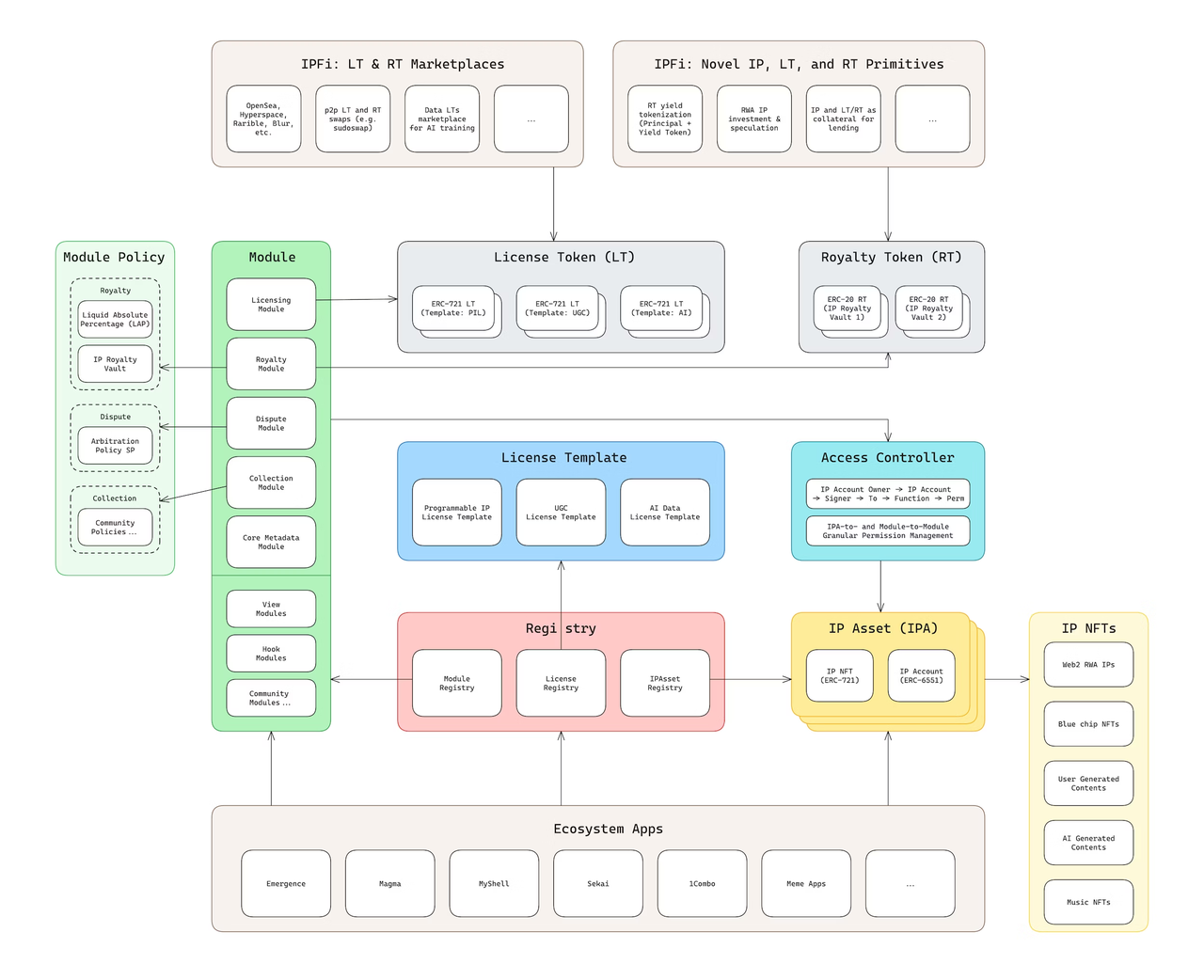
At the base layer, Story Network operates as a Layer 1 blockchain designed specifically for intellectual property. It provides transaction execution, data storage, and a smart contract environment. The network maintains EVM compatibility while optimizing infrastructure to handle complex IP relationships such as derivative works and royalty distribution.
Running on top of this foundation, the Proof-of-Creativity protocol manages intellectual property through a set of smart contracts. These contracts register works as on-chain IP assets and coordinate licensing, derivative relationships, and royalty allocation.
Within this protocol framework, several key components operate together:
-
IP Asset: the on-chain representation of intellectual property
-
IP Account: the account associated with each IP asset
-
Modules: protocol components supporting licensing, royalty management, and dispute resolution
-
Registry: the system that maintains the global protocol state
-
Programmable IP License (PIL): a mechanism that maps on-chain rules to real-world legal frameworks
Through this architecture, intellectual property can be composed, licensed, and traded in ways similar to assets within decentralized finance ecosystems.
How Story Protocol Operates
Understanding the operation of Story Protocol requires examining several core components. Elements such as IP Asset, IP Account, the IP Graph, programmable IP licensing, automated royalty distribution mechanisms, and the IP token together form a comprehensive on-chain intellectual property management system.
IP Asset: Intellectual Property as On-Chain Assets
Within Story Protocol, intellectual property first appears in the form of an ERC-721 NFT. After creation, the NFT is registered in the protocol and becomes an IP Asset.
This structure serves as the central data representation for intellectual property in the network. It records metadata, licensing information, and relationships with derivative works.
IP Account: On-Chain Accounts for Intellectual Property
When an IP Asset is created, the system automatically deploys an IP Account based on the ERC-6551 token-bound account standard. This account stores licensing information, revenue flows, and other interactions associated with the IP asset.
Through this mechanism, each intellectual property asset functions as a programmable entity capable of independently managing permissions, licensing activity, and revenue distribution.
Modules: Functional Components of the Protocol
A modular architecture extends the functionality of IP assets and enables a composable IP ecosystem. Several modules support different aspects of the system:
-
Licensing Module: establishes licensing relationships and derivative connections between IP assets
-
Royalty Module: automates revenue distribution among participants
-
Dispute Module: supports resolution processes for intellectual property disputes
-
Metadata Module: manages the metadata associated with IP assets
Programmable IP: Programmable Intellectual Property
A central concept within Story Protocol is programmable intellectual property.
In traditional copyright systems, licensing terms are typically defined through legal agreements. Within the Story Protocol framework, these rules can instead be encoded directly into smart contracts. Examples include permissions for derivative works, conditions for commercial use, royalty percentages, revenue sharing structures, licensing duration, and permitted usage scope.
When another user interacts with or builds upon the intellectual property, the system automatically enforces these predefined rules. This approach reduces the need for manual oversight and helps streamline licensing and royalty management.
Example Workflow of Story Protocol
A simplified example illustrates how the protocol operates in practice.
Consider a creator who develops a fictional universe on-chain. The original author, Alice, first registers her novel The Silver Chronicle on Story Protocol. The system generates an IP Asset for the work and deploys a corresponding IP Account.
Later, an illustrator named Bob creates character artwork based on the novel and registers it in the system while referencing the original IP source. The protocol automatically records this derivative relationship within the IP Graph.
Through programmable licensing rules, the parties define a revenue-sharing structure in which the original author receives 60% of the revenue while the illustrator receives 40%.
When the artwork is sold as an NFT or licensed by another project, the protocol’s Royalty Core automatically distributes the revenue to the respective IP Accounts.
Throughout this process, ownership relationships, derivative paths, and revenue distribution remain recorded on-chain and enforced through smart contracts.
Advantages of Story Protocol
Compared with traditional copyright management systems, Story Protocol introduces several structural improvements.
One advantage relates to transparency. Relationships between original works, derivative creations, and revenue flows are recorded on the blockchain, allowing anyone to verify the associated information.
Another advantage involves interoperability. Story Protocol supports multiple smart contract standards and enables developers to build various applications on top of the protocol, creating a broader ecosystem around intellectual property assets.
Automated revenue distribution also helps reduce disputes related to royalty payments. Smart contracts execute predefined sharing rules, allowing creators to receive compensation more consistently without relying on intermediaries.
Finally, the protocol encourages open collaboration in creative work. Creators can build upon existing intellectual property under clearly defined licensing conditions, enabling a network of derivative and collaborative creations to evolve over time.
Conclusion
Through the Story Network and the Proof-of-Creativity protocol, Story Protocol transforms intellectual property into programmable on-chain assets. With components such as IP Assets, IP Accounts, modular protocol architecture, and programmable IP licensing, the system forms a composable infrastructure for managing intellectual property.
Within this framework, creators, developers, and AI applications can register, license, and extend intellectual property assets within the same network. As Web3 creative platforms and AI applications continue to develop, programmable intellectual property may play an increasingly important role in the future digital content economy.
FAQs
How Does Story Protocol Differ From NFTs?
NFTs are commonly used to represent ownership of a single digital asset. Story Protocol focuses on the broader intellectual property network surrounding that asset, including derivative relationships between works, licensing rules, and revenue distribution structures.
Does Story Protocol Support Real-World Copyright Registration?
At present, Story Protocol primarily focuses on on-chain creative ecosystems. In the future, integration with real-world copyright databases or copyright organizations may be possible through API connections.
Do Creators Need Blockchain Knowledge to Use Story Protocol?
No. Story Protocol provides simplified SDKs and user-friendly platforms that allow creators to register and manage intellectual property in a similar way to using a social platform, without requiring deep blockchain expertise.
What Are the Use Cases of Programmable IP?
Programmable intellectual property can support various applications. Examples include licensing for AI-generated content, composable character creation in games, derivative story networks for film or television content, and collaborative digital creative communities.