As Ethereum staking traditionally requires locking funds and delegating control, this model introduces a structure where users can participate in validation without giving up custody or flexibility. ether.fi integrates staking, liquidity, and restaking into a unified process, reflecting a shift toward multi-layered capital utilization in decentralized systems.
What is the design goal of ether.fi?
The design goal of ether.fi is to build a non-custodial, liquid, and composable staking system that enhances user control while improving how staked capital can be utilized across the Ethereum ecosystem.
Traditional staking often requires users to choose between security (staking) and flexibility (liquidity). ether.fi restructures this model by introducing a system where both can coexist through tokenization and modular infrastructure.
It aims to achieve the following:
-
Preserve asset ownership Users retain control over withdrawal rights, reducing dependence on third-party custodians.
-
Maintain liquidity Staked ETH is represented by liquid tokens, allowing continued use in decentralized finance without interrupting staking.
-
Extend capital utility Through restaking mechanisms, the same staked assets can support additional network services beyond Ethereum validation.
-
Reduce centralization reliance The protocol distributes responsibilities across users and node operators, limiting dependence on large staking providers.
ether.fi restructures staking into a system where secured assets remain active and reusable, rather than locked and isolated.
How ether.fi handles staking and liquidity provisioning
ether.fi manages staking through a pooled system combined with tokenized asset issuance, allowing users to participate in Ethereum validation while maintaining liquidity.
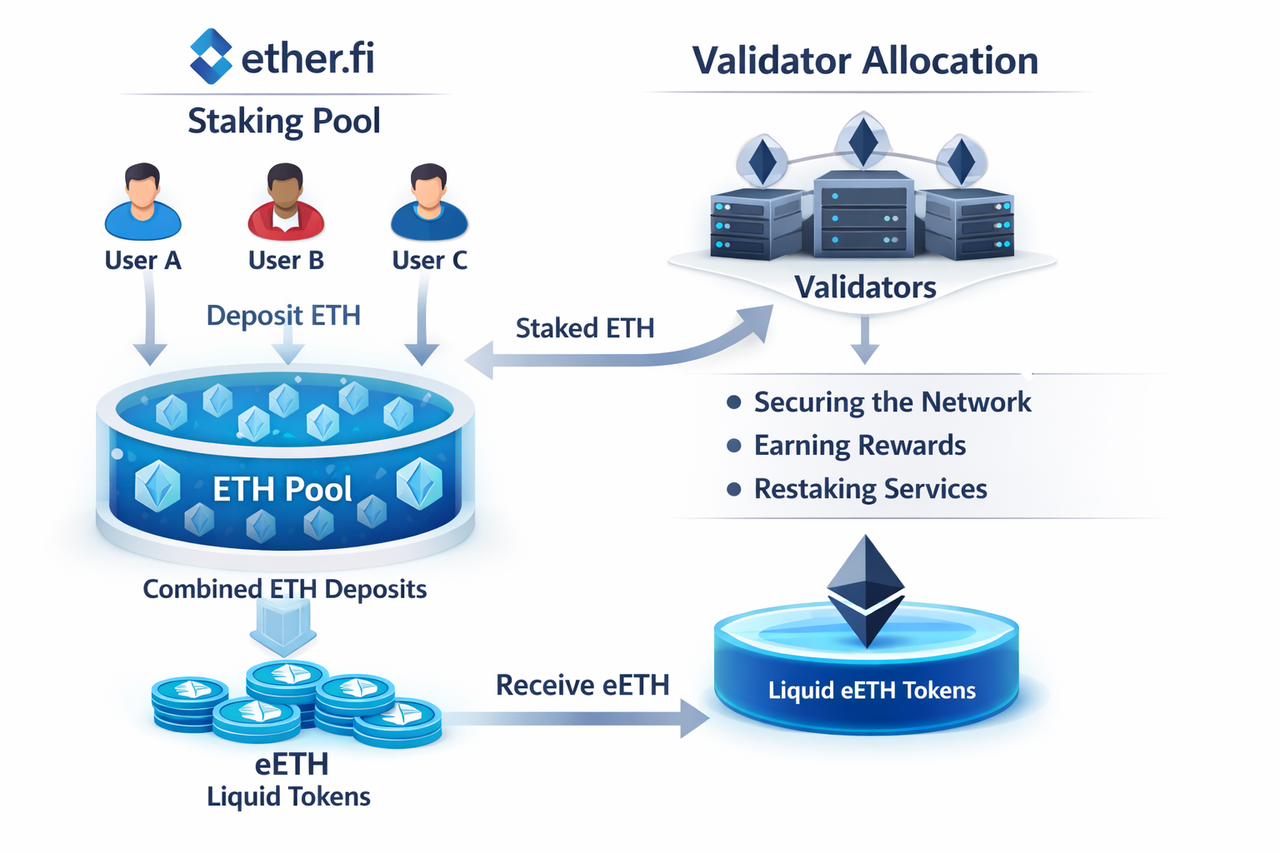
The process follows a structured sequence:
Step 1: ETH deposit Users deposit ETH into the protocol, initiating participation in the staking system and entering a shared liquidity pool.
Step 2: Pool aggregation Deposited ETH is combined into a collective pool, enabling efficient allocation of funds and reducing the need for individual validator setup.
Step 3: Validator allocation The pooled ETH is assigned to validators that perform network validation tasks, contributing to Ethereum’s consensus and security.
Step 4: Token issuance In return, users receive eETH, a liquid staking token that represents their share of the pooled ETH along with accrued rewards.
ether.fi restructures staking by pooling user deposits and converting them into liquid tokens, rather than assigning each deposit to a fixed validator position. This approach allows ETH to remain actively used in validator operations while simultaneously being represented as a transferable asset, so participation in staking does not restrict how the capital can be used.
Within this structure, ETH continues to support network validation in the background, while users maintain control over withdrawal rights through a non-custodial design. The issued token, eETH, functions as a liquid representation of the staked position, making it possible to transfer, hold, or integrate the asset into decentralized finance applications without interrupting the underlying staking process.
How ether.fi distributes and compounds staking yields
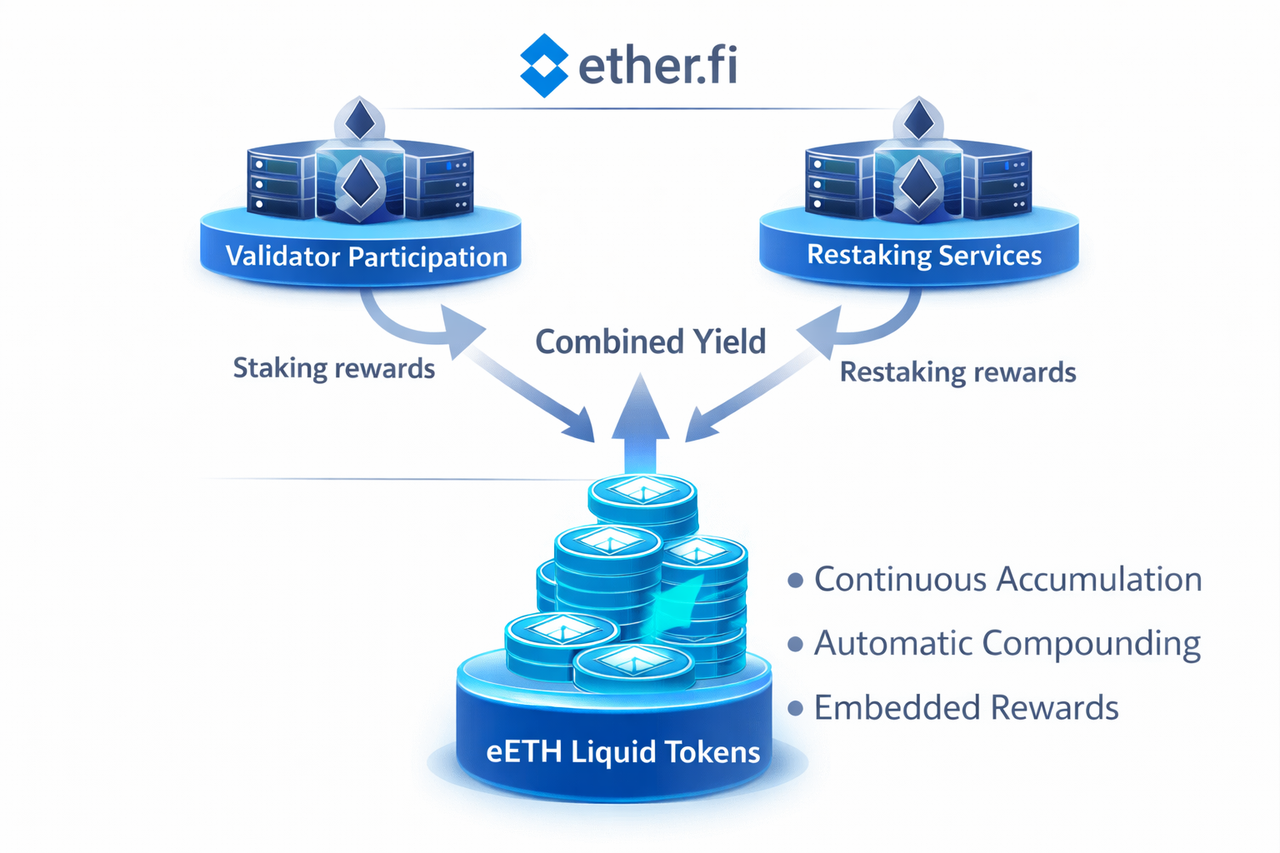
ether.fi applies an integrated reward mechanism where staking and restaking returns are continuously accumulated and reflected directly within its liquid staking tokens. Instead of distributing rewards as separate payouts, the protocol embeds yield into the token structure itself, allowing balances to update automatically over time.
Reward structure
Rewards in ether.fi originate from multiple layers of network participation:
-
Staking rewards: Generated from validator activity on Ethereum, including block validation and consensus participation.
-
Restaking rewards: Earned by extending staked ETH into additional security or validation services beyond the base network.
-
Aggregated yield: The combination of these reward streams, unified and reflected within the liquid staking token.
Distribution and compounding mechanism
The protocol manages reward distribution through an automated and continuous process:
-
Rewards accumulate at the protocol level as validators perform their functions
-
eETH balances increase through a rebasing mechanism that reflects earned yield
-
Users do not need to manually claim or reinvest rewards
-
Compounding occurs natively, as newly accrued rewards become part of the staking base
In ether.fi, rewards are embedded directly into the structure of the liquid staking token, meaning yield is reflected as an increasing balance or value rather than a separate distribution.
The role of eETH and governance mechanisms within ether.fi
ether.fi separates economic representation, technical compatibility, and governance control into distinct tokens, each serving a specific role within the system.
| Token |
Layer |
Core Function |
Role in the System |
| eETH |
Economic layer |
Liquid staking token |
Represents deposited ETH and accumulated rewards. Its balance or value updates automatically as rewards are generated, serving as the primary economic representation of staked assets. |
| weETH |
Technical compatibility layer |
Wrapped liquid token |
A non-rebasing version of eETH designed for integration with DeFi protocols that require fixed balances, improving usability across different platforms. |
| ETHFI |
Governance layer |
Governance and coordination token |
Enables participation in protocol decisions, including upgrades, parameter adjustments, and treasury allocation, aligning stakeholders within the ecosystem. |
ether.fi distributes responsibilities across specialized tokens, separating asset representation, technical usability, and governance into independent but interconnected layers.
The differences between ether.fi and traditional staking or DeFi models
ether.fi operates as a hybrid system combining infrastructure and financial functionality.
| Aspect |
Traditional Staking |
DeFi Systems |
ether.fi Model |
| Asset custody |
Often requires transferring control of assets to custodial providers or staking services |
Typically non-custodial, with users retaining wallet control |
Non-custodial design where users retain withdrawal rights and ownership of assets |
| Liquidity model |
Assets are locked for a fixed period and cannot be used elsewhere |
Assets remain liquid and can be freely deployed across protocols |
Uses liquid staking tokens (eETH/weETH) to represent staked ETH, enabling continued usability |
| Yield source |
Primarily derived from validator participation in network consensus |
Generated through market activities such as lending, trading, and liquidity provision |
Combines validator rewards with additional yield from restaking mechanisms |
| Primary function |
Secures the blockchain network through validator operations |
Facilitates financial activities such as lending, borrowing, and trading |
Integrates network security with financial composability, bridging infrastructure and DeFi |
| Capital efficiency |
Limited, as staked assets are idle outside validation |
High, as assets can be reused across multiple applications |
Enhanced, as staked ETH remains active while also being usable in DeFi and restaking |
| User responsibility |
Requires technical setup or reliance on third-party operators |
Managed directly by users through smart contracts |
Abstracts validator complexity while preserving user control through protocol design |
| Risk profile |
Includes slashing risk and custodial risk |
Includes smart contract and market risk |
Combines staking risks (e.g., slashing) with smart contract and liquidity risks |
| Composability |
Low, due to locked and isolated assets |
High, assets are designed for interoperability |
High, as liquid staking tokens integrate with DeFi and restaking ecosystems |
ether.fi merges the security function of staking with the flexibility of DeFi, transforming staked ETH from a locked resource into a composable financial asset.
The advantages and potential issues of ether.fi’s operating model
While ether.fi introduces greater flexibility and capital efficiency into Ethereum staking, its operating model also brings additional layers of technical and economic complexity that should be considered alongside its benefits.
Advantages of ether.fi’s operating model
-
Non-custodial control Users retain ownership of their assets by maintaining control over withdrawal rights, reducing reliance on third-party custodians and minimizing counterparty risk.
-
Liquid staking Staked ETH is represented by liquid tokens, allowing assets to remain usable across decentralized finance applications instead of being locked in validator contracts.
-
Automated compounding Rewards are integrated directly into token balances, enabling continuous accumulation and compounding without requiring manual claiming or reinvestment.
-
Restaking integration Staked assets can be extended into additional validation or security services, increasing capital efficiency by generating multiple layers of utility from the same underlying ETH.
Limitations of ether.fi’s operating model
-
Smart contract risk As a protocol built on smart contracts, vulnerabilities or coding errors may expose user funds to potential loss, even if the system has undergone audits.
-
Validator dependency Staking performance depends on validator reliability; issues such as downtime or misconfiguration can reduce rewards or lead to penalties.
-
Liquidity variation Liquid staking tokens such as eETH may not always maintain a one-to-one market value with ETH, especially during periods of market stress or low liquidity.
-
System complexity The combination of staking, liquid tokens, and restaking introduces multiple interacting layers, making the overall system more complex to evaluate and understand.
While non-custodial design reduces counterparty risk, it introduces technical and system-level complexity.
Summary
ether.fi combines staking, liquidity, and restaking into a single system where assets remain both productive and usable. Instead of locking ETH in a fixed staking position, the protocol allows it to support network validation while also being represented as a liquid token.
In this structure, staking continues to secure Ethereum, liquid tokens make staked assets usable in financial applications, and restaking extends their role into additional services. By separating validator operations from asset ownership and embedding rewards directly into tokens, ether.fi turns staking into a more flexible and reusable process.
This approach reflects a broader shift toward financial systems that prioritize user control, asset mobility, and composability.
FAQs
How does ether.fi differ from normal staking?
It allows users to retain asset control while receiving liquid tokens that can be used across decentralized finance.
What is eETH in ether.fi?
eETH is a liquid staking token representing staked ETH and accumulated rewards.
How are rewards distributed?
Rewards are automatically reflected in token balances through a rebasing mechanism.
What is restaking in ether.fi?
Restaking allows staked ETH to secure additional services and generate additional rewards.
What role does ETHFI play?
ETHFI is the governance token used to manage protocol decisions and ecosystem development.