Gold Prices Reach Record Highs and Bitcoin Surges Back to $89,000 — In-Depth Analysis of Market Risk Sentiment and Asset Allocation
Market Background: Rising Risk Aversion and Macro Factors in Sync
As 2025 draws to a close, the global macro environment remains highly complex, with market sentiment shaped by multiple layers of uncertainty. On one side, recurring geopolitical tensions, international conflicts, and trade disputes are disrupting global economic outlooks and driving sustained demand for safe-haven assets. On the other, expectations for Federal Reserve monetary policy have become a key variable in global asset allocation, with market speculation about the future path of rate cuts intensifying.
In this environment, investors are weighing risk and return more cautiously, prompting dynamic shifts in asset allocation strategies. This trend has led to heightened interest in traditional safe-haven assets such as precious metals, while also creating opportunities for short-term recoveries in certain high-risk assets.
Key Drivers Behind Gold’s Record Highs
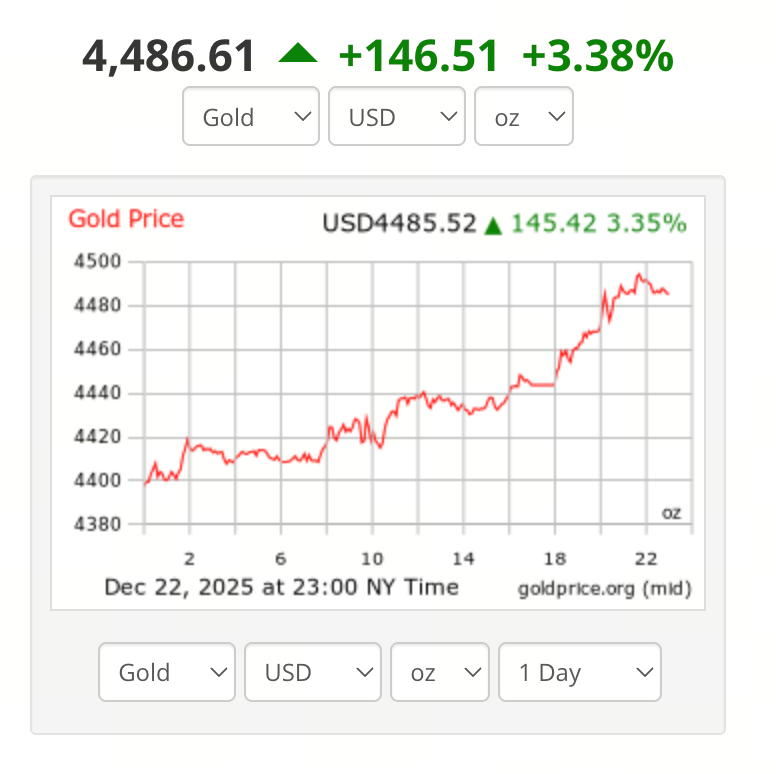
Source: https://goldprice.org/
Gold has repeatedly set new all-time highs, with spot prices breaking above $4,400 per ounce and maintaining strong momentum. The main drivers fueling this rally include:
Persistent Safe-Haven Demand: With global political and economic uncertainty on the rise, gold’s role as a traditional safe-haven asset has become even more pronounced. During periods of frequent risk events, capital tends to flow into assets that preserve value, supporting gold’s continued ascent.
Shifting Interest Rate Expectations: The market broadly anticipates further rate cuts from the Federal Reserve in the coming cycle. Lower rate expectations reduce the opportunity cost of holding non-yielding assets, making gold more attractive within diversified portfolios.
Support from Central Banks and ETFs: Central banks around the world are steadily increasing their gold reserves to optimize foreign asset structures and hedge systemic risks. Simultaneously, stable inflows into gold ETFs provide a solid foundation for medium- and long-term demand.
Together, these factors have been instrumental in driving gold to new record highs.
Market Implications of Bitcoin’s Return to $89,000
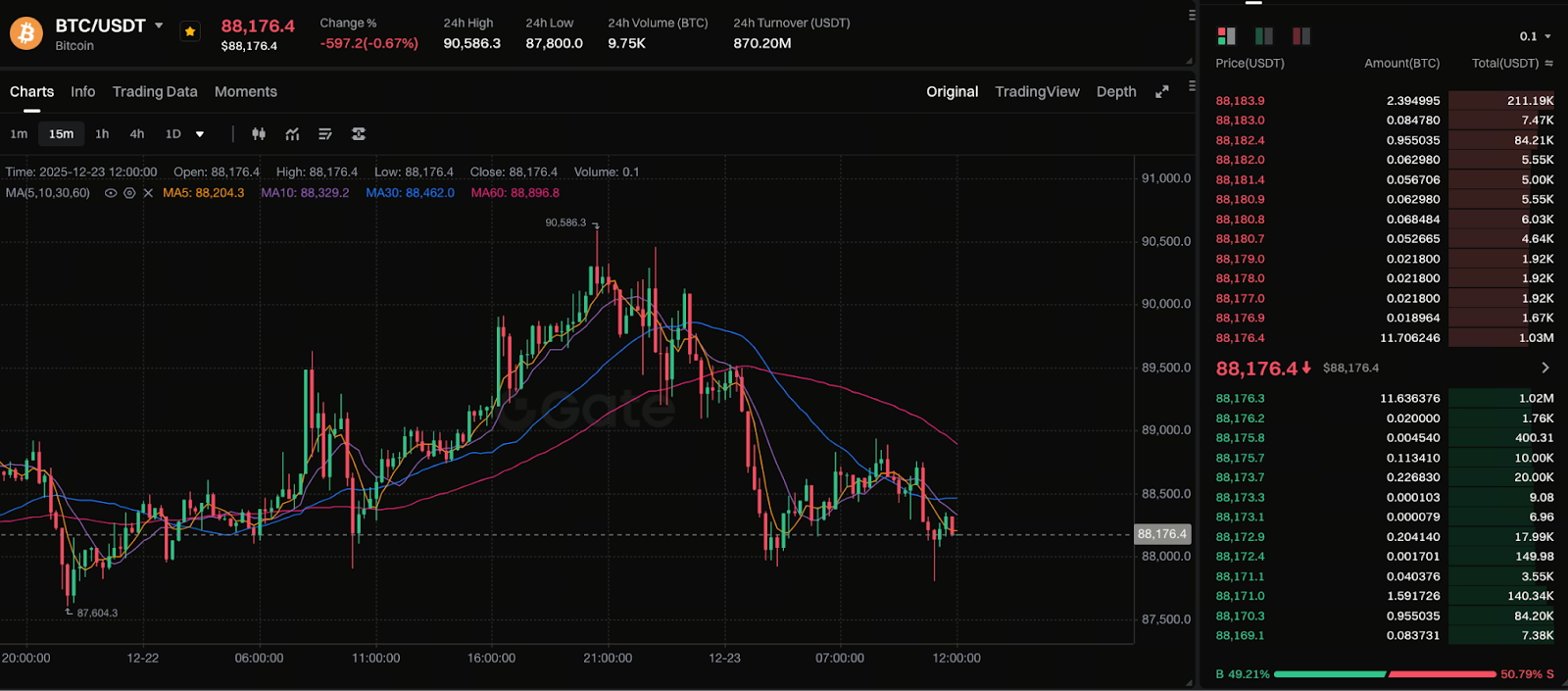
Source: https://www.gate.com/trade/BTC_USDT
While traditional safe-haven assets have rallied, the digital asset market has also seen a period of recovery. Following recent consolidation, Bitcoin (BTC) has reclaimed the critical $89,000 level, signaling a partial rebound in market risk appetite.
Several factors may be driving Bitcoin’s price recovery:
Phase-Based Return of Macro Capital to Risk Assets: As some macro risks are digested, capital is gradually shifting from safe-haven assets back into high-volatility assets, providing marginal support for the crypto market.
Technical Structure Improvement: Bitcoin has attracted buyers near key support levels, forming a short-term stabilization and rebound pattern that underpins the price recovery.
Marginal Improvement in ETF and Institutional Demand: Although caution still prevails, institutional investors are showing renewed interest in Bitcoin allocations, providing medium-term support for prices.
It’s important to note that Bitcoin remains a highly volatile asset, with price movements highly sensitive to global liquidity, policy expectations, and shifts in market sentiment.
Rotation Dynamics Between Traditional and Digital Assets
From an allocation perspective, gold and Bitcoin are exhibiting a degree of rotation in the current cycle:
- When risk aversion dominates, capital gravitates toward low-volatility assets like gold, driving prices higher;
- When risk appetite returns and liquidity expectations improve, high-beta assets such as Bitcoin attract renewed capital and experience short-term rallies.
This rotation is not a simple substitution, but rather reflects natural shifts in risk preferences across different market phases. Understanding this dynamic helps investors manage risk more effectively in multi-asset portfolios.
Investor Strategies and Risk Considerations
Given the current macro environment and rotation across asset classes, investors should focus on the following principles:
- Diversification: Avoid concentrating capital in a single asset. Gold and Bitcoin can serve as defensive and offensive components, respectively;
- Volatility Management: Bitcoin suits investors with higher risk tolerance and flexible allocation strategies, while gold is more appropriate for medium- to long-term, stable holdings;
- Ongoing Monitoring of Macro Variables: Interest rate policy, the US dollar’s trajectory, and global liquidity shifts all have significant impacts on both asset classes.
Market volatility is inherently unpredictable. Investment decisions should be made cautiously and aligned with individual risk tolerance.
Outlook and Summary
Looking ahead, global macroeconomic trends and market sentiment will remain the key variables influencing gold and Bitcoin prices. If global uncertainty persists, gold may continue to outperform. Conversely, if risk appetite fully recovers, high-volatility assets like Bitcoin could enter a new upward cycle.
In summary, gold’s record highs and Bitcoin’s return to $89,000 reflect the dynamic rotation between safe-haven and risk assets in global portfolios. A deep understanding of the macro drivers behind these moves can help investors identify structural opportunities in complex markets with greater rationality.
Share
Content


Related Articles

2025 BTC Price Prediction: BTC Trend Forecast Based on Technical and Macroeconomic Data

Flare Crypto Explained: What Is Flare Network and Why It Matters in 2025

Pi Coin Transaction Guide: How to Transfer to Gate.com

How to Use a Crypto Whale Tracker: Top Tool Recommendation for 2025 to Follow Whale Moves

What is N2: An AI-Driven Layer 2 Solution