Gate Vault Full Analysis: How MPC Multi-Chain Wallet Upgrades Asset Security Experience

Beginner
Quick Reads
Last Updated 2026-03-26 17:30:02
Reading Time: 1m
Gate Safe Box uses MPC technology to create a robust multi-chain wallet. With distributed key management, delayed fund settlement, and disaster recovery mechanisms, it empowers users to strengthen both the security and control of their digital assets.

Why Digital Asset Security Demands a New Approach

In the early stages of the crypto industry, single private key wallets gained popularity due to their straightforward design. As asset volumes increased, however, incidents like private key leaks, phishing attacks, and device loss became more frequent—escalating the risks associated with single points of failure. Users have come to recognize that simply “managing a string of private keys themselves” no longer meets the security requirements for high-value assets.

In response, innovative security solutions powered by MPC technology have emerged as an industry standard. Gate Safe Box exemplifies this new direction.

Core Design Principles of Gate Safe Box

Gate Safe Box is Gate’s next-generation secure asset management tool. Rather than just replacing traditional wallets, it aims to balance security, autonomy, and usability. Leveraging MPC technology, Gate Safe Box ensures that no complete private key ever exists, fundamentally reducing the risk of asset theft or accidental operations.

Gate Safe Box also supports multi-chain asset management and integrates seamlessly with Gate’s existing trading and Web3 product ecosystem. This integration helps users minimize trade-offs between security and operational efficiency.

How MPC Technology Transforms Security

The power of MPC (Multi-Party Computation) technology lies in “distributed authority without divided control.” Within Gate Safe Box, the private key is split into multiple shards, which are separately stored on the user’s device, Gate’s servers, and third-party provider nodes.

Throughout the process:

  • The private key never appears in its entirety
  • No single node can control the assets
  • Transaction signing is completed through secure collaborative computation

This framework eliminates the single point of failure that plagues traditional wallets. It shifts asset security from reliance on individual user behavior to robust system architecture.

Gate Safe Box: The “Four-Layer Protection System”

1. Distributed Key Architecture: With a three-party distributed storage model, even if one node is compromised, the complete key cannot be reconstructed—providing foundational asset protection.

2. 2-of-3 User-Driven Authorization: Gate and third parties only hold key shards and cannot independently initiate transfers. All asset movements require user initiation and authorization, ensuring the platform never holds unilateral control.

3. Delayed Settlement Risk Controls: By default, outgoing funds enter a 48-hour delay period. During this window, users can proactively freeze abnormal transactions, giving them time to react to potential threats.

4. Independent Recovery in Extreme Scenarios: Even if the platform’s services are interrupted, users can export their key shards via third-party providers and use open-source tools to recover assets—mitigating systemic risk.

Gate Safe Box: Fee Structure and Target Users
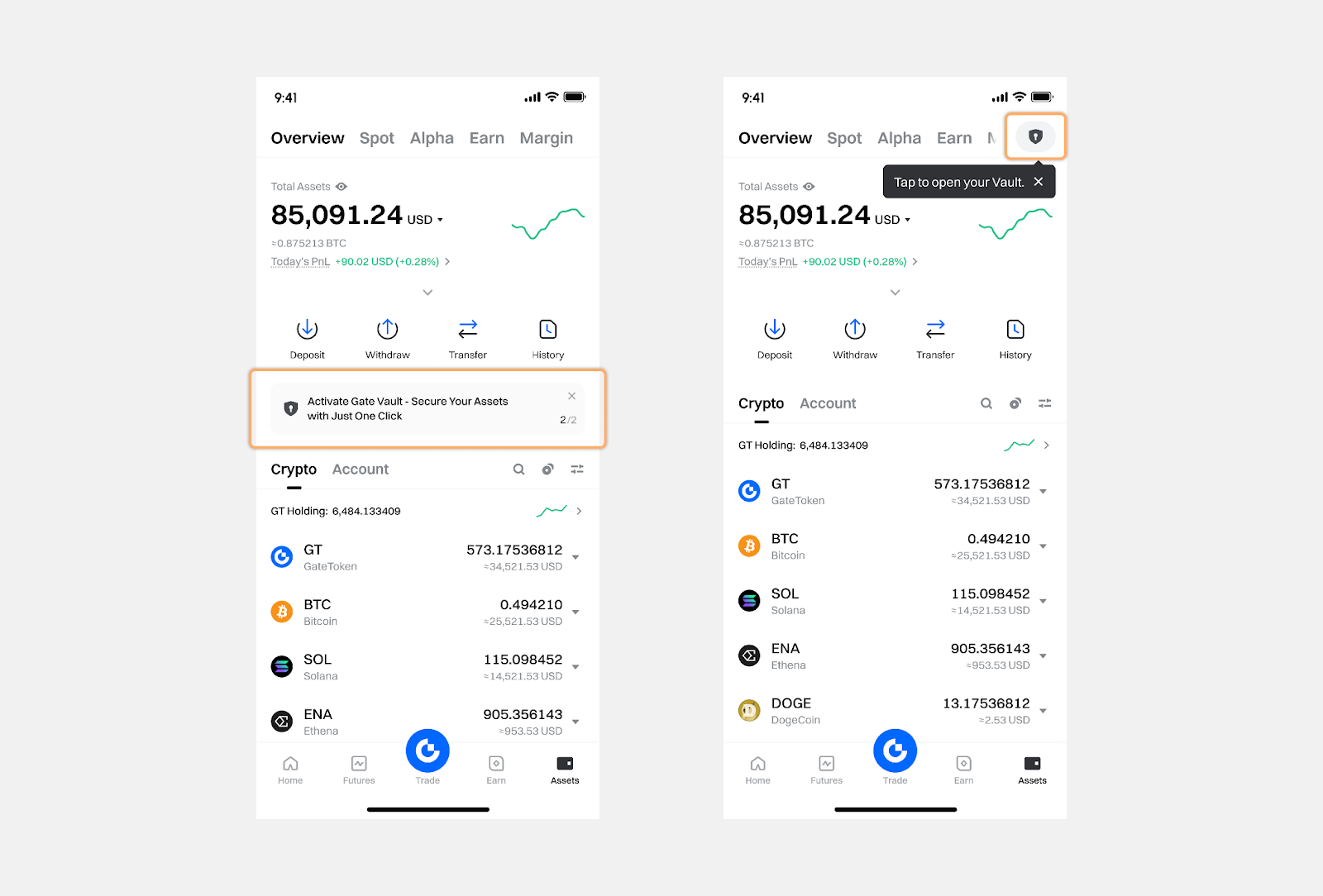
For transfers to Gate accounts, Gate Safe Box charges a 0.1% security service fee per transaction, capped at $100. This fee supports the ongoing operation of the risk control system and delayed settlement mechanism.

Currently, Gate Safe Box is available free of charge for a limited time to VIP3 and above users. Other users will be able to access it through paid options in the future. To enable these features, users must upgrade the Gate App to version V7.23.6 or later.

Gate Safe Box’s Role in the Web3 Ecosystem

Gate Safe Box is not a standalone product—it serves as the security hub of Gate’s Web3 strategy. Alongside Gate Layer, Gate Perp DEX, Gate Fun, Meme Go, and other offerings, it forms a comprehensive ecosystem from infrastructure to application layer.

Within this framework, Gate Safe Box acts as the “security trust layer,” delivering a stable and reliable foundation for on-chain transactions, self-custody of assets, and high-value operations.

Summary: Who Should Choose Gate Safe Box

Gate Safe Box is especially well-suited for:

  • Users holding medium to high-value crypto assets
  • Users seeking enhanced security without the burden of complex operations
  • Users transitioning from centralized accounts to Web3 self-custody

By combining MPC technology with multiple risk control mechanisms, Gate Safe Box offers a robust, future-ready asset management solution. As the Web3 era advances, Gate Safe Box is establishing itself as a key infrastructure for digital asset security management.

Author: Max
Disclaimer
* The information is not intended to be and does not constitute financial advice or any other recommendation of any sort offered or endorsed by Gate.
* This article may not be reproduced, transmitted or copied without referencing Gate. Contravention is an infringement of Copyright Act and may be subject to legal action.

Related Articles

AI-Native Settlement Layers: How United Stables Is Building the Next Financial Rail
Beginner

AI-Native Settlement Layers: How United Stables Is Building the Next Financial Rail

Stablecoins were originally designed as dollar substitutes within exchanges, primarily used for asset pricing and trade settlement. As on-chain financial ecosystems have matured, their role has expanded beyond simple payments to include collateral assets, cross-chain liquidity mediums, and unified settlement units. In particular, as AI systems and automated agents begin to participate directly in economic activity, demand has risen sharply for programmable value units capable of instant settlement. This shift is pushing stablecoins toward the role of foundational financial infrastructure.
2026-03-25 03:16:17
DePIN Identity Network and Real World Applications: How Humanity Protocol Brings on-chain Identity Into the Physical World
Beginner

DePIN Identity Network and Real World Applications: How Humanity Protocol Brings on-chain Identity Into the Physical World

Most Web3 identity systems remain confined to on-chain environments and struggle to achieve meaningful adoption in real world settings. Through a DePIN architecture and physical verification hardware, Humanity Protocol aims to bring decentralized identity into access control systems, hospitality, public services, and offline events, allowing on-chain identity to function not just as a digital credential, but as foundational infrastructure for real world access.
2026-03-25 07:40:53
Gold Price Forecast for the Next Five Years: 2026–2030 Trend Outlook and Investment Implications, Could It Reach $6,000?
Beginner

Gold Price Forecast for the Next Five Years: 2026–2030 Trend Outlook and Investment Implications, Could It Reach $6,000?

Analyze current gold price trends alongside authoritative five-year forecasts, integrating an evaluation of market risks and opportunities. This gives investors insight into the potential trajectory of gold prices and the main drivers expected to shape the market over the next five years.
2026-03-25 18:13:30
Aster vs Hyperliquid: Which Perp DEX Will Prevail?
Beginner

Aster vs Hyperliquid: Which Perp DEX Will Prevail?

Aster and Hyperliquid are the two representative protocols of the "purpose-built L1 path" within the current decentralized perpetual exchange (Perp DEX) sector. As a pioneer in the field, Hyperliquid has built a deep liquidity moat through its highly mature order book architecture and strong community consensus. Conversely, Aster, as a rising challenger, seeks to leapfrog the competition in high-performance trading through more aggressive multi-chain aggregation logic, private transaction modules, and an underlying execution environment optimized for 2026 market demands.
2026-03-24 11:58:33
Aerodrome Tokenomics: How ve(3,3) Powers Base's Most Profitable DEX
Beginner

Aerodrome Tokenomics: How ve(3,3) Powers Base's Most Profitable DEX

AERO is the native token of Aerodrome Finance, a core decentralized exchange and liquidity protocol in the Base ecosystem. It is primarily used for liquidity incentives and ecosystem operations. veAERO is a governance NFT that users receive by locking AERO, representing both voting power and the right to share protocol revenue. Through a dual track structure of AERO as a utility token and veAERO as a governance credential, Aerodrome separates liquidity usage value from long term governance power, allowing participants to act as liquidity providers, governance decision makers, and revenue sharers within the same system.
2026-03-25 06:40:31
The ve(3,3) Flywheel Explained: How AERO Tokenomics Powers Aerodrome’s DeFi Economy
Beginner

The ve(3,3) Flywheel Explained: How AERO Tokenomics Powers Aerodrome’s DeFi Economy

In the competition for DeFi liquidity, high-inflation mining alone is no longer enough to build lasting advantages. Aerodrome applies the ve(3,3) economic model to redesign token emissions, voting mechanisms, and revenue distribution, creating a liquidity flywheel centered on governance and cash flow. This article examines AERO tokenomics, the veAERO locking mechanism, and protocol revenue models to explain how Aerodrome builds a sustainable DeFi economic system.
2026-03-25 06:41:58





