As AI agents evolve from analytical tools into systems capable of autonomous action, new execution layers are required to translate AI-generated decisions into financial transactions. In the cryptocurrency ecosystem, these interactions must connect with both centralized exchanges and blockchain-based decentralized markets.
The Gate for AI framework introduces standardized interfaces that allow AI agents to access trading environments, market data, and wallet systems through unified architecture. Within this framework, the exchange and decentralized execution modules represent two different operational paths through which AI agents can carry out trading strategies.
Overview of Gate Exchange for AI and Gate DEX for AI
Gate Exchange for AI and Gate DEX for AI are two execution modules that enable AI agents to interact with cryptocurrency markets through different infrastructure models.
Gate Exchange for AI connects AI agents to centralized exchange trading systems. Through standardized interfaces, agents can query market data, create orders, manage positions, and retrieve account information directly from the exchange environment.
Gate DEX for AI connects AI agents to decentralized trading environments where transactions occur on blockchain networks. It provides tools for cross-chain swaps, perpetual trading, token analytics, and other on-chain interactions using standardized protocols.
Both modules operate within the broader Gate for AI infrastructure, which connects AI agents with exchange services, wallets, data feeds, and other financial tools through layered architecture.
Gate for AI Execution Architecture
Gate for AI is structured as a multi-layer architecture that organizes how AI agents interact with financial systems.
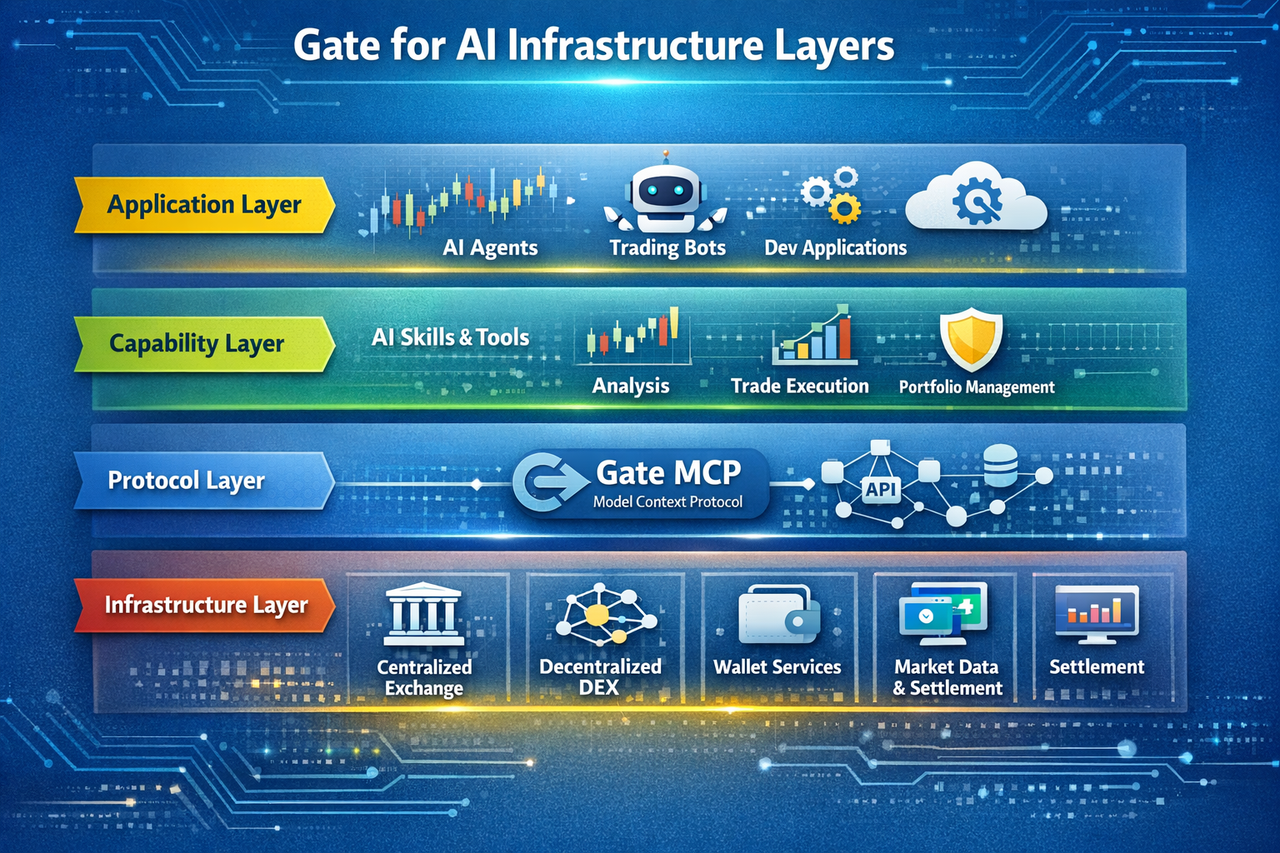
The architecture typically includes four major layers:
Application Layer
This layer contains AI agents, developer applications, and automated trading systems. Agents generate decisions, interpret market data, and initiate tasks.
Capability Layer
The capability layer contains modular AI Skills that define workflows such as market analysis, trade execution, and portfolio monitoring.
Protocol Layer
Gate MCP (Model Context Protocol) acts as the communication bridge that allows AI agents to interact with external services through standardized tool interfaces.
Infrastructure Layer
The infrastructure layer contains the operational services that AI agents ultimately interact with, including:
These layers together transform AI-generated instructions into executable financial actions.
What Gate Exchange for AI Means for AI Agents
Gate Exchange for AI provides a centralized execution path where AI agents interact with a traditional exchange trading engine.
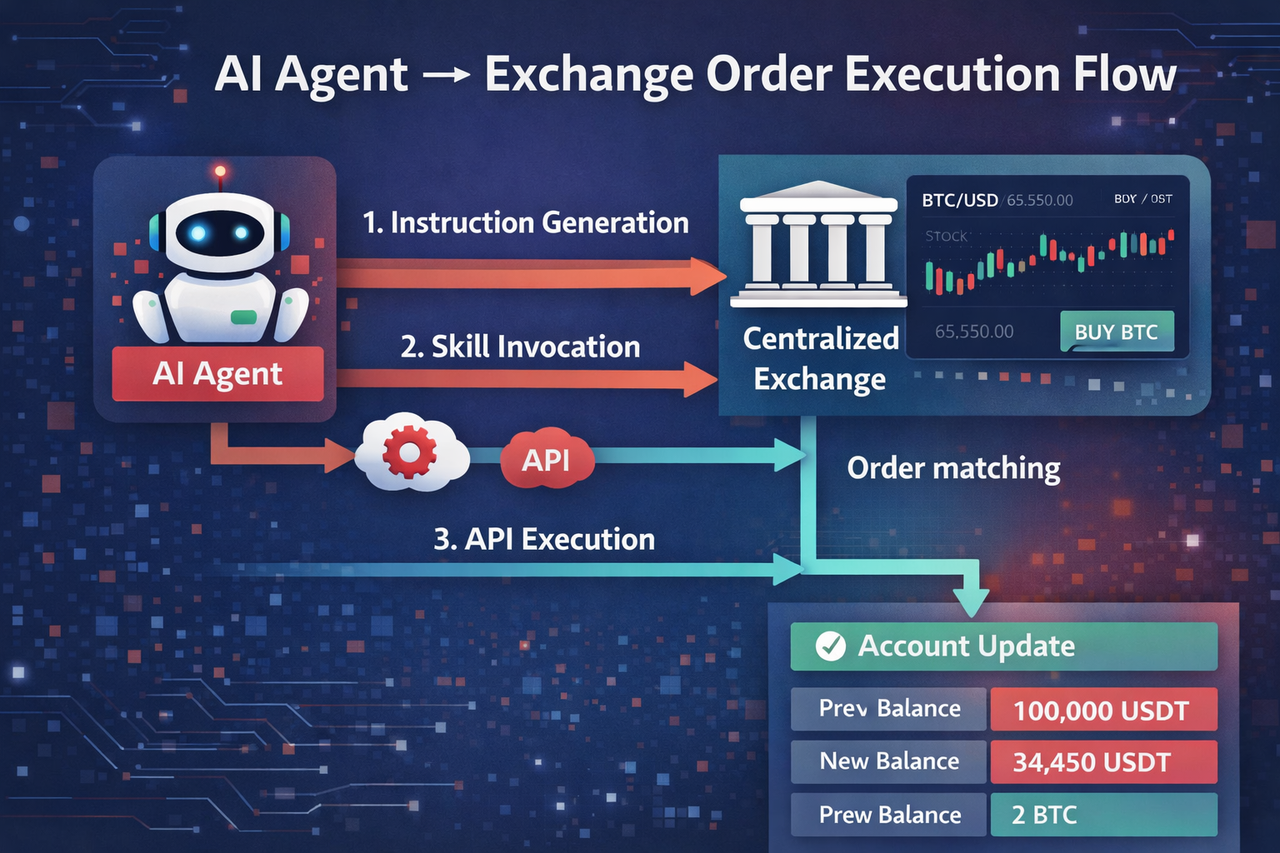
The execution process typically follows this sequence:
-
Instruction generation The AI agent decides to perform a trade based on analysis or strategy.
-
Skill invocation An AI Skill triggers a trading operation through MCP tools.
-
API execution The request is sent to the centralized exchange infrastructure.
-
Order matching The exchange matching engine processes the order and executes it.
-
Account update The exchange updates balances and positions.
In this path, the exchange infrastructure handles liquidity aggregation, order matching, and settlement.
For AI agents, this environment offers predictable execution conditions and integrated market infrastructure.
What Gate DEX for AI Means for AI Agents
Gate DEX for AI enables AI agents to interact directly with decentralized finance systems operating on blockchain networks.
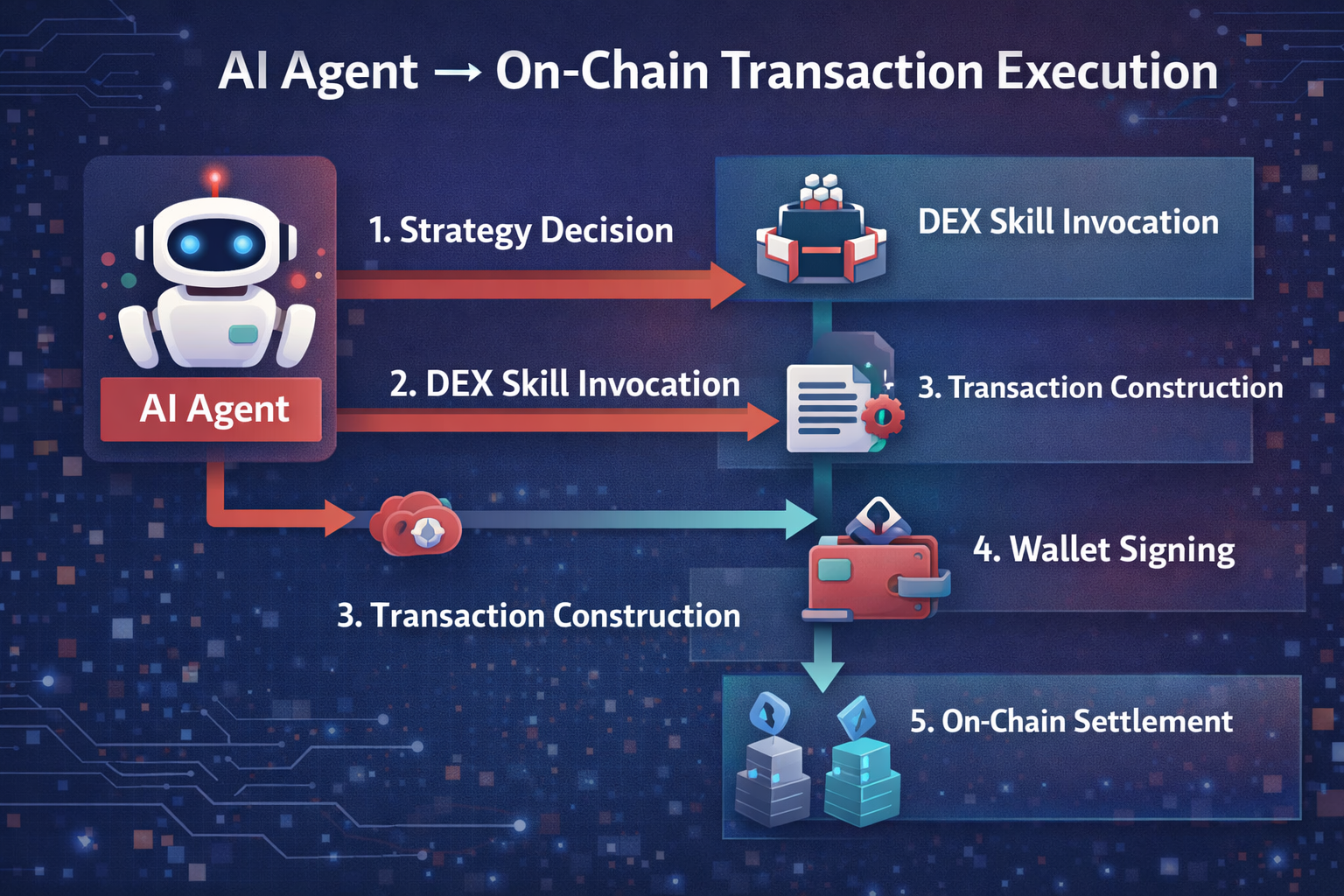
The execution flow typically involves:
-
Strategy decision The AI agent identifies an on-chain trading opportunity.
-
DEX skill invocation The agent calls a skill designed for decentralized trading.
-
Transaction construction A blockchain transaction is prepared.
-
Wallet signing The transaction is signed through an integrated wallet module.
-
On-chain settlement The transaction is submitted to the blockchain network.
DEX environments allow AI agents to interact with decentralized liquidity pools, cross-chain swaps, and smart-contract-based trading systems.
Operational Differences Between Execution Paths
The exchange and decentralized execution paths differ in several structural aspects.
| Dimension |
Exchange Execution Path |
DEX Execution Path |
| Infrastructure |
Centralized exchange trading engine |
Blockchain smart contracts |
| Transaction type |
Off-chain order matching |
On-chain transaction execution |
| Asset custody |
Exchange-managed accounts |
Self-custodied wallets |
| Settlement model |
Internal exchange ledger |
Blockchain settlement |
| Latency characteristics |
Typically lower execution latency |
Dependent on blockchain confirmation |
These differences influence how AI agents design strategies, manage risk, and coordinate trading actions.
When Each Execution Path Fits Better
Different trading environments can favor different execution models.
Exchange execution paths may be suitable when:
-
Strategies require fast order execution
-
High-liquidity trading pairs are involved
-
Agents need advanced order types
DEX execution paths may be more suitable when:
-
Strategies rely on decentralized liquidity pools
-
Cross-chain trading is required
-
On-chain data or token ecosystems are central to the strategy
In practice, AI agents may combine both paths within a single strategy to access multiple liquidity environments.
Risks and Limitations
Despite expanding AI capabilities, both execution paths involve operational considerations.
Exchange execution risks
-
Dependence on centralized infrastructure
-
API reliability and access permissions
-
Platform-specific operational constraints
DEX execution risks
-
Smart contract vulnerabilities
-
On-chain transaction fees
-
network congestion and confirmation delays
Additionally, AI agents interacting with financial systems must manage tool-execution safety and validation mechanisms to prevent unintended actions.
Future Outlook
As AI agents become more capable, execution infrastructure is likely to evolve toward deeper integration between centralized and decentralized systems.
Possible developments include:
-
Hybrid liquidity routing across exchanges and DEX networks
-
Autonomous portfolio management by AI agents
-
Improved security layers for agent-initiated transactions
-
Standardized protocols for AI-driven financial workflows
Unified frameworks such as Gate for AI illustrate how execution environments may adapt to support increasingly autonomous financial agents.
Conclusion
Gate Exchange for AI and Gate DEX for AI represent two distinct execution paths that allow AI agents to interact with cryptocurrency markets.
The exchange module connects agents to centralized trading infrastructure, while the DEX module enables interaction with decentralized blockchain-based markets. These paths differ in custody structure, settlement mechanisms, and transaction routing.
Understanding how these execution environments operate helps clarify how AI agents can navigate complex financial systems that combine centralized services with decentralized networks.
FAQ
What is Gate Exchange for AI?
Gate Exchange for AI is a module within the Gate for AI infrastructure that allows AI agents to interact with centralized exchange trading systems through standardized APIs and protocol interfaces.
What is Gate DEX for AI?
Gate DEX for AI is a module that enables AI agents to execute transactions on decentralized exchanges, including cross-chain swaps, on-chain trading, and token analytics.
Why are two execution paths necessary for AI agents?
Centralized exchanges and decentralized finance systems operate with different architectures. Supporting both allows AI agents to access broader liquidity and interact with multiple types of financial infrastructure.
Can AI agents use both execution paths simultaneously?
Yes. Within unified frameworks, AI agents can combine centralized and decentralized trading environments as part of a coordinated strategy.
What role does MCP play in Gate for AI?
The Model Context Protocol (MCP) provides standardized interfaces that allow AI agents to access exchange APIs, blockchain services, and other financial tools within the Gate for AI ecosystem.