As Ethereum transitioned to a proof-of-stake consensus model, staking became essential for network security but introduced trade-offs related to liquidity and control. Protocols like ether.fi address these constraints by combining staking participation with tokenized liquidity and user-controlled validator structures, making staking more flexible and composable within decentralized systems.
What is ether.fi?
As a non-custodial liquid staking and restaking protocol, ether.fi enables users to stake ETH while retaining control of withdrawal rights and receiving a liquid representation of their staked assets.
It belongs to the broader category of liquid staking infrastructure within decentralized finance and blockchain validation systems.

Source: ether.fi
It is a protocol that enables Ethereum staking without transferring custody, while issuing liquid tokens that represent staked assets and accrued rewards.
It primarily solves:
-
Loss of liquidity in traditional staking
-
Custodial risk from third-party staking providers
-
Limited usability of staked capital
Why does ether.fi exist?
Ethereum staking is essential for securing the network, but it introduces several structural limitations that can reduce flexibility, accessibility, and capital efficiency. ether.fi is designed to address these constraints by rethinking how staking interacts with ownership, liquidity, and reward generation.
Key limitations and ether.fi’s approach
| Limitation |
What it means in traditional staking |
How ether.fi addresses it |
| Custody risk |
Users often rely on third-party operators, giving up control over their assets |
Users retain withdrawal rights, enabling a non-custodial staking experience |
| Illiquidity |
Staked ETH is locked and cannot be used elsewhere in the ecosystem |
Liquid tokens like eETH allow staked assets to remain usable across DeFi |
| Single reward layer |
Rewards are limited to Ethereum staking yields |
Restaking introduces additional utility and potential reward layers |
| Centralization |
Large staking providers dominate validator operations, increasing concentration risk |
Distributed validator coordination supports a more decentralized infrastructure |
In traditional models, staking requires users to trade liquidity for security. ether.fi attempts to reduce this trade-off by enabling both to coexist, allowing users to secure the network while keeping their capital active and flexible.
How does ether.fi work?
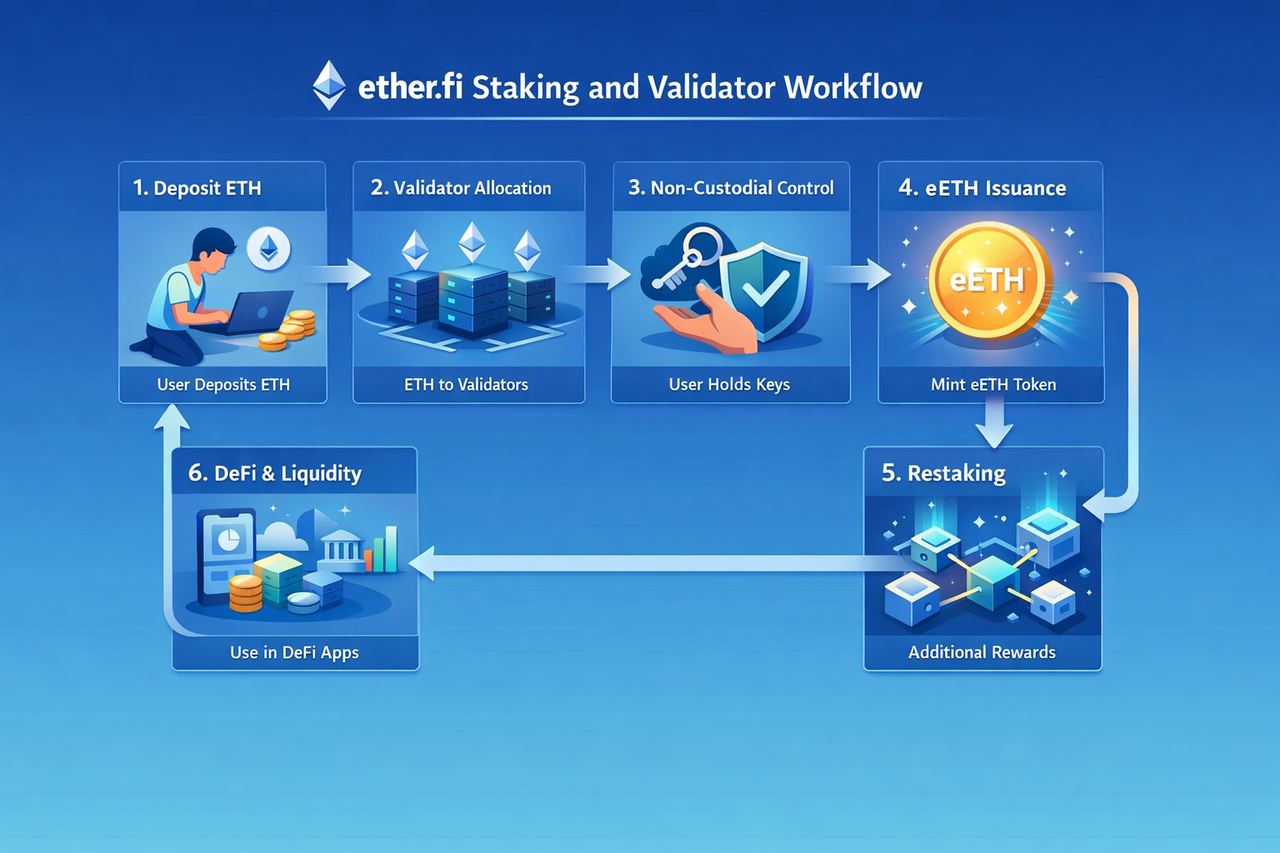
ether.fi integrates staking, validator infrastructure, and tokenization into a coordinated system.
Process overview
Step 1: Deposit: The user deposits ETH into the ether.fi protocol, marking the entry into the staking system where funds are prepared for validator participation.
Step 2: Validator allocation: The deposited ETH is allocated to validators within the Ethereum network, enabling the assets to support consensus and network security.
Step 3: Key separation and ownership: The protocol separates validator operations from withdrawal rights, allowing users to retain control over their assets and maintain a non-custodial structure.
Step 4: Token issuance (eETH): In return for the deposit, the protocol issues eETH, a liquid staking token that represents the user’s staked ETH along with accumulated rewards.
Step 5: Restaking integration: The staked assets can be reused within additional validation or security layers through restaking mechanisms, extending potential reward sources beyond standard Ethereum staking.
Step 6: DeFi usage and liquidity: Users can utilize eETH or its wrapped version in decentralized finance applications, maintaining liquidity while continuing to earn staking rewards.
ether.fi separates validator operation from asset ownership, allowing users to retain control while infrastructure providers handle technical execution.
Core components and key features of ether.fi
ether.fi consists of several interconnected components:
Key components overview
-
eETH: A liquid staking token that represents staked ETH along with accumulated rewards, while remaining transferable and usable across the ecosystem.
-
weETH: A wrapped version of eETH designed to improve DeFi compatibility by using a non-rebasing format suitable for integration.
-
Validator system: The node infrastructure that allocates deposited ETH to validators, securing the Ethereum network and generating staking rewards.
-
Non-custodial design: A key ownership model that ensures users retain control of their assets, separating ownership from validator operations.
-
Restaking layer: An extended validation mechanism that reuses staked assets for additional services, increasing capital efficiency and potential rewards.
Key features of ether.fi
-
Non-custodial architecture Users retain withdrawal credentials, reducing reliance on centralized intermediaries.
-
Liquid staking tokens Tokens such as eETH allow staked assets to remain active within financial ecosystems.
-
Validator coordination Infrastructure separates technical operation from asset ownership.
-
Restaking capability Staked ETH can contribute to additional systems beyond base Ethereum validation.
Together, these components and features position ether.fi as a modular staking system that combines self-custody, liquidity, and multi-layered yield generation within the Ethereum ecosystem.
ETHFI tokenomics: governance, incentives, and treasury management
ETHFI serves as the governance and coordination layer of the ether.fi ecosystem, playing a central role in aligning stakeholders, distributing incentives, and guiding the protocol’s long-term evolution.
Token role overview
| Function |
Description |
| Governance |
Enables token holders to vote on protocol upgrades, parameters, and key decisions affecting system design and operations |
| Incentives |
Facilitates reward distribution to users, node operators, and contributors to encourage active participation and ecosystem growth |
| Treasury |
Supports funding for development, partnerships, and strategic initiatives through DAO-controlled resource allocation |
| Coordination |
Aligns the interests of users, developers, and operators by linking participation with influence over protocol direction |
ETHFI does not represent staked ETH or yield-bearing assets such as eETH. Instead, it functions as a governance primitive that determines how the protocol evolves, how incentives are structured, and how resources are allocated across the ecosystem.
Structural considerations
-
Governance decisions made by ETHFI holders directly shape protocol upgrades, validator policies, and economic parameters
-
Incentive mechanisms are designed to drive user participation, operator reliability, and sustained network activity
-
The treasury acts as a long-term capital pool, supporting ecosystem expansion, infrastructure development, and strategic initiatives
Together, ETHFI operates as the coordination layer that connects governance, incentives, and capital allocation within ether.fi.
Main uses and applications of ether.fi
ether.fi operates across multiple layers of the Ethereum ecosystem, enabling users to participate in staking while maintaining flexibility and access to broader financial use cases.
Ethereum staking participation Users can stake ETH to support network security and earn rewards without relinquishing asset control.
Liquid asset utilization Through tokens like eETH and weETH, staked ETH remains usable across DeFi, allowing users to retain liquidity instead of locking capital.
DeFi integration Liquid staking assets can be deployed in lending, liquidity provision, and other on-chain strategies, extending their utility beyond passive holding.
Restaking-based yield expansion Assets can be reused to secure additional services or protocols, enabling multiple reward streams from the same underlying capital.
Collateral and financial structuring eETH and weETH can function as collateral within DeFi systems, supporting more complex financial strategies and capital efficiency.
Liquid staking transforms staked ETH from a passive asset into an actively usable financial instrument, enabling participation in both network security and decentralized finance simultaneously.
What are the risks and limitations of ether.fi?
ether.fi introduces flexibility and capital efficiency into Ethereum staking, but it does not eliminate the underlying risks associated with blockchain systems, DeFi integrations, and market dynamics.
One of the primary considerations is smart contract risk. Like all on-chain protocols, ether.fi relies on complex smart contracts to manage deposits, token issuance, and reward distribution. Any bugs, vulnerabilities, or unforeseen edge cases in these contracts could potentially affect user funds, even if the system has undergone audits.
There is also validator risk, which relates to how staked ETH is used within the Ethereum network. Validators that perform poorly, experience downtime, or act incorrectly may receive reduced rewards or incur penalties. In extreme cases, this can lead to slashing events, where a portion of staked assets is lost.
Another factor is liquidity and market risk. Although tokens like eETH and weETH are designed to track the value of staked ETH, their market price may deviate due to supply-demand dynamics, trading conditions, or broader market volatility. This divergence can impact users who rely on these assets for trading or collateral.
The protocol also introduces complexity risk. ether.fi combines multiple layers, including staking, liquid staking, restaking, and DeFi integrations. This multi-layered structure can make it more difficult for users to fully understand how rewards are generated, how risks propagate, and how different components interact.
Finally, there is ecosystem dependency risk. The effectiveness of ether.fi’s model depends on the continued growth and adoption of Ethereum, DeFi protocols, and restaking infrastructure. If these ecosystems fail to expand or face disruptions, the expected benefits of liquidity and additional yield opportunities may be reduced.
While the non-custodial design helps reduce counterparty risk by allowing users to retain control of their assets, it does not remove exposure to protocol-level vulnerabilities, validator performance issues, or broader market uncertainties.
Summary
ether.fi is a non-custodial staking system that combines validator participation, liquid asset representation, and extended utility through restaking, transforming staking from a fixed commitment into a flexible financial layer within Ethereum.
At a system level, it reflects the convergence of three structural trends: user-controlled infrastructure that prioritizes asset ownership, tokenized liquidity that keeps capital active, and composable financial systems that enable integration across DeFi.
Understanding ether.fi requires viewing staking not as an isolated process, but as part of a broader, interconnected financial architecture where capital can move, adapt, and generate value across multiple layers simultaneously.
FAQs
What makes ether.fi different from traditional staking?
It allows users to retain control of their assets while receiving liquid tokens that can be used elsewhere.
What is eETH?
eETH is a liquid staking token representing staked ETH and accumulated rewards.
What is the difference between eETH and weETH?
eETH is rebasing, while weETH is a wrapped version designed for compatibility in DeFi systems.
What is ETHFI used for?
ETHFI is used for governance, incentives, and treasury coordination within the protocol.
What are the main risks?
Key risks include smart contract vulnerabilities, validator performance issues, liquidity fluctuations, and system complexity.







