Why Is Sector Rotation Accelerating?
In today's marketplace, "rapid rotation" isn't just a perception—it's a structural fact. There are at least three key drivers:
-
Information now spreads in real time: Social media, KOLs, and on-chain monitoring tools have compressed the time lag for "spotting hot sectors" to just minutes. Trends that once offered a mid-cycle window are now often traded away ahead of time.
-
Capital flows are increasingly short-term: The share of capital from futures, quant funds, and event-driven strategies is rising, leading to more frequent "fast surges—rapid divergence—swift rotation" in prices.
-
Narrative half-lives are shrinking: Similar concept projects are launching in quick succession, constantly fragmenting market attention. Narratives that once dominated the market now do so for much shorter periods, resulting in more pulse-like rotations within individual zones.
The upshot: There are more opportunities, but the "window for safe participation" is much narrower.
The Four Most Common Failure Paths for Retail Investors
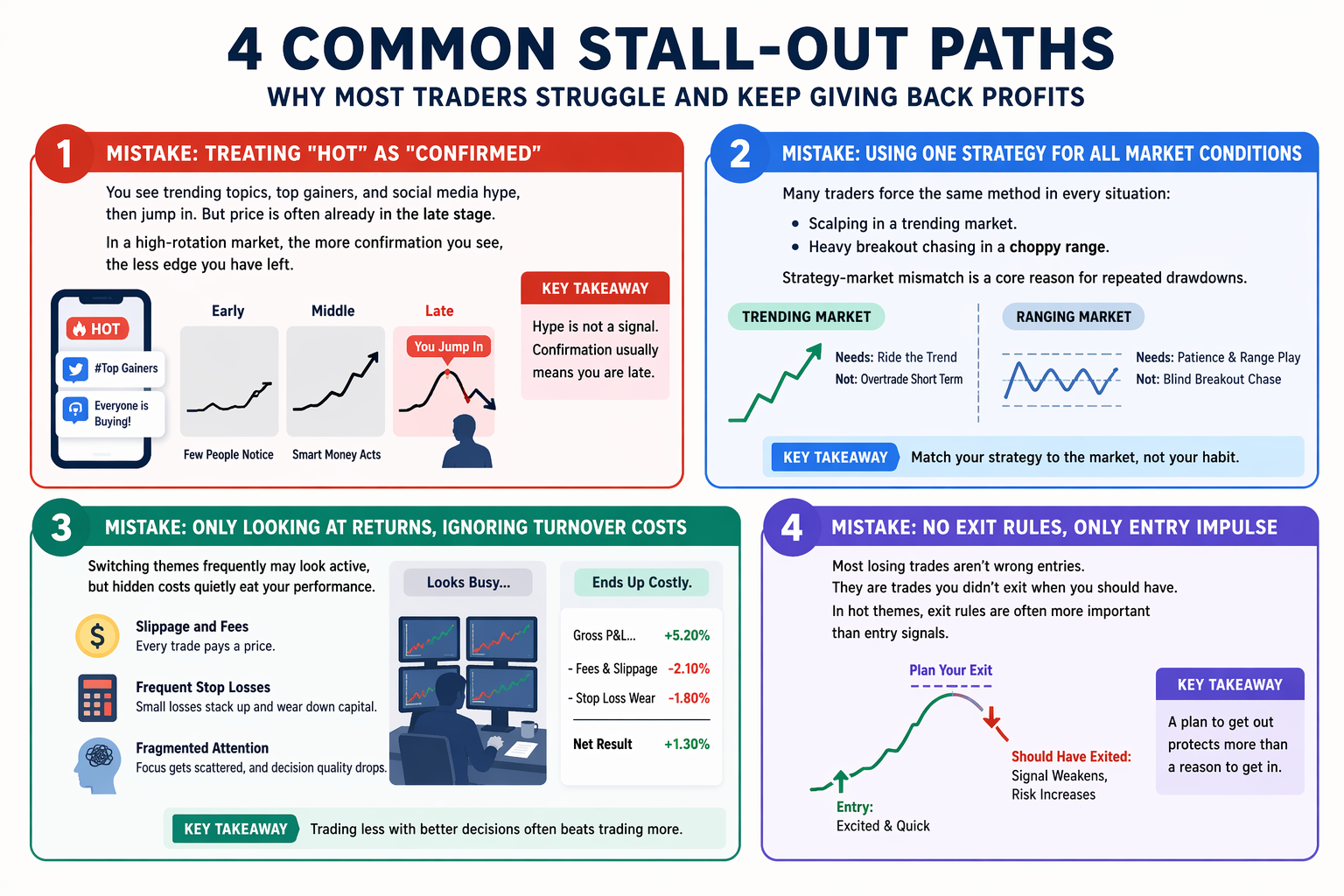
1. Confusing "Spotting a Hot Sector" with "Confirming an Opportunity"
Jumping in only after seeing trending searches, top gainers, or social media buzz often means you're late to the trade.
In a high-rotation environment, the more confirmation you wait for, the less edge you have on price.
2. Applying One Strategy to Every Market Cycle
Many traders use a single playbook for all conditions:
3. Focusing on Returns and Ignoring Turnover Costs
Frequent sector switching may "look busy," but the hidden costs are significant:
-
Slippage and trading fees;
-
Capital erosion from frequent stop-losses;
-
Fragmented attention lowers the quality of decision-making.
4. Having Entry Impulses but No Exit Rules
Most losing trades aren't about buying the wrong asset—they're about failing to exit when you should.
In hot sector trading, exit rules are usually more important than entry signals.
Start with Market Layering, Then Act
The first step to not getting left behind isn't placing orders faster—it's determining "which market layer you're in."
Use a three-layer framework:
-
Mainline Layer (Beta): Driven by macro liquidity and major asset trends. Question: Is the market in offensive or defensive mode?
-
Sector Rotation Layer: Narratives rotating below the mainline, such as RWA, DePIN, L2, Meme, etc. Question: What type of assets is capital currently rewarding?
-
Individual Coin Layer (Execution): Entry and exit for specific assets. Question: Are the odds and invalidation points for this trade clearly defined?
Many mistakes come from "skipping the first two layers and jumping straight to the third." When the mainline is defensive, even the strongest coins are prone to spike and then pull back.
An Executable Rhythm Management Framework: 24 h - 72 h - 7d
This is the most practical execution template for retail investors. The core principle: shift your trading rhythm from "emotion-driven" to "time window-driven."
24 h: Observation and Filtering
The goal is not to trade, but to filter out noise.
Do just three things each day:
-
Check whether sector capital inflows are sustained;
-
See if the sector leader is breaking out on volume or spiking and then retreating;
-
Watch for "high-level divergence + low-level relay" patterns in the market.
Output: Keep only 2–3 candidate directions, no rush to go all-in.
72 h: Confirmation and Trial Positions
Over a three-day window, validate whether the narrative is sustainable.
Focus on:
-
Is there a second tier of assets following?
-
Is the sector leader’s pullback being supported?
-
Does negative news trigger structural damage?
Execution principles:
-
Start with small trial positions, add only after validation;
-
Don’t raise your position limit just because of a single-day surge;
-
If invalidation criteria are met, cut positions mechanically.
7 d: Attribution and Adjustment
Weekly reviews set the pace for the following week.
Focus on four questions:
-
Did profits come from sound judgment or from luck and volatility?
-
Did losses result from being wrong on direction or from execution errors?
-
Which trades were "within plan" mistakes, and which were "outside discipline" mistakes?
-
What types of trades should be reduced next week?
Consistent profitability usually comes from "making fewer repeat mistakes," not "catching every hot sector."
Position Sizing and Risk Control: Survive Rapid Rotation First
In fast-rotating markets, the greatest risk isn't a single bad call—it's keeping oversized positions after repeated mistakes.
Consider a "tiered position sizing template":
-
Base Position (Defensive): 40%–60% in cash and high-liquidity assets to avoid chasing highs passively.
-
Opportunity Position (Offensive): 20%–40% allocated only to confirmed sector opportunities—never emotional trades.
-
Trial Position (Exploratory): 10%–20% for early-stage narratives, with strict stop-losses.
Risk control guidelines:
-
Fix the risk budget per trade; don’t increase it just because a trade "looks strong";
-
If consecutive losses hit a threshold, automatically reduce trading frequency;
-
Proactively reduce net exposure ahead of major events.
In high-volatility phases, position management itself is Alpha.
These position ratios are provided as an educational example to illustrate risk management thinking in fast-rotating markets. They do not constitute investment advice or a guarantee of returns. Individual traders' capital size, risk tolerance, trading experience, and market liquidity conditions vary widely. You should independently evaluate your approach and always size positions within your loss tolerance. In volatile markets, prices can gap and liquidity may deteriorate rapidly. Stop-loss strategies may also face slippage and incomplete execution risk.
How to Distinguish a "New Mainline" from "Short-Term Noise"
To judge whether a hot sector can upgrade from "news trading" to a "true mainline," use these five filters:
-
Sustainability: Is there capital support for 3–5 consecutive trading days?
-
Diffusion: Is momentum spreading from a single leader to similar assets?
-
Drawdown Quality: Is the pullback a low-volume consolidation or a high-volume collapse?
-
Catalyst Density: Are there ongoing fundamental or policy catalysts, or just one-off events?
-
Trade Crowdedness: If financing, funding rates, and sentiment indicators are all overheated, beware of late-stage risk.
A tradable mainline typically meets the first four criteria without overheating on the fifth.
Anti-FOMO Process: Guarding Against Emotional Trading
For retail investors, the hardest part isn’t analysis—it’s self-control in the moment. Establish a five-minute decision process; check every item before trading:
-
Which logic layer does this trade fit (mainline / sector / individual coin)?
-
Is your entry based on data or social media sentiment?
-
What is your invalidation trigger, and will you execute if it’s hit?
-
Is your position size within your preset risk budget?
-
If you’re wrong, can you recover the loss next week?
If you can’t answer any item clearly, default to not trading.
In high-velocity markets, "missing out" usually costs less than "making mistakes."
Conclusion: Trading Is Shifting from "Chasing Hot Sectors" to "Managing Rhythm"
The acceleration of hot sector rotation won’t end soon—this is both a challenge and a turning point.
The old model focused on "finding the next big gainer"; the new model is about "maintaining consistent execution amid high-frequency shifts."
For retail investors, sustainable advantage comes down to three things:
-
Layered judgment: Assess overall market state before zeroing in on specific opportunities;
-
Rule-based execution: Replace impulse with a fixed framework;
-
Continuous review: Turn every market swing into a step toward better discipline.
The market won’t slow down for anyone’s lack of preparation, but with a stable rhythm management system, you can achieve one critical goal:
Even if you don’t catch every hot sector, you won’t be eliminated in every rotation.







