What Are AI Agents in Financial Systems and Crypto Trading Bots
A crypto trading bot is an automated program that follows prewritten instructions to monitor market conditions and place orders when specific criteria are met. In most cases, its logic is narrow: it watches selected data inputs, applies fixed rules, and triggers execution through an exchange API. That makes it suitable for repetitive tasks such as market making, grid trading, arbitrage checks, or scheduled portfolio rebalancing.
An AI agent in a financial system is broader in scope. Instead of only reacting to a fixed signal, it can combine multiple tools and data sources to interpret an objective, gather missing information, choose a workflow, and then act within defined permissions. Gate for AI describes this model as infrastructure that lets agents access exchanges, DEX functions, wallets, news, and on-chain information through MCP and modular AI skills.
In simple terms, a bot usually automates a strategy, while an AI agent can coordinate a process.
How Traditional Trading Bots Work
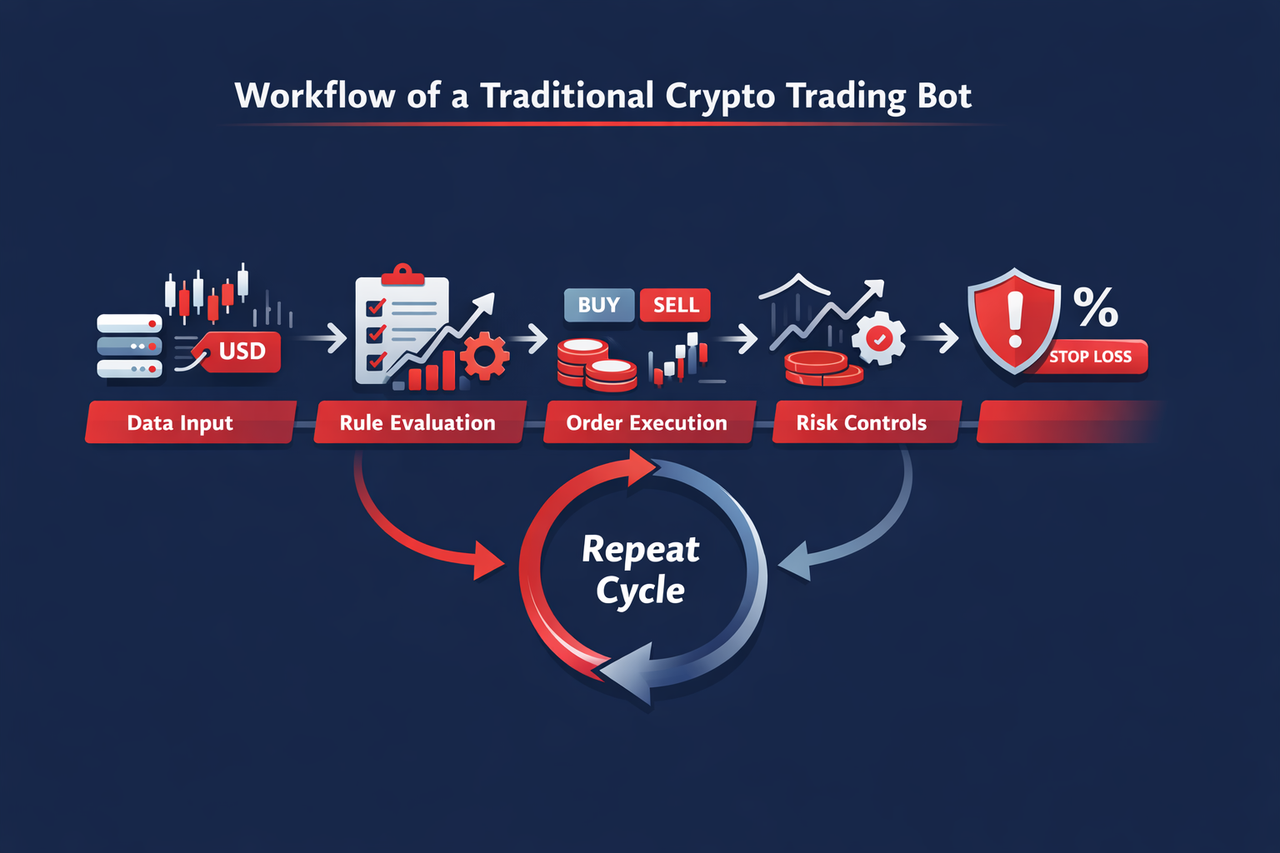
Traditional trading bots usually work through a structured but rigid pipeline:
-
Data input: The bot receives market prices, order book data, indicator values, or account balances from an exchange API.
-
Rule evaluation: It compares incoming data against preset rules such as spread thresholds, RSI levels, moving average crosses, or price ranges.
-
Order execution: When conditions are satisfied, it sends a buy, sell, cancel, or amend command.
-
Risk controls: It may apply stop-loss rules, position limits, cooldown timers, or maximum order size limits.
-
Repeat cycle: The system loops continuously with limited variation unless a developer changes its code or settings.
This architecture is efficient when the environment is stable enough for predefined logic to remain relevant. It is less effective when the system must interpret unstructured information, switch between workflows, or respond to new market conditions that were not encoded in advance.
How AI Agents Work
AI agents work through a more flexible chain of perception, reasoning, tool use, and action. Rather than relying only on a hardcoded trading rule, an agent can break a goal into subtasks and call different tools to complete them.
A typical AI-agent workflow may include:
-
Goal interpretation: The system receives a task such as screening market weakness, checking wallet exposure, or finding an execution path.
-
Context gathering: It calls tools for market data, news, wallet status, token information, or on-chain analytics.
-
Reasoning and planning: It evaluates which information matters and decides what step should come next.
-
Action selection: It may place an order, rebalance holdings, request another data check, or halt because risk conditions are unclear.
-
Feedback loop: It reviews outcomes and updates the next step based on new information.
Gate for AI describes this model through layered architecture: application layer, capability layer, protocol layer, and infrastructure layer. In that structure, Gate MCP provides the protocol interface, while AI skills orchestrate workflows built on top of multiple tools. The GitHub documentation also shows that the related MCP services expose market data, trading, wallet, DEX, news, and information endpoints, which are consistent with an agent-style operating model rather than a single-purpose bot.
AI agents therefore differ not only in intelligence claims, but in system design. They are built to choose among tools, not just run one script.
What Changes in Crypto Environments
Crypto markets create operating conditions that make the distinction between bots and agents more significant.
First, the market is multi-venue. Trading can happen across centralized exchanges, perpetual platforms, on-chain DEXs, and cross-chain routes. Second, the market is information-heavy. News, social signals, token launches, liquidity shifts, and on-chain wallet behavior can all affect outcomes. Third, the environment is operationally fragmented. Execution, custody, analytics, and monitoring often sit in separate systems.
This is one reason agent infrastructure has gained attention. Gate for AI organizes capabilities into exchange, DEX, wallet, news, info, and payment modules, showing that modern automation may need access to more than order placement alone. On the GitHub side, Gate MCP lists public market data tools, authenticated trading tools, DEX functions, on-chain information, and news access under one tool framework.
In a simpler market, a bot can be enough. In a fragmented market, automation often needs coordination.
AI Agents vs Bots: Key Differences
The differences between AI agents and traditional crypto trading bots become clearer when comparing how they make decisions, handle data, and interact with trading environments. While both systems automate tasks, they are designed with different levels of flexibility and operational scope.
The table below summarizes the main distinctions in their decision models, data usage, workflow capabilities, and integration with financial tools and services.
| Aspect |
Crypto Trading Bots |
AI Agents |
| Decision Model |
Operate using predefined rules and fixed logic that trigger trades when specific conditions are met. |
Interpret goals and dynamically choose workflows or actions based on context and available tools. |
| Data Handling |
Primarily rely on structured market inputs such as price data, volume, and technical indicators. |
Can combine structured and semi-structured data sources, including news feeds, wallet activity, and on-chain signals. |
| Scope of Action |
Usually designed for a narrow task such as executing a specific strategy or monitoring price signals. |
Can coordinate multiple steps such as research, risk analysis, trade execution, and post-trade monitoring. |
| Adaptability |
Adapt only when developers modify the underlying rules or parameters. |
Can adjust decisions in response to changing context, although performance still depends on model quality and system design. |
| Tool Integration |
Often connected to a single exchange or limited API workflow. |
Typically designed to interact with broader tool ecosystems, including market data services, wallets, DEX tools, and information APIs. |
| Output Type |
Mainly produce transactions, order executions, or alerts based on predefined conditions. |
Can generate analytical outputs such as explanations, summaries, comparisons, monitoring reports, and coordinated actions across systems. |
Practical Use Cases of AI Agents and Crypto Trading Bots
Crypto trading bots remain useful in cases where the task is repetitive and well defined:
-
Grid trading in a range-bound market
-
Simple arbitrage monitoring
-
Scheduled portfolio rebalancing
-
Basic market-making logic
-
Stop-loss and take-profit automation
AI agents are more suitable when the task involves multiple tools or changing context:
-
Screening tokens using market data, holder distribution, and security checks
-
Combining news, sentiment, and price movement before execution
-
Monitoring wallets and re-evaluating exposure after on-chain activity
-
Choosing between centralized and decentralized execution paths
-
Coordinating trade execution with post-trade reporting or payment workflows
Gate DEX for AI, for example, describes use cases such as token research, market tracking, smart money alerts, on-chain DCA, and wallet analysis. Gate for AI describes wallet analytics, portfolio auditing, due diligence, risk screening, and event monitoring. These examples illustrate how agent systems tend to operate across research, monitoring, and execution rather than focusing on a single trigger.
Benefits and Advantages of AI Agents and Crypto Trading Bots
Benefits of crypto trading bots
-
Speed: Bots can react to predefined signals faster than manual traders.
-
Consistency: They apply the same logic every time.
-
Operational discipline: They reduce emotional decision-making in narrow workflows.
-
Simplicity: Their behavior is easier to predict when rules are explicit.
Benefits of AI agents
-
Broader context awareness: Agents can use multiple data and service layers instead of one signal source.
-
Workflow orchestration: They can connect analysis, execution, monitoring, and reporting in one flow.
-
Cross-system operation: They are better suited to environments that span exchanges, wallets, DEXs, and information feeds.
-
Flexible task handling: They can support research-oriented and operational tasks, not just trade placement.
These advantages do not mean AI agents replace bots in every setting. In many cases, the bot’s narrow design is a strength because it reduces ambiguity. The main advantage of agents appears when the problem is not only execution, but coordination.
Risks and Limitations of AI Agents and Crypto Trading Bots
Both systems carry material limitations.
Risks of traditional bots
-
Rigidity: Fixed logic can fail when market regimes change.
-
Overfitting: A strategy may look strong in past data but break in live conditions.
-
Execution risk: API failures, slippage, and liquidity gaps can distort outcomes.
-
Maintenance burden: Strategies need ongoing review and parameter updates.
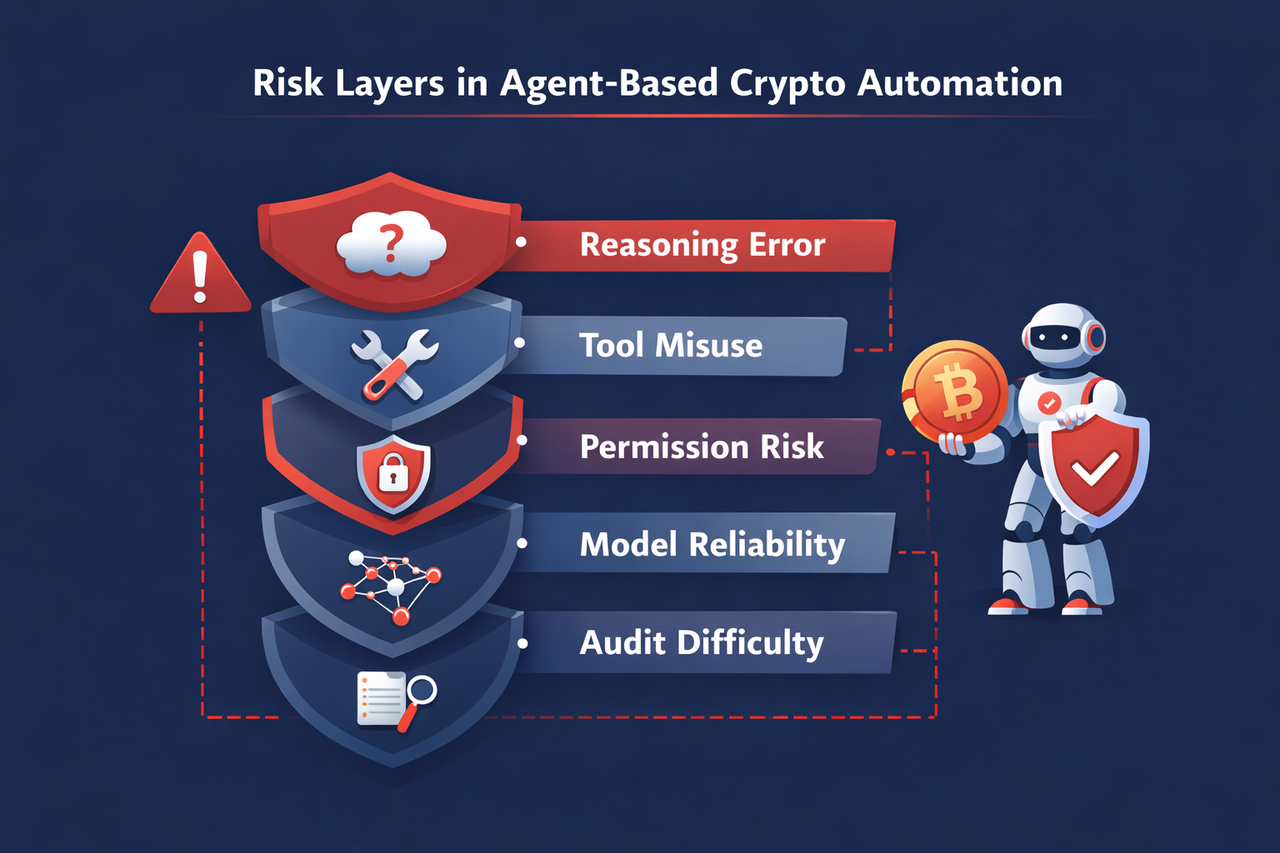
Risks of AI agents
-
Reasoning error: An agent may interpret goals or context incorrectly.
-
Tool misuse: Access to multiple tools increases operational complexity.
-
Permission risk: If wallet, trading, or payment permissions are too broad, the damage from mistakes may be greater.
-
Model unreliability: Output can vary depending on prompts, model behavior, and incomplete context.
-
Audit difficulty: It can be harder to trace exactly why an agent chose one path over another.
Infrastructure providers acknowledge these issues indirectly through emphasis on structured APIs, secure authorization, wallet protection, and isolated signing environments. Gate for AI highlights OAuth2 for private MCP tools and TEE-based wallet protection through Keygenix-related infrastructure, which suggests that secure control layers are a central requirement for agent-based finance. (GitHub)
Future Outlook of AI Agents and Crypto Trading Bots
The most likely near-term outcome is coexistence rather than full replacement. Traditional bots will probably remain common for narrow, deterministic strategies where clear rules are enough. They are relatively transparent, easier to test, and often more suitable for highly constrained execution tasks.
AI agents are more likely to expand in areas where crypto operations increasingly require multi-step coordination. As trading, wallet actions, payments, news analysis, and on-chain monitoring become more interconnected, agent systems may function as supervisory layers above simpler execution engines. In that model, an agent does not necessarily replace a bot; it may decide when to deploy one.
Infrastructure trends support that direction. Gate for AI positions its system around interoperable modules, MCP endpoints, and reusable skills, while Gate Pay for AI extends the same logic into programmable payments and agent-to-service transactions. That suggests a broader movement from isolated automation scripts toward connected financial tool ecosystems for AI systems.
Conclusion
The difference between AI agents and crypto trading bots lies mainly in scope, flexibility, and system design. A crypto trading bot is usually a rule-based executor built for a defined strategy. An AI agent is a goal-oriented system that can gather context, use multiple tools, and coordinate actions across research, execution, wallets, and information services.
In practical terms, bots are best understood as focused automation tools. AI agents are better understood as orchestration systems. As crypto environments become more complex and multi-layered, the value of agent-based systems may grow, but their added flexibility also introduces added operational and security risk. The clearest way to understand them is not as identical technologies with different labels, but as different levels of automation maturity.
FAQ
-
Are AI agents just more advanced trading bots?
Not exactly. Some AI agents can include trading-bot functions, but the two are not the same. A trading bot usually follows fixed rules, while an AI agent can interpret tasks, gather context, and choose among multiple tools or workflows.
-
Can a crypto trading bot use AI?
Yes. A bot can include AI-based forecasting or signal generation, but still remain a bot if its structure is mainly a fixed execution pipeline. The presence of AI in one component does not automatically make the whole system an agent.
-
Are AI agents always better than bots?
No. For narrow and repetitive tasks, a traditional bot may be more predictable and easier to control. AI agents are more useful when the task requires context gathering, cross-platform coordination, or flexible sequencing.
-
Why are AI agents becoming more relevant in crypto?
Crypto markets combine centralized venues, decentralized trading, wallets, real-time news, and on-chain analytics. That fragmentation makes tool coordination more important, which is where agent systems may provide an advantage.
-
Do AI agents remove trading risk?
No. They may improve information handling or workflow coordination, but they do not eliminate volatility, slippage, model error, tool failure, or security risk.
-
Can AI agents operate beyond trading?
Yes. Agent systems can also support wallet monitoring, token research, due diligence, risk screening, payment flows, and on-chain data analysis when connected to the right tools and permissions.