


MELD vs ETH: Which Cryptocurrency Offers Better Long-Term Growth Potential?
Introduction: MELD vs ETH Investment Comparison
In the cryptocurrency market, MELD vs ETH comparison has always been a topic that investors can't avoid. The two not only have significant differences in market cap ranking, application scenarios, and price performance, but also represent different cryptocurrency asset positioning.
MELD (MELD): Since its launch, it has gained market recognition for its focus on GameFi and NFT monetization.
Ethereum (ETH): Since 2015, it has been hailed as the foundation for decentralized applications and smart contracts, and is one of the cryptocurrencies with the highest global trading volume and market capitalization.
This article will comprehensively analyze the investment value comparison of MELD vs ETH, focusing on historical price trends, supply mechanisms, institutional adoption, technological ecosystems, and future predictions, and attempt to answer the question that investors care about most:
"Which is the better buy right now?"
I. Price History Comparison and Current Market Status
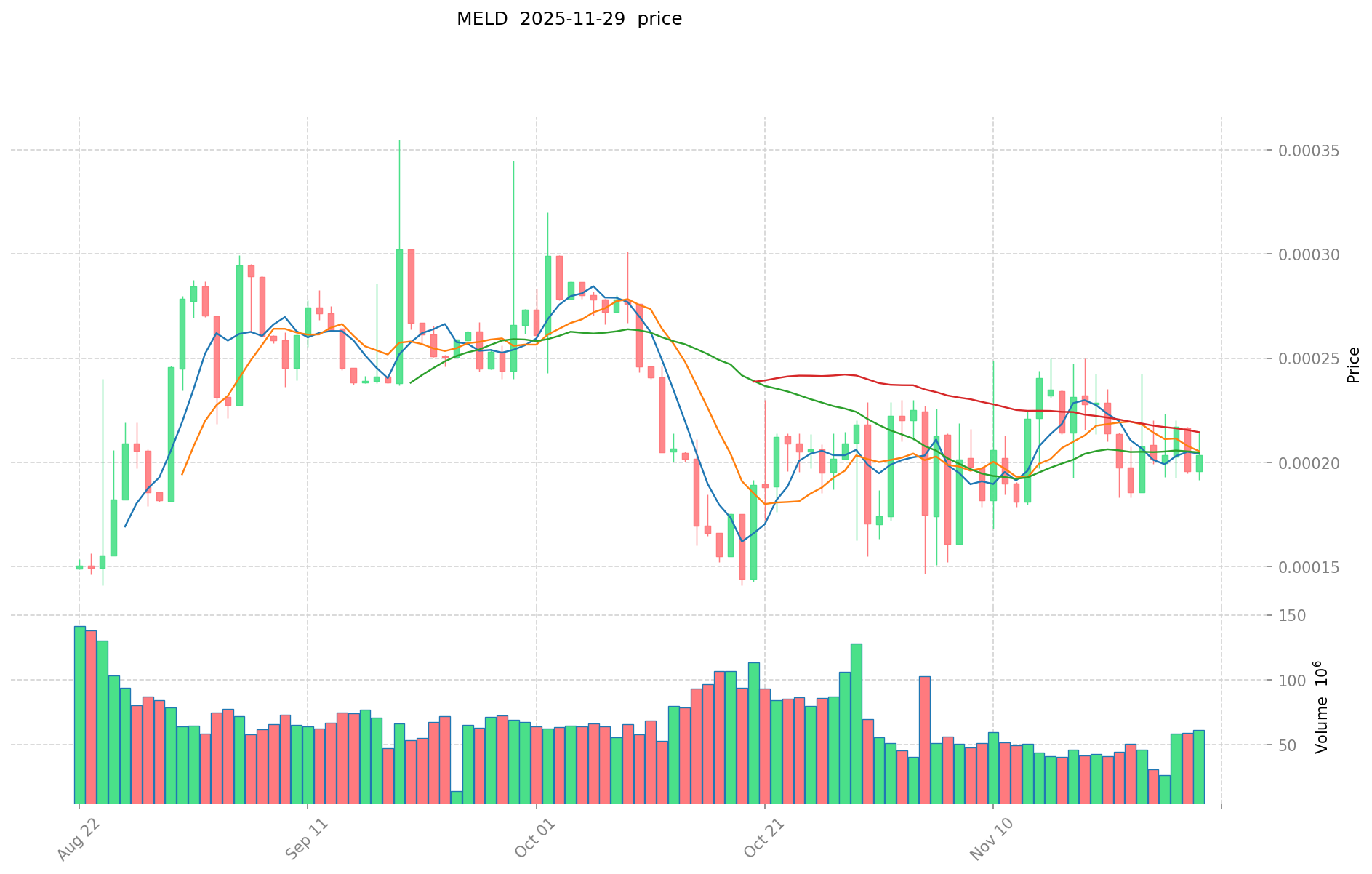
MELD (Coin A) and ETH (Coin B) Historical Price Trends
- 2024: MELD reached its all-time high of $0.102 on January 1, 2024.
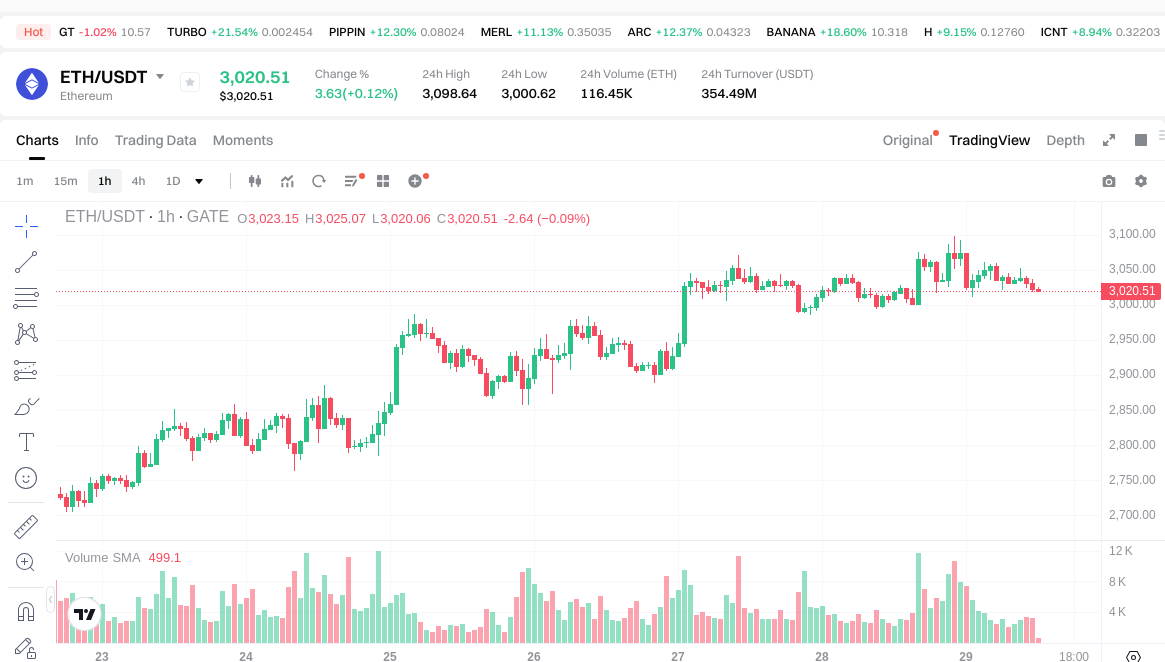
- 2025: ETH hit a new all-time high of $4,946.05 on August 25, 2025.
- Comparative analysis: In the recent market cycle, MELD dropped from its high of $0.102 to a low of $0.000042 on April 6, 2025, while ETH has shown more stability, currently trading at $3,024.04.
Current Market Situation (2025-11-29)
- MELD current price: $0.00020301
- ETH current price: $3,024.04
- 24-hour trading volume: MELD $12,805.11 vs ETH $354,636,676.19
- Market Sentiment Index (Fear & Greed Index): 28 (Fear)
Click to view real-time prices:
- View MELD current price Market Price
- View ETH current price Market Price
II. Key Factors Influencing Investment Value of MELD vs ETH
Supply Mechanisms Comparison (Tokenomics)
-
MELD: Fixed total supply of 4 billion tokens
-
ETH: Deflationary model after EIP-1559 implementation with burning mechanism
-
📌 Historical Pattern: Fixed supply tokens like MELD typically create scarcity value if demand increases, while ETH's deflationary mechanism has been shown to reduce net issuance, potentially supporting price over time.
Institutional Adoption and Market Applications
- Institutional Holdings: ETH has significantly higher institutional adoption, with established investment products like ETH ETFs and institutional staking services
- Enterprise Adoption: ETH dominates in enterprise blockchain solutions and powers thousands of dApps, while MELD is still developing its enterprise partnerships
- Regulatory Stance: ETH enjoys clearer regulatory status in most jurisdictions as a commodity, while newer tokens like MELD face more regulatory uncertainty
Technical Development and Ecosystem Building
- MELD Technical Focus: DeFi protocol connecting traditional banking with crypto, offering services like lending, borrowing, and fiat currency loans
- ETH Technical Development: Ongoing scaling solutions (L2s, sharding), already transitioned to energy-efficient Proof of Stake consensus
- Ecosystem Comparison: ETH has a mature ecosystem spanning DeFi, NFTs, payments and smart contracts with billions in TVL, while MELD is building a focused banking-crypto bridge ecosystem with fewer applications currently live
Macroeconomic Factors and Market Cycles
- Inflation Performance: ETH has demonstrated some store of value properties during inflationary periods, while MELD has insufficient historical data to evaluate
- Macroeconomic Monetary Policy: Interest rate changes tend to impact the entire crypto market, with ETH showing higher correlation to broader market movements than smaller altcoins
- Geopolitical Factors: ETH's global distribution and recognition provides resilience against regional restrictions, while newer tokens may face more barriers to cross-border adoption
III. 2025-2030 Price Prediction: MELD vs ETH
Short-term Prediction (2025)
- MELD: Conservative $0.000142079 - $0.00020297 | Optimistic $0.00020297 - $0.0002882174
- ETH: Conservative $1631.7126 - $3021.69 | Optimistic $3021.69 - $3565.5942
Mid-term Prediction (2027)
- MELD may enter a growth phase, with estimated price range $0.0001687228719 - $0.000368378270315
- ETH may enter a consolidation phase, with estimated price range $3439.22108082 - $3962.58081051
- Key drivers: Institutional inflows, ETF developments, ecosystem growth
Long-term Prediction (2030)
- MELD: Base scenario $0.000322835633823 - $0.000448382824754 | Optimistic scenario $0.000448382824754 - $0.000614284469914
- ETH: Base scenario $2976.78461054375352 - $4651.225953974614875 | Optimistic scenario $4651.225953974614875 - $4930.299511213091767
Disclaimer: This analysis is based on historical data and projections. Cryptocurrency markets are highly volatile and unpredictable. This information should not be considered as financial advice. Always conduct your own research before making investment decisions.
MELD:
| 年份 | 预测最高价 | 预测平均价格 | 预测最低价 | 涨跌幅 |
|---|---|---|---|---|
| 2025 | 0.0002882174 | 0.00020297 | 0.000142079 | 0 |
| 2026 | 0.000316815873 | 0.0002455937 | 0.000218578393 | 20 |
| 2027 | 0.000368378270315 | 0.0002812047865 | 0.0001687228719 | 38 |
| 2028 | 0.000444964393918 | 0.000324791528407 | 0.000308551951987 | 59 |
| 2029 | 0.000511887688346 | 0.000384877961162 | 0.000373331622328 | 89 |
| 2030 | 0.000614284469914 | 0.000448382824754 | 0.000322835633823 | 120 |
ETH:
| 年份 | 预测最高价 | 预测平均价格 | 预测最低价 | 涨跌幅 |
|---|---|---|---|---|
| 2025 | 3565.5942 | 3021.69 | 1631.7126 | 0 |
| 2026 | 4182.925467 | 3293.6421 | 2700.786522 | 8 |
| 2027 | 3962.58081051 | 3738.2837835 | 3439.22108082 | 23 |
| 2028 | 4967.05766313645 | 3850.432297005 | 3734.91932809485 | 27 |
| 2029 | 4893.70692787850475 | 4408.744980070725 | 2336.63483943748425 | 45 |
| 2030 | 4930.299511213091767 | 4651.225953974614875 | 2976.78461054375352 | 53 |
IV. Investment Strategy Comparison: MELD vs ETH
Long-term vs Short-term Investment Strategy
- MELD: Suitable for investors focused on DeFi innovations and banking-crypto integration
- ETH: Suitable for investors seeking stability, ecosystem growth, and potential store of value
Risk Management and Asset Allocation
- Conservative investors: MELD: 5% vs ETH: 95%
- Aggressive investors: MELD: 20% vs ETH: 80%
- Hedging tools: Stablecoin allocation, options, cross-currency portfolio
V. Potential Risk Comparison
Market Risk
- MELD: Higher volatility, lower liquidity, and potential for rapid price swings
- ETH: Correlation with broader crypto market, susceptible to macro-economic factors
Technical Risk
- MELD: Scalability, network stability, and smart contract vulnerabilities
- ETH: Network congestion, high gas fees during peak usage
Regulatory Risk
- Global regulatory policies may have different impacts on both, with ETH having a more established regulatory stance in many jurisdictions
VI. Conclusion: Which Is the Better Buy?
📌 Investment Value Summary:
- MELD advantages: Innovative DeFi protocol, potential for high growth, focus on banking-crypto integration
- ETH advantages: Established ecosystem, institutional adoption, deflationary mechanism, ongoing technical improvements
✅ Investment Advice:
- New investors: Consider allocating a larger portion to ETH for its stability and established market position
- Experienced investors: Diversify with a mix of ETH and a smaller allocation to MELD for potential high-risk, high-reward opportunities
- Institutional investors: Focus on ETH for its liquidity, regulatory clarity, and ecosystem dominance
⚠️ Risk Warning: The cryptocurrency market is highly volatile. This article does not constitute investment advice. None
VII. FAQ
Q1: What are the main differences between MELD and ETH? A: MELD is a newer DeFi protocol focused on connecting traditional banking with crypto, while ETH is an established blockchain platform for decentralized applications. ETH has a larger market cap, higher trading volume, and a more developed ecosystem.
Q2: Which cryptocurrency has shown more price stability? A: Ethereum (ETH) has demonstrated more price stability compared to MELD. ETH is currently trading at $3,024.04, while MELD has experienced more significant price fluctuations.
Q3: How do the supply mechanisms of MELD and ETH differ? A: MELD has a fixed total supply of 4 billion tokens, while ETH follows a deflationary model after the implementation of EIP-1559, which includes a token burning mechanism.
Q4: Which cryptocurrency has higher institutional adoption? A: Ethereum (ETH) has significantly higher institutional adoption, with established investment products like ETH ETFs and institutional staking services. It also enjoys clearer regulatory status in most jurisdictions.
Q5: What are the key factors influencing the investment value of MELD and ETH? A: Key factors include supply mechanisms, institutional adoption, market applications, technical development, ecosystem building, and macroeconomic factors such as inflation performance and geopolitical considerations.
Q6: What are the potential risks associated with investing in MELD and ETH? A: Both face market risks, but MELD has higher volatility and lower liquidity. Technical risks include scalability and network stability for MELD, and network congestion for ETH. Regulatory risks may impact both, with ETH having a more established regulatory stance.
Q7: How should investors approach allocating between MELD and ETH? A: Conservative investors might consider allocating 5% to MELD and 95% to ETH, while more aggressive investors could allocate 20% to MELD and 80% to ETH. New investors may want to focus more on ETH for its stability, while experienced investors might diversify with a mix of both.
Share
Content
Introduction: MELD vs ETH Investment Comparison
I. Price History Comparison and Current Market Status
II. Key Factors Influencing Investment Value of MELD vs ETH
III. 2025-2030 Price Prediction: MELD vs ETH
IV. Investment Strategy Comparison: MELD vs ETH
V. Potential Risk Comparison
VI. Conclusion: Which Is the Better Buy?
VII. FAQ


