
Ethereum Liquidity Staking Protocol Lido released its 2025 annual report on Tuesday, revealing that total revenue for the year dropped to $40.5 million, a 23% decrease from $52.4 million in 2024. The report pointed out that the decline was primarily driven by two structural factors: net staking fund outflows (users actively withdrawing assets) and the continuous compression of the network-wide annual percentage rate (APR).
Dual Causes of Revenue Decline
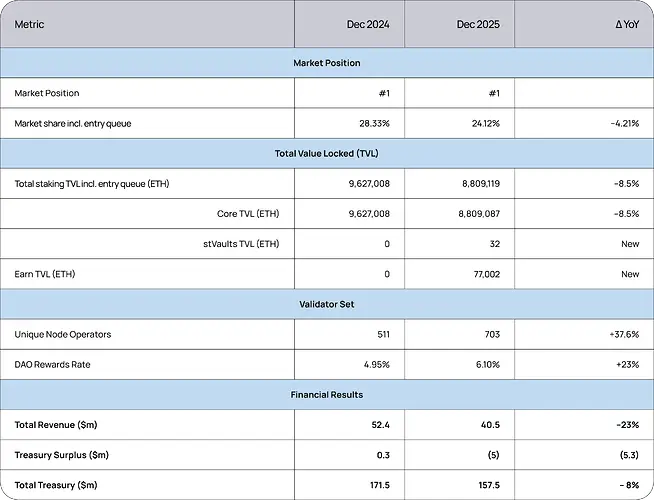 (Source: Lido Research)
Lido explicitly identified two revenue decline pathways in its annual report. First, net staking fund outflows directly reduce the protocol’s management scale, narrowing the pool of distributable staking rewards; second, the compression of the network APR results from the increasing number of Ethereum validators, which dilutes individual stakers’ yields and further reduces the incentive for new funds to enter the protocol.
The report states that in 2025, the Ethereum staking market experienced a “structural shift”: network APR compression, funds shifting from Simple LST to exchanges and institutional staking, and intensified competition collectively shrank the overall size of Lido’s niche market. Lido emphasizes that this is not merely a redistribution of market share but a contraction of its most robust segment itself.
Three Main Directions of LST Market Fund Migration
According to Lido’s annual report, funds originally belonging to the Simple LST segment are shifting toward the following channels:
Exchange Staking: Centralized exchanges offer a one-stop operation experience, attracting retail funds to transfer
Institutional Low-Risk Staking: Institutional investors prefer regulated, operationally controllable staking channels rather than on-chain protocols
High APR Pursuit Market (APR-maxis): Some users are turning to higher-yield strategies, seeking staking returns that surpass the market average
These migration trends pose dual pressures on Lido: not only eroding its existing user base but also compressing the space for rebuilding growth within its original market.
Transformation Strategies: Layoffs, LDO Buybacks, and Institutional Deployment
Facing ongoing revenue pressures, Lido completed a 15% layoff in August 2025 to ensure long-term financial sustainability. The protocol also clearly stated that its core strategy for 2025 is to expand beyond core staking and to launch differentiated products for institutional investors and high-yield users.
In terms of token buybacks, Lido is evaluating initiating an LDO token repurchase plan, expected to be executed in Q2 2026. According to the proposed plan, staking rewards generated by the protocol will be used to buy back LDO tokens from the open market and deploy them into DAO-held LDO/wstETH liquidity positions, creating a cycle of protocol revenue and token demand. The final plan is subject to DAO governance approval.
In the institutional market, WisdomTree, with an asset management scale of $140 billion, has launched an Ethereum ETF in Europe using the Lido decentralized protocol as the staking reward source, becoming the first significant example of Lido’s institutional layout.
Frequently Asked Questions
Why did Lido’s revenue decline in 2025?
Lido’s annual report points out two core reasons: user asset withdrawals leading to net outflows of staked funds, reducing management scale; and the continuous compression of network staking yields (APR) due to increasing validator numbers, shrinking the protocol’s reward pool. Both effects combined caused total revenue to decrease by 23% compared to 2024.
How does the LDO token buyback plan work?
According to Lido’s disclosed proposal, the protocol will use the generated staking rewards to buy back LDO tokens from the open market and deploy the repurchased tokens into DAO-held LDO/wstETH liquidity positions. The plan is expected to start in Q2 2026, with final approval pending DAO governance processes.
What is the significance of WisdomTree’s cooperation with Lido?
WisdomTree, with an asset management scale of about $140 billion, launched an Ethereum ETP in Europe using the Lido protocol as the staking reward source. This marks the first major case where a traditional asset management institution uses a decentralized staking protocol as the underlying infrastructure for an ETP, signifying substantial progress in Lido’s institutional market deployment.
Отказ от ответственности: Информация на этой странице может поступать от третьих лиц и не отражает взгляды или мнения Gate. Содержание, представленное на этой странице, предназначено исключительно для справки и не является финансовой, инвестиционной или юридической консультацией. Gate не гарантирует точность или полноту информации и не несет ответственности за любые убытки, возникшие от использования этой информации. Инвестиции в виртуальные активы несут высокие риски и подвержены значительной ценовой волатильности. Вы можете потерять весь инвестированный капитал. Пожалуйста, полностью понимайте соответствующие риски и принимайте разумные решения, исходя из собственного финансового положения и толерантности к риску. Для получения подробностей, пожалуйста, обратитесь к
Отказу от ответственности.
Связанные статьи
Sui запускает нативный стейблкоин USDsui в масштабах экосистемы DeFi
Блокчейн Sui запустил свою нативную стейблкоин-монету USDsui — теперь она интегрирована в различные цифровые кошельки и приложения DeFi. Этот запуск усиливает инфраструктуру DeFi Sui, облегчая одноранговое кредитование и автоматизированную торговлю, при этом снижая зависимость от внешних стейблкоинов. Успех зависит от широкого внедрения в экосистеме.
GateNews1ч назад
Atlas выходит в сеть на Rootstock с поддержкой BTC, ETH, USDC и многого другого
Rootstocklabs запустила Atlas — единый интерфейс для перевода биткоина и других активов в Rootstock, сеть Bitcoin layer two ( L2), которая работает с 2018 года.
Ключевые выводы:
Rootstocklabs запустила Atlas 15 апреля 2026 года, объединив BTC-бриджинг в одном интерфейсе для всех пользователей.
B
Coinpedia1ч назад
Chaos W от Nexters и Velop превысила 470 тыс. предварительных регистраций перед запуском во II квартале
Nexters и Velop объявили, что их мобильная MMORPG Chaos W превысила 470 000 предварительных регистраций до запуска во II квартале 2026 года. Гибридная модель игры сочетает элементы RTS и RPG, использует экономику с фиксированным предложением и предлагает доступную предварительную регистрацию через Telegram, стремясь к росту на глобальном рынке.
GateNews2ч назад
Uniswap Labs запускает платформу для разработчиков с инструментами ИИ и расширенным доступом к API на 18 блокчейнах
Uniswap Labs запустила платформу для разработчиков, предлагающую инструменты для интеграции DeFi, включая AI-набор инструментов, песочницу API и функции управления ликвидностью. Платформа, которой пользуются более 500 000 разработчиков для доступа к ресурсам, стремится упростить интеграцию и расширить возможности разработчиков.
GateNews2ч назад
Анализ цены Шиба-ину: инновации Layer 3 и бычий импульс впереди
Шиба-ину демонстрирует признаки восстановления: ключевая поддержка удерживается, а объем торгов растет.
Обновления Shibarium и Layer-3 усиливают полезность, конфиденциальность и расширение экосистемы по всей сети.
Механизмы сжигания и холдинги, связанные с правительством, привлекают внимание и поддерживают интерес к рынку в долгосрочной перспективе.
Шиба-ину
CryptoNewsLand3ч назад
Предложение Космической сети об интеграции Osmosis проваливает голосование по управлению; Osmosis продолжит работу как независимая блокчейн-сеть
Предложение Космической сети (Cosmos Hub) об интеграции Osmosis провалилось с минимальным перевесом, при этом Osmosis признала итог. Команда сохранит независимость, сосредоточившись на безопасности пользователей и продвижении своей дорожной карты. Дальнейшие обновления последуют.
GateNews4ч назад


