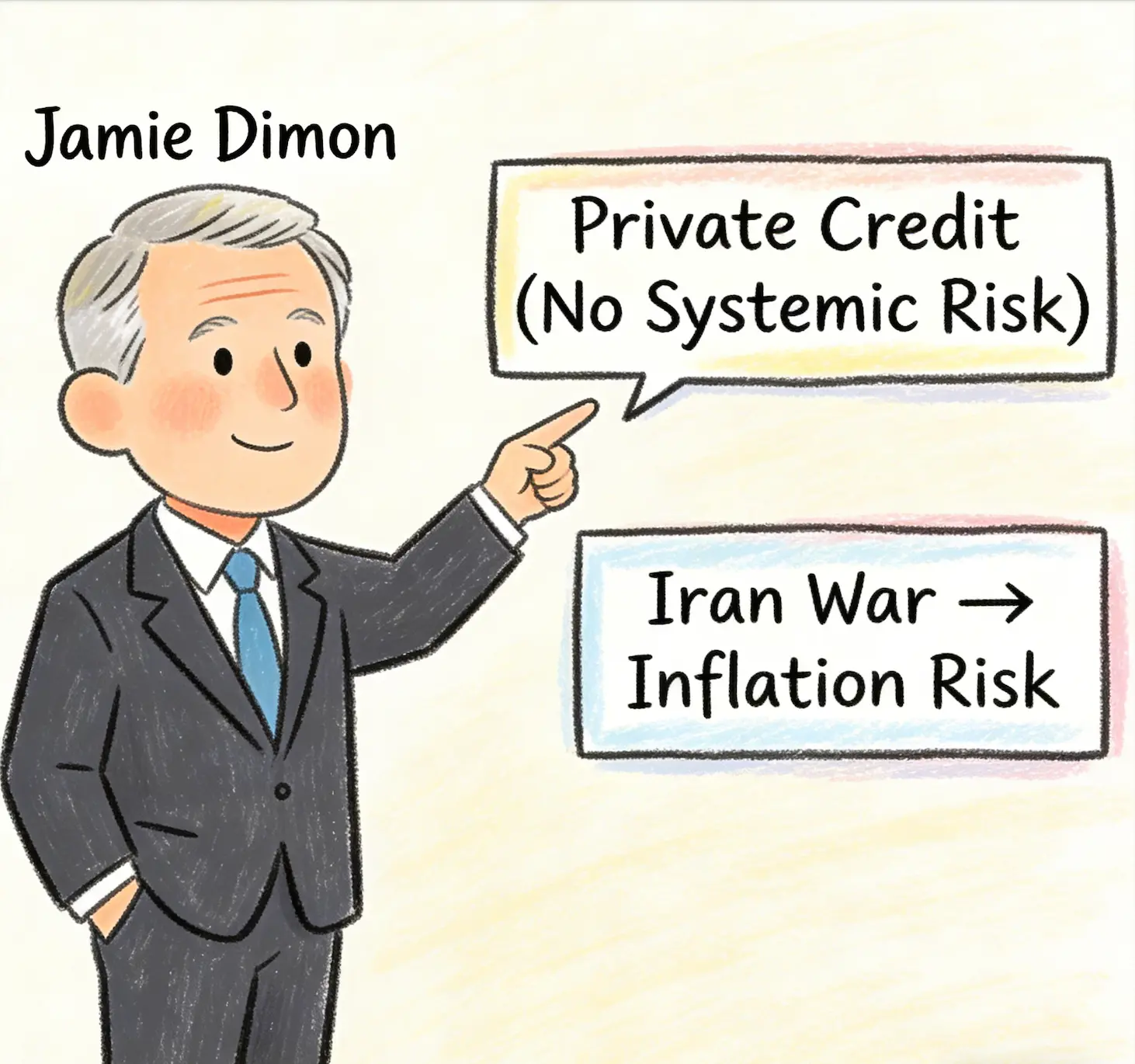
 In his annual letter to shareholders released on April 6, 2026, JPMorgan Chase CEO Jamie Dimon downplayed the threat of a private credit meltdown, stating the $1.8 trillion leveraged private credit market likely does not present systemic risk, while warning that the war in Iran could drive oil shocks, sticky inflation, and higher interest rates than markets currently expect.
Dimon also sharply criticized revised U.S. bank capital rules as “very flawed” and “nonsensical,” and reiterated that artificial intelligence adoption is transformational but its ultimate winners and losers remain uncertain.
Private Credit Market Does Not Pose Systemic Risk, Dimon Says
Dimon noted that the leveraged private credit market totals $1.8 trillion, compared to $13 trillion in investment-grade bonds and another $13 trillion in residential mortgage securities and loans. “In the great scheme of things, private credit probably does not present a systemic risk,” he wrote.
However, Dimon acknowledged that a credit downturn, “which will happen one day,” will lead to “higher than expected” losses on all leveraged lending because credit standards have been modestly weakening across the board. He also warned that private credit generally lacks great transparency or rigorous valuation “marks” of loans, increasing the chance that investors will sell if they perceive the environment worsening, even if actual realized losses barely change.
The comments came on the same day that Goldman Sachs disclosed that repurchase requests in its private credit funds represented less than 5% of shares as of December 31, 2025, below its quarterly repurchase cap, signaling no investor panic. Meanwhile, Blue Owl last week told investors it was limiting withdrawals from two funds after a historic level of first-quarter redemption requests, with AI-related worries driving an exodus from its technology-focused fund.
Iran War Risks Oil Shocks, Sticky Inflation, and Higher Rates
Dimon warned that the war in Iran risks significant ongoing oil and commodity price shocks, along with the reshaping of global supply chains, which may lead to stickier inflation and ultimately higher interest rates than markets currently expect. War-driven inflation worries have led markets to largely rule out interest rate cuts in 2026, after monetary easing fueled record equity highs in 2025.
The benchmark S&P 500 index closed its worst-performing quarter since 2022, weighed down since late February by the war and the resulting spurt in energy prices. Dimon said the U.S. economy continues to be resilient, with consumers still earning and spending (though with some recent weakening) and businesses still healthy. However, he cautioned that the economy has been fueled by large amounts of government deficit spending and past stimulus, while increased infrastructure expenditure remains a growing need.
The fiscal stimulus from President Donald Trump’s “Big, Beautiful Bill,” deregulation policies, and AI-driven capital spending are other positives for the economy, Dimon added. But geopolitical risks—including the war in Ukraine, broader hostilities in the Middle East, and tensions with China—remain significant challenges. “The outcome of current geopolitical events may very well be the defining factor in how the future global economic order unfolds,” he said.
Dimon Calls Revised Bank Capital Rules ‘Very Flawed’ and ‘Un-American’
Dimon sharply criticized revised capital rules proposed by U.S. bank regulators last month, stating that while the proposals reduced the required capital increase from 2023 drafts, some aspects remain “frankly nonsensical.” He specifically cited the Global Systemically Important Bank (GSIB) surcharge, which he said would require JPMorgan to hold as much as 50% more capital across the vast majority of loans to U.S. consumers and businesses compared to a large non-GSIB bank for the same loans.
“Frankly, it’s not right, and it’s un-American,” Dimon wrote. He said the aggregate proposed surcharges of about 5% punish the bank’s success and are “absurd.” Dimon also criticized capital and liquidity requirements, the Federal Reserve’s stress test construction, and what he called a “badly handled” process at the Federal Deposit Insurance Corporation.
AI Adoption Transformational but Winners and Losers Uncertain
Dimon reiterated that the pace of AI adoption is unlike any technology before it. While its implementation will be “transformational,” it remains to be seen how the AI revolution will unfold. “Overall, the investment in AI is not a speculative bubble; rather, it will deliver significant benefits. However, at this time, we cannot predict the ultimate winners and losers in AI-related industries,” he said.
JPMorgan has been at the forefront of Wall Street firms introducing AI at every level of its business. In February, Dimon said AI was reshaping JPMorgan’s workforce and that the bank had “huge redeployment plans” for employees. “We have focused on some of the ‘known and predictable’ and some of the ‘known unknown’ events. But huge technological shifts like AI always have second- and third-order effects as well that can deeply impact society. We should be monitoring for this kind of transformation, too,” he added.
FAQ
Does Jamie Dimon believe private credit poses a systemic risk to the financial system?
No. Dimon stated that the $1.8 trillion private credit market is relatively small compared to $13 trillion in investment-grade bonds and $13 trillion in residential mortgage securities, and therefore “probably does not present a systemic risk.” However, he warned that when a credit downturn occurs, losses on leveraged lending will be higher than expected due to weakening credit standards and lack of transparency.
How does the Iran war affect Dimon’s outlook on inflation and interest rates?
Dimon warned that the war risks significant oil and commodity price shocks, reshaping global supply chains, leading to stickier inflation and ultimately higher interest rates than markets currently expect. He noted that war-driven inflation worries have led markets to largely rule out rate cuts in 2026.
What is Dimon’s criticism of the revised bank capital rules?
Dimon called aspects of the revised Basel III Endgame and GSIB surcharge proposals “nonsensical” and “un-American,” arguing that the GSIB surcharge would require JPMorgan to hold as much as 50% more capital for the same loans as a large non-GSIB bank. He said the proposals remain “very flawed” despite improvements from 2023 drafts.
Disclaimer: The information on this page may come from third parties and does not represent the views or opinions of Gate. The content displayed on this page is for reference only and does not constitute any financial, investment, or legal advice. Gate does not guarantee the accuracy or completeness of the information and shall not be liable for any losses arising from the use of this information. Virtual asset investments carry high risks and are subject to significant price volatility. You may lose all of your invested principal. Please fully understand the relevant risks and make prudent decisions based on your own financial situation and risk tolerance. For details, please refer to
Disclaimer.


