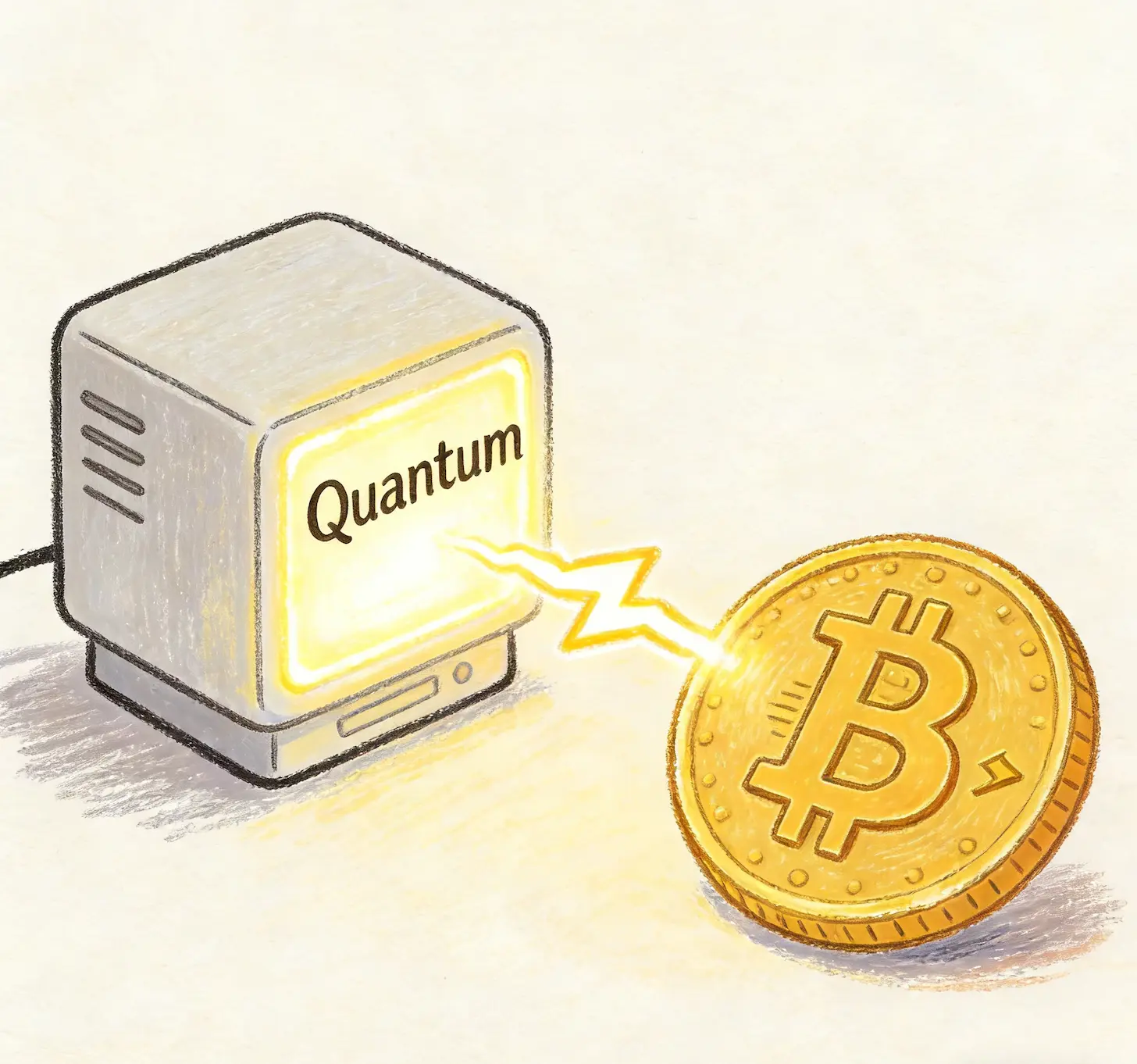
 A team from Caltech and startup Oratomic published research on March 31, 2026 demonstrating that a fault-tolerant quantum computer capable of running Shor’s algorithm could be built with as few as 10,000 physical qubits, dramatically reducing previous estimates that placed the requirement at one million qubits or higher.
The finding, combined with Google Quantum AI’s simultaneous mapping of approximately 6.7 million Bitcoin sitting in addresses vulnerable to quantum at-rest attacks, compresses the timeline for when quantum machines could threaten blockchain cryptography and challenges the assumption that the quantum threat remains decades away.
Quantum Error-Correction Architecture Reduces Physical Qubit Requirements by Factor of 200
The Caltech team’s new error-correction architecture exploits the unique properties of neutral atom quantum computing platforms, where laser-based optical tweezers can physically move atoms across qubit arrays, enabling long-range entanglement and high-rate error-correction codes. This approach cuts the physical-to-logical qubit ratio from approximately 1,000-to-1 down to roughly 5-to-1.
Breaking Bitcoin’s elliptic curve cryptography requires approximately 2,100 logical qubits. Under previous error-correction models requiring 1,000 physical qubits per logical qubit, the total hardware requirement was approximately 2.1 million physical qubits. The Caltech architecture reduces that requirement to approximately 10,500 physical qubits—less than double the 6,100-atom array that Caltech professor Manuel Endres already built in his laboratory.
Caltech’s Richard P. Feynman Professor of Theoretical Physics John Preskill, who has worked on fault-tolerant quantum computing for decades, stated that the field is finally getting close to its goal. The researchers have founded Oratomic to commercialize their architecture and aim to build utility-scale fault-tolerant quantum computers before the decade ends.
Google Quantum AI Maps 6.7 Million Bitcoin Vulnerable to Quantum Attack
One day prior to the Caltech announcement, Google Quantum AI published a whitepaper mapping Bitcoin’s quantum attack surface, identifying approximately 6.7 million BTC sitting in addresses vulnerable to at-rest attacks. These include Pay-to-Public-Key addresses from Bitcoin’s earliest mining era, in which public keys are permanently exposed on the blockchain.
Around 1.7 million Bitcoin are locked in Pay-to-Public-Key scripts alone, many held in dormant wallets including coins widely attributed to Satoshi Nakamoto. As Deloitte’s analysis has noted, these addresses cannot be upgraded or migrated to post-quantum cryptography because the public keys are permanently exposed on the blockchain.
A quantum computer running Shor’s algorithm could derive private keys from those exposed public keys and drain the funds. The mapping establishes a concrete vulnerability metric that was previously theoretical, giving the Bitcoin community a quantifiable understanding of assets at risk.
Governance, Not Technology, Emerges as Critical Bottleneck
CryptoQuant CEO Ki Young Ju has argued that reaching consensus within the Bitcoin community on how to handle vulnerable coins—particularly the potential freezing of Satoshi’s estimated one million Bitcoin—could prove far more difficult than writing new code. The block size debate lasted over three years and produced hard forks, and a proposal to freeze dormant coins would likely face similar or greater resistance.
The Caltech paper removes the comfortable assumption that the community has decades to figure out a response. While the research does not solve the governance problem, it compresses the timeline for when the Bitcoin ecosystem must address the quantum threat. The researchers noted that the accelerated timeline indicates that the security of digital communications, including financial transactions, could be vulnerable to data breaches sooner than expected.
FAQ
What quantum computing breakthrough did Caltech researchers achieve?
Caltech researchers developed a new quantum error-correction architecture that reduces the physical qubit requirement for a fault-tolerant quantum computer from approximately one million qubits to as few as 10,000 qubits. The approach exploits the ability of neutral atom qubits to be physically moved across arrays using optical tweezers, enabling high-rate error-correction codes.
How many Bitcoin are vulnerable to quantum attack**?**
Google Quantum AI identified approximately 6.7 million Bitcoin sitting in addresses vulnerable to quantum at-rest attacks, including Pay-to-Public-Key addresses from Bitcoin’s earliest mining era where public keys are permanently exposed on the blockchain. Approximately 1.7 million Bitcoin are locked in Pay-to-Public-Key scripts alone.
What is the timeline for quantum threat to Bitcoin?
Previous estimates placed the quantum threat 30 to 50 years away based on physical qubit requirements of approximately 21 million. The Caltech research compresses that timeline significantly by showing useful quantum computers could be built with as few as 10,000 qubits by the end of the decade, though governance challenges around vulnerable Bitcoin addresses may prove more difficult to resolve than technical migration.
Disclaimer: The information on this page may come from third parties and does not represent the views or opinions of Gate. The content displayed on this page is for reference only and does not constitute any financial, investment, or legal advice. Gate does not guarantee the accuracy or completeness of the information and shall not be liable for any losses arising from the use of this information. Virtual asset investments carry high risks and are subject to significant price volatility. You may lose all of your invested principal. Please fully understand the relevant risks and make prudent decisions based on your own financial situation and risk tolerance. For details, please refer to
Disclaimer.


