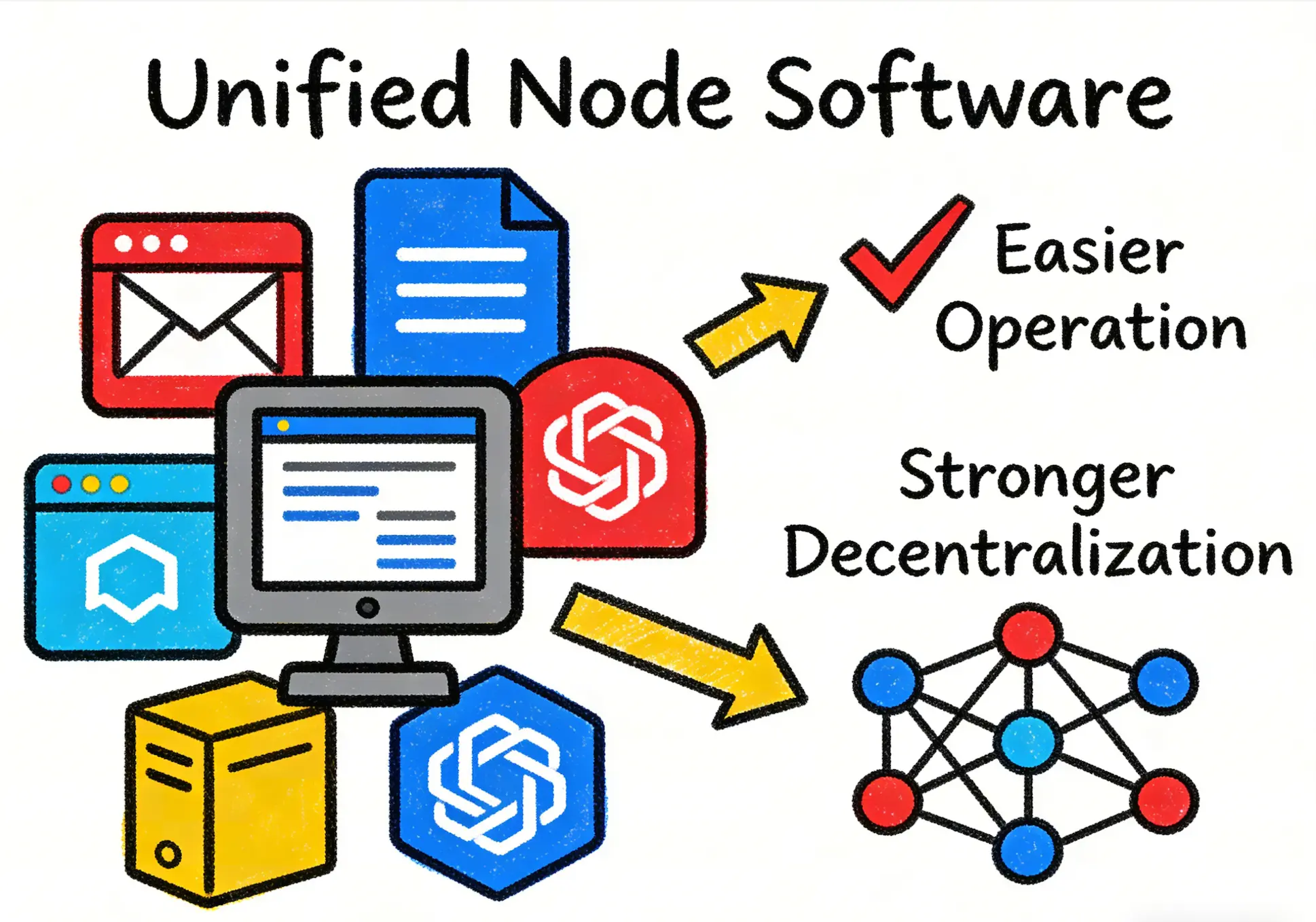
 Ethereum co-founder Vitalik Buterin submitted a pull request on March 15, 2026, proposing to merge the backend programs powering Ethereum’s Beacon Chain consensus layer and execution layer into a single unified codebase.
The proposal aims to reduce the technical complexity of running an Ethereum node, currently requiring validators to operate two separate software stacks, and enable broader individual participation in network validation rather than reliance on third-party remote procedure call (RPC) providers.
If implemented, the consolidation would eliminate the need for node operators to manage parallel synchronization and communication between Ethereum’s consensus and execution layers, addressing long-standing criticism that hardware requirements and technical overhead have concentrated validation power among professional operators.
Technical Proposal: Unifying Ethereum’s Dual-Layer Architecture
Current Node Operation Requirements
Ethereum validators must currently run two separate programs:
Each component requires independent setup, configuration, and ongoing synchronization to coordinate data transmission between layers. Misalignment between the two stacks can complicate maintenance and compromise node uptime.
Proposed Consolidation
Buterin’s pull request would integrate both functions into a single codebase, streamlining node setup and reducing the technical expertise required for operation. The unified structure would maintain all existing network functionality while eliminating the coordination overhead inherent in dual-stack architectures.
Decentralization Rationale: Individual Participation as Network Priority
Buterin’s Stated Position
In a post on X accompanying the proposal, Buterin argued that node operation has been unnecessarily framed as a specialized task appropriate only for professionals:
“I feel like at every level, we have implicitly made this decision that running a node is this oh so scary DevOps task that it is ok to leave to professionals. It is not. We need to reverse this. Running your own Ethereum infrastructure should be the basic right of every individual and household. ‘The hardware requirement is high, therefore it’s okay for the DevOps skill and time requirements to also be high,’ is not an excuse.”
Even users capable of affording high-end node hardware typically lack the time for complex setup and maintenance, Buterin added, emphasizing that “nodes should be easy.”
Centralization Concerns with RPC Providers
The proposal addresses growing concerns about reliance on remote procedure call (RPC) providers, which currently handle a significant portion of Ethereum node traffic. A market structure dominated by a few RPC services faces “strong pressure to deplatform or censor users,” according to Buterin, who noted that “many RPC providers already exclude entire countries.”
Independent node operators can verify transactions and participate in governance without depending on external services, enhancing network resilience against geopolitical or policy-driven access restrictions.
Related Infrastructure Initiatives: Partially Stateless Nodes
May 2025 Proposal
Buterin previously proposed partially stateless nodes in May 2025 as a complementary approach to reducing node operational barriers. This architecture allows nodes to operate without maintaining full blockchain history, retaining only data required for specific user tasks.
Hardware Requirement Reduction
Disk space represents the primary bottleneck for node operators according to Go-Ethereum (GETH). Smart contract blockchains generate substantial data requiring ever-increasing storage capacity, making specialized hardware a practical necessity. Partial statelessness would lower storage requirements by enabling nodes to keep delta-state information relevant to user interactions rather than the complete chain state, potentially expanding the pool of participants who can run local infrastructure.
Ethereum Foundation Funding and Strategic Direction
Personal Commitment to Infrastructure Development
In late January 2026, Buterin disclosed setting aside 16,384 Ether (approximately $45 million at the time) from personal holdings to support:
-
Privacy-preserving technologies
-
Open hardware initiatives
-
Secure and verifiable software development
Deployment Timeline and Foundation Context
The funds will be deployed gradually over coming years as the Ethereum Foundation enters a period described as “mild austerity” while continuing to pursue its technical roadmap. This financial commitment underscores longer-term strategy to fortify core infrastructure and align research with inclusive, privacy-conscious ecosystem development.
Implications for Network Accessibility and Security
Potential Validator Pool Expansion
Consolidating Ethereum’s two layers into one coherent codebase could simplify maintenance, reduce misconfiguration risks, and accelerate update deployment across the network. If the change reduces node operation complexity, more users may validate and participate directly in consensus, potentially enhancing network security through diversified validator sets.
Balance Considerations
The proposal navigates ongoing tension between decentralization ideals and practical hardware, bandwidth, and maintenance realities. Critics have long noted that technical complexity and hardware requirements for node operation raise centralization concerns, as validation power concentrates among those who can afford specialized setups and professional expertise.
Frequently Asked Questions
How would unifying Ethereum’s node software simplify operation?
Currently, Ethereum validators must run two separate programs—one for the Beacon Chain consensus layer and one for the execution layer—each requiring independent setup and ongoing synchronization. Buterin’s proposed consolidation would merge both into a single codebase, eliminating the need to manage parallel stacks and reducing the technical expertise required for node operation. This streamlines maintenance while maintaining all existing network functionality.
What are partially stateless nodes and how do they differ from full nodes?
Partially stateless nodes do not maintain complete blockchain history, instead retaining only data necessary for specific user tasks such as sending transactions or verifying the blockchain. This architecture reduces disk space and storage requirements, which currently represent the primary bottleneck for node operators. By lowering hardware barriers, more users could run local nodes for transaction validation and block verification, contributing to network decentralization.
Why does Vitalik Buterin emphasize individual node operation over RPC provider reliance?
Buterin argues that dependence on a small number of remote procedure call (RPC) providers creates centralization risks, including potential deplatforming or censorship if providers restrict access for geopolitical or policy reasons. Individual node operators can verify transactions and participate in governance without relying on external services, enhancing network resilience. His proposal aims to make self-hosted infrastructure accessible to individuals and households, framing node operation as a basic right rather than a professional specialty.
Disclaimer: The information on this page may come from third parties and does not represent the views or opinions of Gate. The content displayed on this page is for reference only and does not constitute any financial, investment, or legal advice. Gate does not guarantee the accuracy or completeness of the information and shall not be liable for any losses arising from the use of this information. Virtual asset investments carry high risks and are subject to significant price volatility. You may lose all of your invested principal. Please fully understand the relevant risks and make prudent decisions based on your own financial situation and risk tolerance. For details, please refer to
Disclaimer.
Gerelateerde artikelen
ETH and Altcoins Could See Parabolic Surge Upon Following Bullish Russell 2000 ATH Path
ETH and altcoins coils see parabolic surge upon following a bullish indicators.
The Russell 2000 just set a new ATH at 2,798 for the first time.
This new ATH indicator is a bullish signal for altcoins.
The crypto community is pleased to see that both BTC and ETH are trading at higher
CryptoNewsLand43m geleden
Bitmine 单周增持超 10 万枚 ETH,距「5% 以太坊总供应量」目标再进一步
Bitmine 单周增持 101,627 枚 ETH,总持仓逼近 500 万枚。本文解析企业级 ETH 囤积的质押收益逻辑、机构化趋势及其对以太坊供应结构的影响。
GateInstantTrends1u geleden
Arbitrum Security Council Freezes 30,766 ETH From KelpDAO Exploit, 9 of 12 Members Vote in Favor
Arbitrum froze 30,766 ETH from the KelpDAO hack, worked with law enforcement, and recovered about a quarter of assets, while locking funds pending governance amid decentralization versus security debates.
Abstract: This article reports that the Arbitrum Security Council froze 30,766 ETH (about $70 million) tied to the KelpDAO exploit, with nine of twelve votes, and moved funds to a secure wallet in coordination with law enforcement. The operation targeted only affected assets to minimize network disruption. The exploiter is suspected to be DPRK-associated. The breach began April 18 via a LayerZero-powered bridge, draining 116,500 rsETH (~$292 million). About a quarter of stolen assets have been recovered. The frozen funds will remain locked until governance and legal authorities decide the next steps, prompting debate over decentralization versus security.
GateNews1u geleden
Tether Mints 1 Billion USDT on Ethereum
Gate News message, April 21 — According to Onchain Lens, Tether minted 1 billion USDT on Ethereum eight minutes ago.
GateNews2u geleden
OCBC Launches GOLDX Tokenized Gold Fund on Ethereum and Solana
OCBC launches GOLDX, a tokenized physical gold fund on Ethereum and Solana with Lion Global Investors and DigiFT, targeting institutions and Web3 participants; tokenized RWAs reach $29B on chains.
OCBC, with Lion Global Investors and DigiFT, introduced GOLDX, a tokenized version of the LionGlobal Singapore Physical Gold Fund on Ethereum and Solana. The product targets institutional investors and high‑net‑worth individuals, allowing purchases with stablecoins or fiat and delivery to blockchain wallets, providing on‑chain exposure to about $525 million in gold assets. OCBC views GOLDX as a milestone linking traditional finance with the decentralized finance ecosystem to attract Web3 participants. The broader context shows rapid growth in tokenized real‑world assets, with RWAs on public blockchains exceeding $29 billion by mid‑April 2026, while gold prices traded in a tight range around $4,775–$4,831 per ounce.
GateNews2u geleden
Bitmine 上週購入 101627 枚 ETH!Tom Lee:加密寒冬接近結束
Bitmine Immersion Technologies(BMNR)於 4 月 20 日宣布,上週購入 101,627 枚以太坊(ETH),為該公司 2026 年以來最大單週購買,使其 ETH 總持倉量增至 4,976,000 枚。Bitmine 董事長 Tom Lee 公開表示,加密貨幣寒冬比市場預期更接近結束。
MarketWhisper5u geleden


