President Trump announced this morning that a 25% tariff will be imposed on countries conducting economic dealings with Iran, raising energy and inflation risks, and forcing the global supply chain to choose sides.
(Background: Starlink has also been interfered with by Iran, how does Jack Dorsey’s “Bitchat” break through via Bluetooth network?)
(Additional context: Iran has shut down the entire internet nationwide, but people are desperately using various methods to utilize cryptocurrencies.)
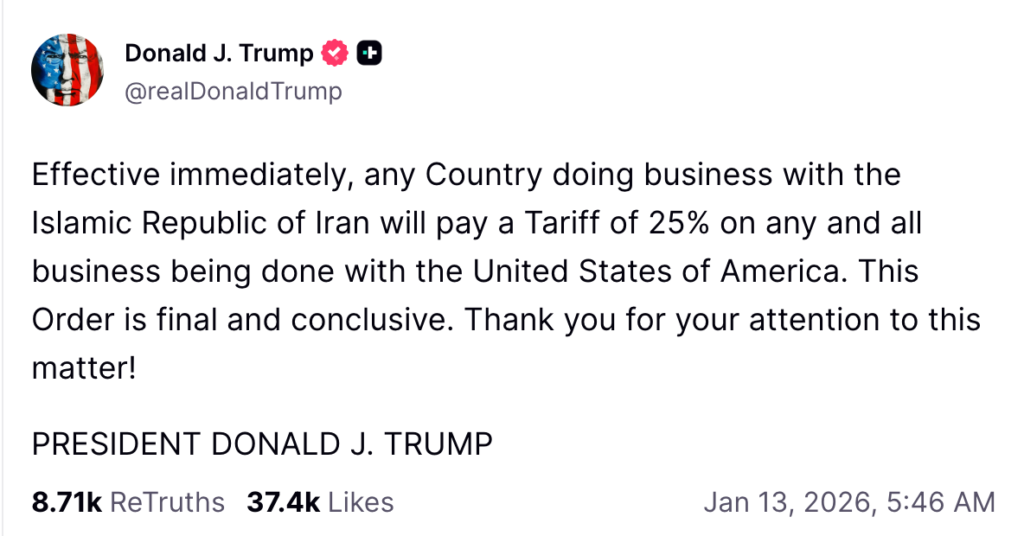
This morning (13), the US has further escalated sanctions against Iran. President Trump announced on Truth Social: Any country maintaining commercial relations with Iran will immediately face a 25% punitive tariff on all goods and services exported to the United States, with no transition period.
Effective immediately, any country conducting business with the Islamic Republic of Iran must pay a 25% tariff on all transactions with the United States. This order is final and conclusive.
China and India as the epicenters
Unlike past sanctions focused on a single commodity, this time the tariffs are directly added on top of existing standards, creating a binary choice: continue doing business with Iran or protect the US market.
Since China is Iran’s largest trading partner and oil importer, this order effectively adds an extra 25% on top of China’s current tariffs. Analysis suggests this will raise China’s average tariff costs from about 20% to over 45%.
Additionally, India, which already faces a 50% tariff for purchasing Russian oil, may see the threshold climb to 75%.
Impacted industries: chemicals and electronics bear the brunt first
Iran is the world’s largest methanol exporter, so the chemical supply chain will first feel the cost pressure; Chinese and Indian plastic, fertilizer, and basic chemical factories are expected to face profit compression. The electronics and machinery sector is also not immune, as any parts containing Iranian-sourced metals like copper and zinc could trigger high tariffs.
Trump’s “Iran economic encirclement” tightly binds trade and geopolitical interests, forcing companies and governments to reassess energy dependencies and market strategies.

Disclaimer: The information on this page may come from third parties and does not represent the views or opinions of Gate. The content displayed on this page is for reference only and does not constitute any financial, investment, or legal advice. Gate does not guarantee the accuracy or completeness of the information and shall not be liable for any losses arising from the use of this information. Virtual asset investments carry high risks and are subject to significant price volatility. You may lose all of your invested principal. Please fully understand the relevant risks and make prudent decisions based on your own financial situation and risk tolerance. For details, please refer to
Disclaimer.


