Fuse Energy is an innovative DePIN (Decentralized Physical Infrastructure Network) project on the Solana blockchain, designed to revolutionize energy consumption and rewards through tokenized incentives. Launched in 2025, Fuse Energy has garnered attention for its user-friendly app that allows individuals to earn cryptocurrency rewards for everyday energy usage, while promoting sustainable practices. With a recent SEC No-Action Letter marking it as the first such approval since 2019, Fuse Energy is positioning itself as a compliant bridge between real-world energy markets and Web3, potentially transforming how households interact with utilities and blockchain.
Fuse Energy’s Purpose: Tokenizing Energy Consumption for Rewards
Fuse Energy aims to democratize energy rewards by leveraging blockchain to track and incentivize efficient, sustainable energy use. Users connect their energy accounts to the Fuse app, which monitors consumption patterns and automatically distributes $ENERGY tokens based on behaviors like reducing peak-hour usage or adopting green practices. This creates a “pay-for-performance” model where everyday actions—such as smart home optimization or EV charging—earn real crypto value.
The project’s core thesis is simple: energy is a massive, untapped asset class for DePIN, with global consumption exceeding $10 trillion annually. By tokenizing data from meters and smart devices, Fuse Energy enables users to monetize their consumption while utilities gain insights for grid efficiency. Early adopters report earning up to $50 monthly in $ENERGY, redeemable for bill credits or traded on Solana DEXs.
Technology and Solana Integration: Seamless DePIN Infrastructure
Built on Solana’s high-throughput blockchain, Fuse Energy uses smart contracts to automate reward distribution and verify energy data via oracles. The app integrates with IoT devices and utility APIs, ensuring tamper-proof tracking of metrics like kWh usage and carbon offset. Solana’s low fees (sub-$0.01 per transaction) and 65,000 TPS make it ideal for real-time energy events, such as peak-demand alerts or instant rebate claims.
Key tech highlights:
- DePIN Model: Decentralized energy data networks where users contribute anonymized usage info for collective rewards.
- $ENERGY Token: Utility token for staking, governance, and redemptions; total supply 10 billion, TGE January 2026.
- App Features: Mobile login with domestic phone numbers (e.g., China), address setup for bill simulations, and AI-driven insights (e.g., $2,000 GBP energy cost estimates for UK setups).
The platform’s early testing revealed intuitive onboarding but highlighted regional pricing variations, like high UK energy simulations prompting user queries.
Regulatory Milestone: SEC No-Action Letter – The First Since 2019
(Sources: SEC No-Action Letter)
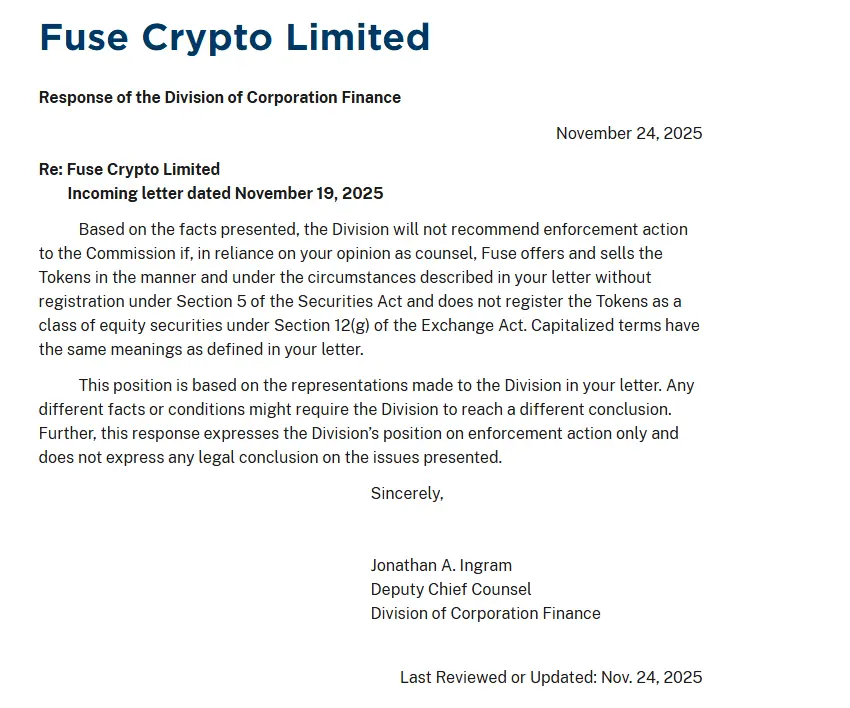
In a landmark achievement, Fuse Energy received a SEC No-Action Letter on November 25, 2025—the first for a DePIN project since 2019. This regulatory clearance confirms the project’s compliant structure for token issuance and rewards, allowing U.S. users to participate without securities concerns. The letter addresses energy data tokenization as non-security activity, paving the way for broader adoption.
This approval elevates Solana from a meme and DeFi hub to a “legitimate project zone,” as evidenced by Circle’s issuance of $5.5 billion USDC on Solana in November 2025 alone.
Funding and Tokenomics: $9 Million Raise for Sustainable Growth
Fuse Energy secured $9 million in seed funding on September 23, 2025, from undisclosed investors, supporting app development and mainnet preparations. The $ENERGY token has a total supply of 10 billion, with ~16.5% initial circulation at TGE (January 2026). Allocation prioritizes community (40%), liquidity (20%), team (15% vested), ecosystem (15%), and public sale (10%).
Token utility includes staking for rewards, governance voting, and energy redemptions. The funding enables expansions like AI-powered bill forecasts and multi-region support, with early users noting seamless China phone registration but high simulated costs (e.g., $2,000 GBP for UK addresses).
Community and Adoption: Early Traction and Challenges
Fuse Energy’s app has onboarded thousands via simple registration, with features like energy simulations sparking curiosity. However, high projected costs in some regions highlight accessibility hurdles. The project fosters community through airdrops and staking, with $ENERGY’s January TGE expected to drive listings.
As a DePIN innovator, Fuse Energy aligns with Solana’s growth, potentially capturing a slice of the $10 trillion energy market through tokenized rewards.
2025 Fuse Energy Prediction: $500M Market Cap Entry
Fuse Energy prediction for 2025: $500 million market cap, with 50% growth. Bull catalysts: SEC approval; bear risks: Adoption hurdles testing $300M support.
For users, how to join Fuse Energy via the app ensures entry. How to earn $ENERGY and how to stake Fuse Energy offer rewards. Sell $ENERGY for cash and convert $ENERGY to cash enable fiat conversions.
In summary, Fuse Energy’s SEC-approved DePIN on Solana tokenizes energy rewards with $9M funding and $ENERGY TGE in January 2026, blending utilities with blockchain for sustainable earnings—positioned for $500M cap in 2025’s DePIN surge.
Disclaimer: The information on this page may come from third parties and does not represent the views or opinions of Gate. The content displayed on this page is for reference only and does not constitute any financial, investment, or legal advice. Gate does not guarantee the accuracy or completeness of the information and shall not be liable for any losses arising from the use of this information. Virtual asset investments carry high risks and are subject to significant price volatility. You may lose all of your invested principal. Please fully understand the relevant risks and make prudent decisions based on your own financial situation and risk tolerance. For details, please refer to
Disclaimer.
Related Articles
SOL spot ETF experienced net inflows of $10.7001 million last week
According to SoSoValue data, from March 9 to March 13, SOL spot ETFs experienced a net inflow of $10.7001 million. The Bitwise ETF BSOL performed notably, with weekly net inflows of $14.673 million, bringing the total net inflow to $782 million. VanEck ETF had a weekly net outflow of $1.9781 million, with a total net inflow of $19.12 million. The total net asset value of SOL spot ETFs was $855 million.
GateNews1h ago
Base and Solana Account for 97% of AI Agent-to-Agent Trading Market Share
Gate News reports that on March 16, Lisk Chief Researcher Leon Waidmann posted on the X platform stating that on-chain payment settlements for AI agents are mainly concentrated on Base and Solana, with these two networks accounting for 97% of all agent-to-agent transactions. Among them, Base accounts for 59% with transaction volume reaching 70.9 million; Solana accounts for 38% with transaction volume reaching 45.3 million; all other networks account for only 3% with transaction volume of 3.9 million.
GateNews2h ago
Solana Network Improvement Proposal SIMD-0266 Approved, Transaction Efficiency Can Increase Up to 19x
Gate News reports that on March 16, the Solana network improvement proposal SIMD-0266 was approved. The proposal was submitted by Anza last year, and its core content involves introducing p-token—a token model with higher computational efficiency—that can increase the computational efficiency of Solana transactions and payments by up to 19 times, significantly reduce token transfer costs, and thereby improve network capacity. This upgrade is expected to be deployed to the mainnet in April of this year.
GateNews2h ago
Citi, PwC, and Solana complete the proof of concept for trade finance tokenization
Gate News: On March 16, Citi, PwC, and Solana jointly completed a proof of concept (PoC) for trade finance tokenization. The solution allows suppliers to issue tokenized payment vouchers and sell them at a discount to banks, enabling instant settlement and replacing the months-long waiting periods of traditional models. This collaboration represents another practical exploration by traditional financial institutions of RWA (real-world asset) applications on the Solana blockchain.
GateNews3h ago
Chinese DeepSeek AI Predicts the Price of XRP and Solana If the Clarity Act Doesn’t Pass in 2026
The CLARITY Act may fail to become law this year if it doesn’t pass committee by the end of April, according to Galaxy Digital research. The main battle is over stablecoin rewards, which banks say could drain deposits
CaptainAltcoin4h ago
SOL breaks through 90 USDT, 24-hour gain of 3.4%
Gate News, on March 15th, market data shows that SOL broke through 90 USDT, currently trading at 90.03 USDT, with a 24-hour gain of 3.4%.
GateNews7h ago


