Key Features of MAP Protocol
Security-Finality
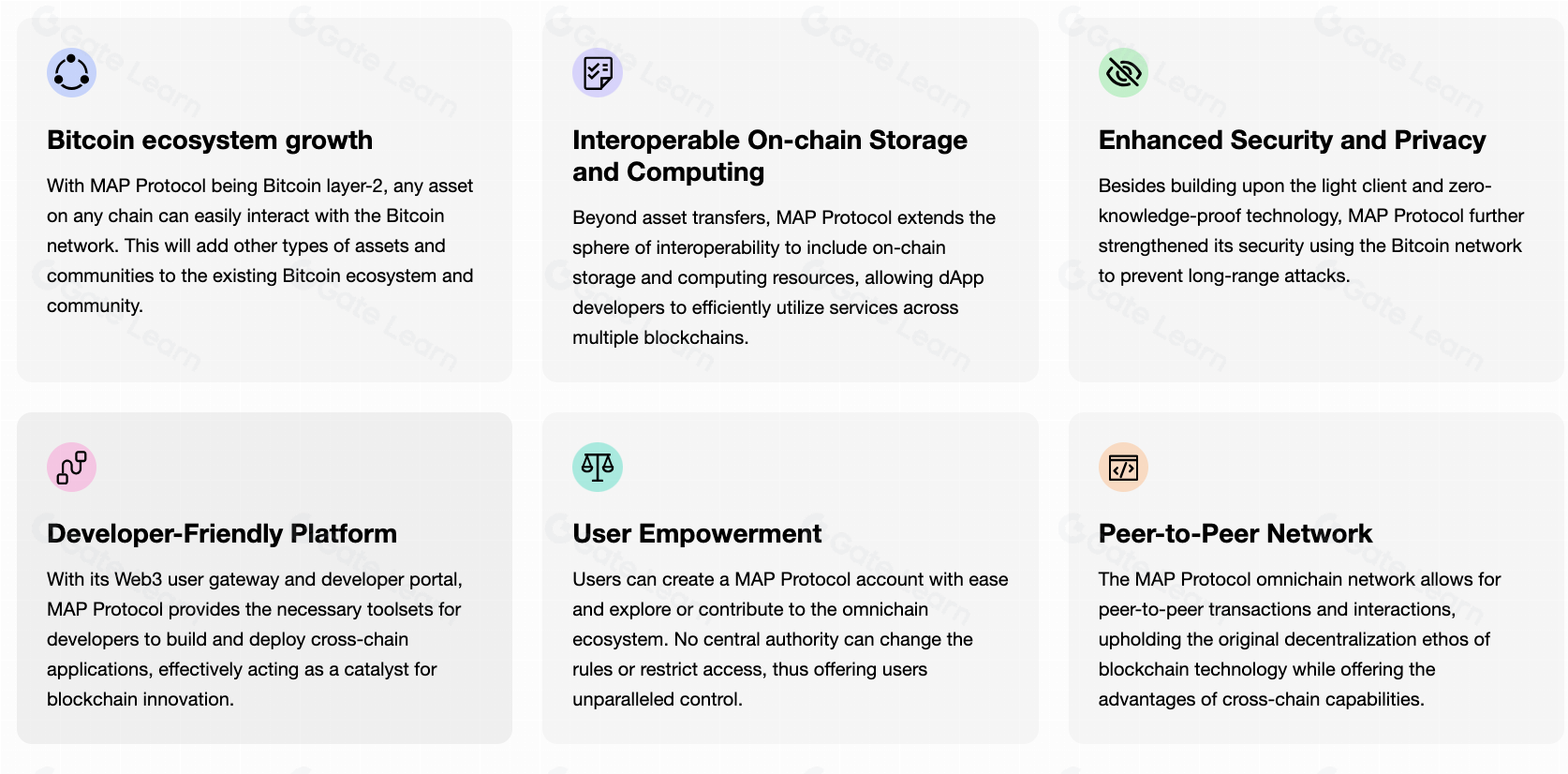
MAP Protocol ensures blockchain-level security through independent self-verifying networks formed by light clients on each connected blockchain. This feature ensures that all transactions are verified and finally confirmed without relying on centralized entities or third parties. By using zero-knowledge proof (ZKP) technology, MAP Protocol verifies transactions without revealing sensitive information, making it a trust-agnostic and secure solution for cross-chain interactions.
All-Chain Coverage
MAP Protocol supports seamless communication between EVM (Ethereum Virtual Machine) and non-EVM chains. It achieves this by embedding the signatures and hash algorithms of different blockchains into the EVM layer of the MAP relay chain. This integration ensures that heterogeneous blockchains can interact seamlessly, enabling the transfer of assets and data between multiple networks without compatibility issues.
Instant Confirmation
The protocol provides instant confirmation for cross-chain transactions, significantly reducing latency and improving user experience. This is achieved through efficient cross-chain communication protocols and on-chain smart contracts, ensuring that transaction speed is only limited by the block time of each participating chain. This feature is crucial for applications that require fast and reliable transaction processing.
Minimum Cost(最低成本)
MAP Protocol maintains the cost-effectiveness of the network by only charging gas fees for MAP relay chain and other connected chains. Cross-chain transactions incur no additional costs, making it an economic solution for developers and users. By utilizing advanced ZKP technology, the protocol further reduces transaction costs by optimizing the verification process.
Developer-Ready Environment
MAP Protocol aims to provide developers with a friendly environment, comprehensive SDK and API to simplify the creation and deployment of cross-chain decentralized applications (dApps). The MAP Omnichain Service (MOS) layer provides built-in interoperability features, allowing developers to build dApps that can run across multiple blockchains with minimal effort. This environment lowers the technical barriers for developers, promotes innovation, and accelerates the development of full-chain applications.
MAPO Token
The MAPO token is the native cryptocurrency of the MAP Protocol ecosystem. It plays a key role in driving network operation, ensuring security, and achieving governance. The token is used to pay for transactions on the MAP Relay Chain and other related chains. At the same time, it serves as an incentive mechanism, rewarding participants who contribute to the network functionality, such as validators and developers. By integrating these functions, the MAPO token ensures the smooth operation and maintenance of the MAP Protocol.
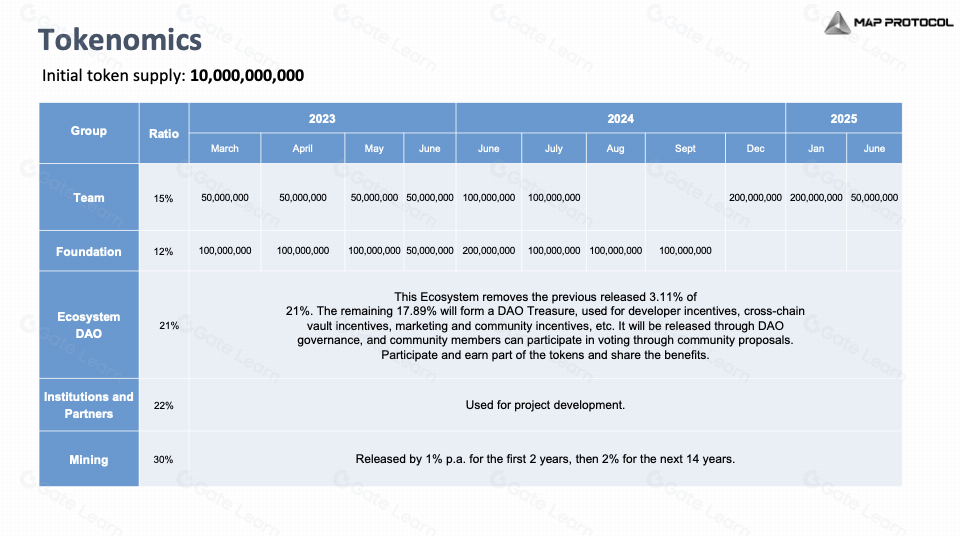
MAPO tokens are designed as multi-functional tokens within the MAP Protocol ecosystem:
Trading Fees: Users need to pay MAPO tokens as transaction fees in cross-chain transactions. This fee structure ensures that the network remains cost-effective in supporting operations across different blockchains.
GovernanceMAPO token holders have the right to participate in the governance of the protocol. They can vote on proposals that affect the development and future direction of the MAP Protocol. This decentralized governance model ensures that the community has a voice in key decision-making and protocol upgrades.
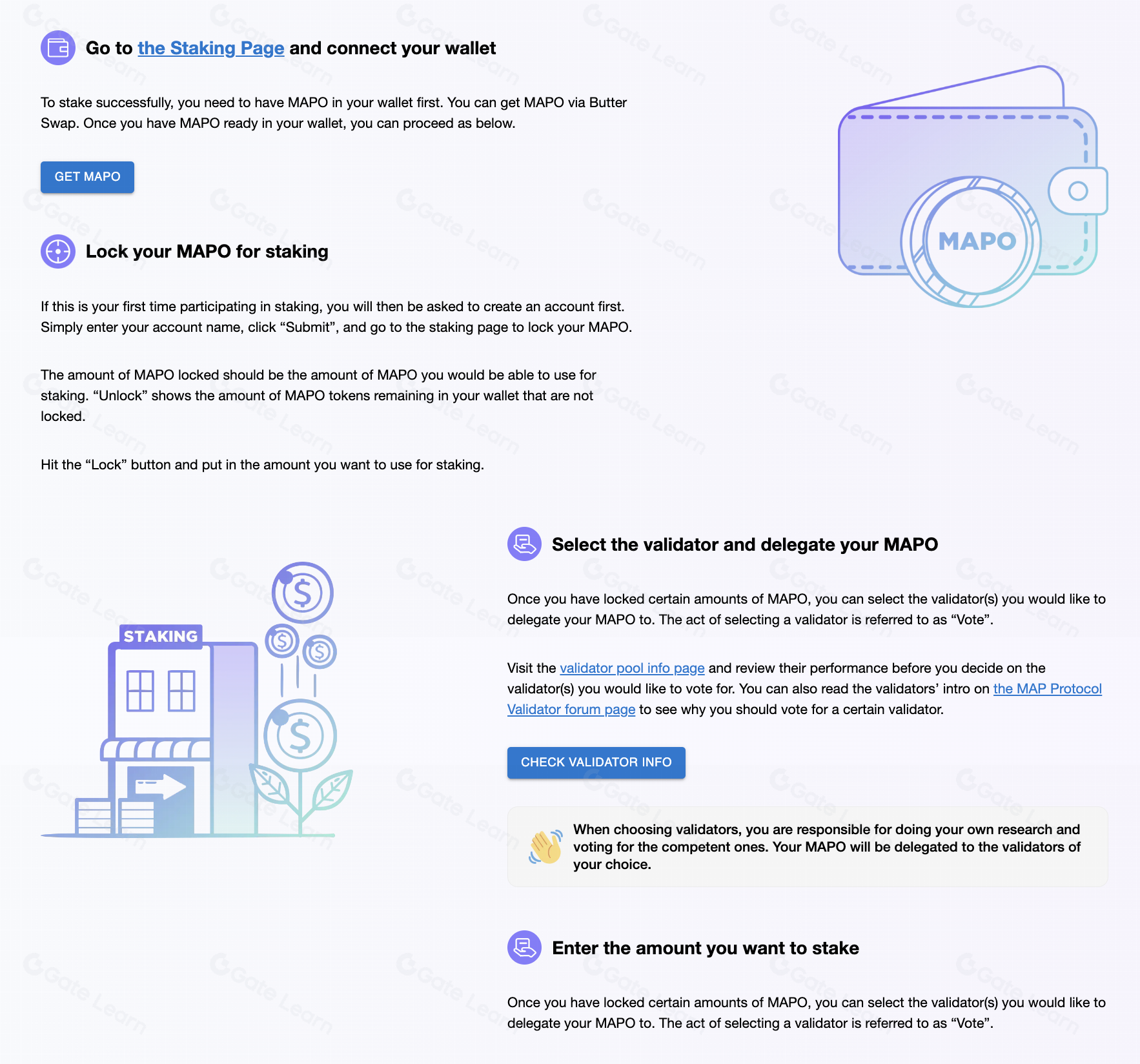
StakeThe MAPO token can be staked to support the security of the network. Token holders can delegate their MAPO tokens to validators, who are responsible for validating transactions and maintaining the integrity of the network. In return, validators will receive rewards, which will be distributed to the token holders who have staked their tokens.
Staking and Rewards
Staking is a fundamental part of the MAP Protocol, ensuring network security and user participation. It operates as follows:
Token holders can lock their MAPO tokens in a staking contract, effectively delegating them to network validators. These validators play a crucial role in transaction validation and network maintenance. By staking, users help protect the network and ensure its smooth operation. Validators are rewarded for their services, and these rewards are proportionally distributed to users staking their tokens. These rewards are typically a portion of the transaction fees collected by the network. Additionally, MAP Protocol adopts a deflationary model where a portion of the transaction fees is burned, reducing the overall token supply and potentially increasing the value of the tokens over time. The staking and reward system is designed to incentivize active participation in the network. By staking their tokens, users not only earn rewards but also contribute to the security and decentralization of the network. This system ensures alignment between the interests of token holders and the health and growth of the MAP Protocol ecosystem.
Here's how to stake MAPO:
How MAP Protocol Works
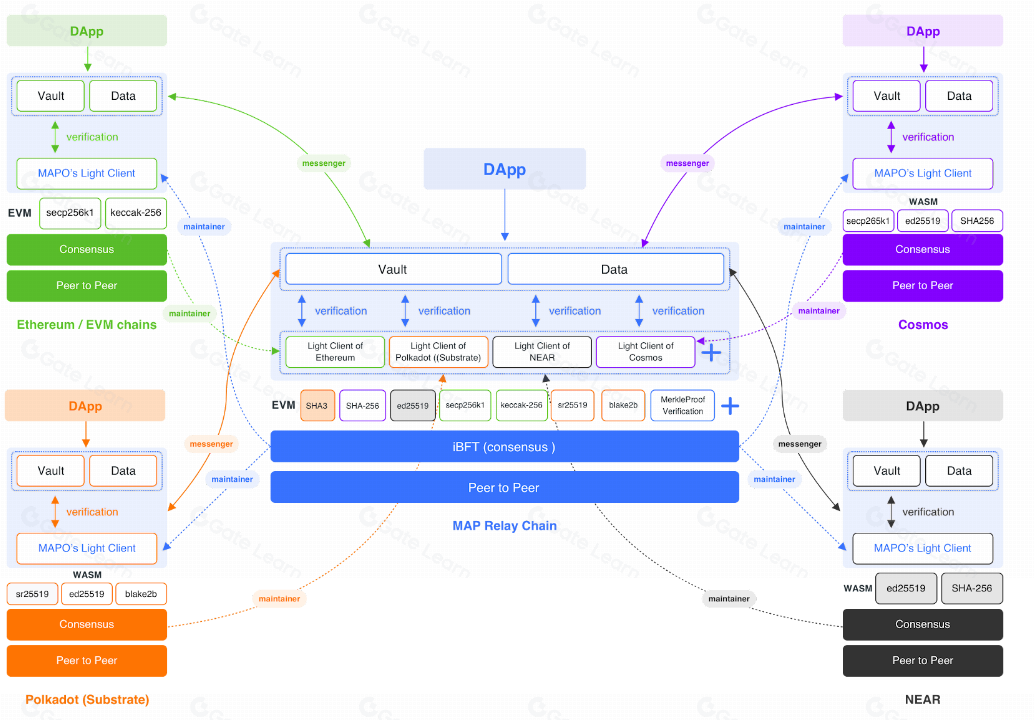
Cross-chain verification process
The cross-chain verification process of MAP Protocol aims to ensure the security and seamless interaction between different blockchain networks. This process relies on a peer-to-peer, trustless model, without involving any privileged third parties. The key components involved in this process are light clients and zero-knowledge proofs (ZKP).
When a transaction is initiated on one blockchain (chain A) and needs to be verified on another blockchain (chain B), the block header information of chain A, including the validator's signature and validator set information, will be synchronized to the light client of chain B. These light clients ensure independent data verification, provide a high level of security, and ensure the legitimacy of transactions without the need to trust external entities.
Light client technology
Light clients, or lightweight clients, are simplified versions of full nodes that do not download the entire blockchain. Instead, they rely on minimal data to verify transactions, using cryptographic hash functions and Merkle proofs to ensure the authenticity of data. This makes light clients very efficient and suitable for resource-constrained devices, such as smartphones or IoT devices.
MAP Protocol's light client mechanism involves only downloading block headers, which contain important information such as block hash and merkle root. When transaction verification is required, the light client requests a merkle proof from full nodes. These proofs mathematically verify that the transaction is part of a specific block, ensuring security and trust without requiring large amounts of data storage or bandwidth.
MAP Protocol improves the efficiency of light clients by integrating ZKP, enabling them to verify block headers through zk-SNARK (zero-knowledge succinct non-interactive arguments of knowledge). This integration significantly reduces gas costs associated with cross-chain validation while maintaining a high level of security.
Zero Knowledge Proof (ZKP)
Zero-knowledge proof is a cryptographic protocol that allows one party (prover) to prove to another party (verifier) that a statement is true without revealing any additional information. This ensures the privacy and security of digital transactions, as the verifier knows nothing except the validity of the statement.
There are two main types of ZKP used in blockchain technology:
- Interactive Zero-Knowledge ProofRequires direct interaction between the prover and the verifier, including multiple rounds of challenges and responses.
- Non-Interactive Zero-Knowledge Proof (NIZK):No interaction required. The prover provides a single proof that the verifier can independently verify.
MAP Protocol uses NIZK, especially zk-SNARK, to enhance the cross-chain verification process. By introducing ZKP, MAP Protocol ensures that transactions are verified under secure and efficient conditions, reducing fraud risks and maintaining the integrity of cross-chain communication.
MAP Protocol's cross-chain validation process, driven by light client technology and zero-knowledge proofs, provides a secure, efficient, and decentralized blockchain interoperability solution. This enables seamless and trustless interaction between various blockchain networks, ensuring the security and integrity of cross-chain transactions.