Challenges Brought by Quantum Computers
At present, Bitcoin's security relies primarily on cryptographic algorithms. While these encryption methods are generally highly secure, theoretically, quantum computers with sufficient power could potentially break these mechanisms.
Potential risks include:
-
Attackers could deduce Private Keys from public blockchain data
-
If Private Keys are exposed, Wallet Assets could be stolen
Although such attacks remain theoretical for now, Developers have already begun working on defensive solutions.
BIP-360: Quantum Defense Upgrade Proposal
A significant proposal from the Bitcoin Group is BIP-360. The central idea is to introduce quantum-resistant Wallets, enabling users to proactively transfer Assets before quantum threats arise. Users can move BTC from old addresses to new, quantum-secure addresses. However, this approach has one drawback: not all users will transfer their Assets in time.
Side Effects of the Emergency Brake Mechanism
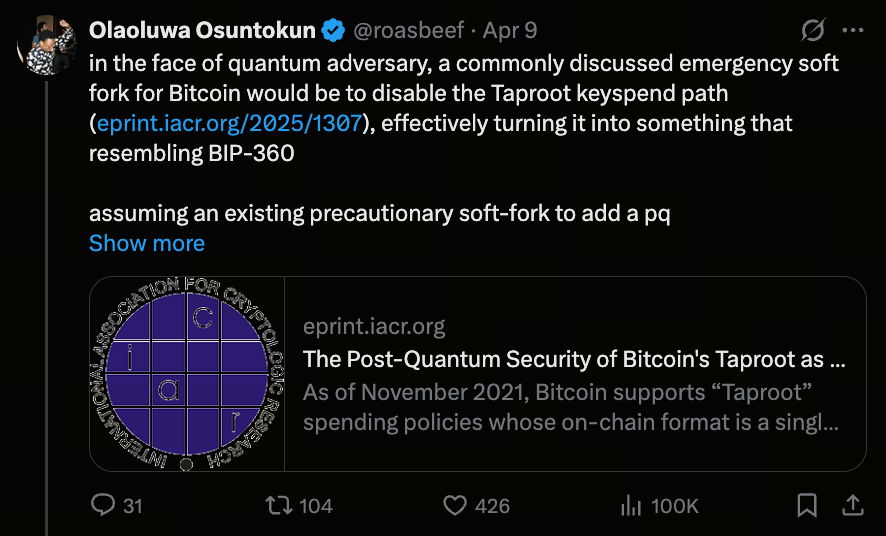
To counter quantum attacks, Developers have also considered a more Aggressive solution known as the Emergency Brake. This mechanism would shut down the network's digital Signature system upon detection of a quantum threat.
Because Bitcoin Trades depend on digital Signatures to prove ownership, disabling this system prevents attackers from forging Trades—but it also creates a major issue: many Wallets would lose the ability to spend funds. Taproot Wallets, widely adopted since 2021 and typically relying on a single Signature, would be especially impacted. If the Signature system is suspended, users can't prove ownership of their addresses, and their Wallet Assets could be permanently Frozen.
New Prototype: Proving Ownership with Seed Phrases
To address this challenge, Lightning Labs CTO Olaoluwa "Roasbeef" Osuntokun developed a new technical prototype that alters the method of ownership verification.
-
Traditional approach: Digital Signatures prove Asset ownership
-
New solution: Users mathematically prove they are the Wallet creator
The verification hinges on the Wallet seed phrase.
Every Bitcoin Wallet is generated from a unique seed. This system enables users to prove their Wallet was created from their own seed—without revealing the seed itself. As a result, even if this mechanism is used to recover Assets, other addresses generated from the same seed remain unaffected.
(Source: roasbeef)
Prototype System Test Results
Osuntokun has completed a functional technical prototype.
During testing:
-
Generating proof took about 55 seconds
-
Verification took less than 2 seconds
-
Proof file size was approximately 1.7 MB
This is similar to the size of a high-resolution image.
Developers emphasized that this is currently a side project and has not yet been optimized for performance.
Ongoing Debate Over Quantum Threats
The Bitcoin Group remains divided on the quantum computer threat. Some research suggests that most quantum breakthroughs are still in the theoretical or experimental phase, and attacking the entire Bitcoin network faces significant technical barriers. On the other hand, some Developers argue that, even if the risk is not immediate, preparing defensive measures in advance is essential.
Why This Prototype Is Significant
While not yet a formal proposal, this technical prototype addresses a critical gap. Previous discussions about Bitcoin's quantum defense always faced a dilemma: upgrades could protect the network but might also lock user Assets. Osuntokun's solution offers a balanced approach—enabling users to prove Wallet ownership and recover Assets in extreme scenarios.
Conclusion
Whether quantum computers pose a threat to Bitcoin remains controversial, but research into defensive mechanisms has persisted for years. The Wallet recovery prototype proposed by Lightning Labs' CTO presents an alternative for future emergency upgrades. If similar technology is integrated into the Bitcoin protocol, it could help protect network security while preventing the permanent freezing of large volumes of user Assets.







