
Apple removes decentralized communication app Bitchat in compliance with Chinese regulations. The app has been deemed to carry social mobilization risk due to its Bluetooth offline and mesh network characteristics, sparking concerns about freedom of communication and the regulatory boundary.
Block CEO Jack Dorsey (Jack Dorsey) posted on the social platform X to confirm that Apple has, at the request of China’s internet regulatory authorities, removed the decentralized communication app Bitchat from China. Due to its Bluetooth offline transmission and decentralized features, China has determined that it violates relevant communication regulations for social mobilization imposed on authorities.
Bitchat violates China’s cybersecurity law, Apple notified it to be removed
According to information publicly shared by Dorsey, the Cyberspace Administration of China (CAC) stated that Bitchat violates Article 3 of the Provisions on the Security Assessment of Internet-based Information Services with Attribute of Public Opinions or Capable of Social Mobilization (internet information service security assessment provisions with attributes of public opinion or capable of social mobilization). This regulation requires that online services with attributes of public opinion or capable of social mobilization must go through an official security assessment process before formally launching and offering services. Apple’s app review team subsequently notified developers that both Bitchat’s official version and its TestFlight test version cannot continue to be supplied in the Chinese market, but the app can still be used and accessed in other countries and regions.
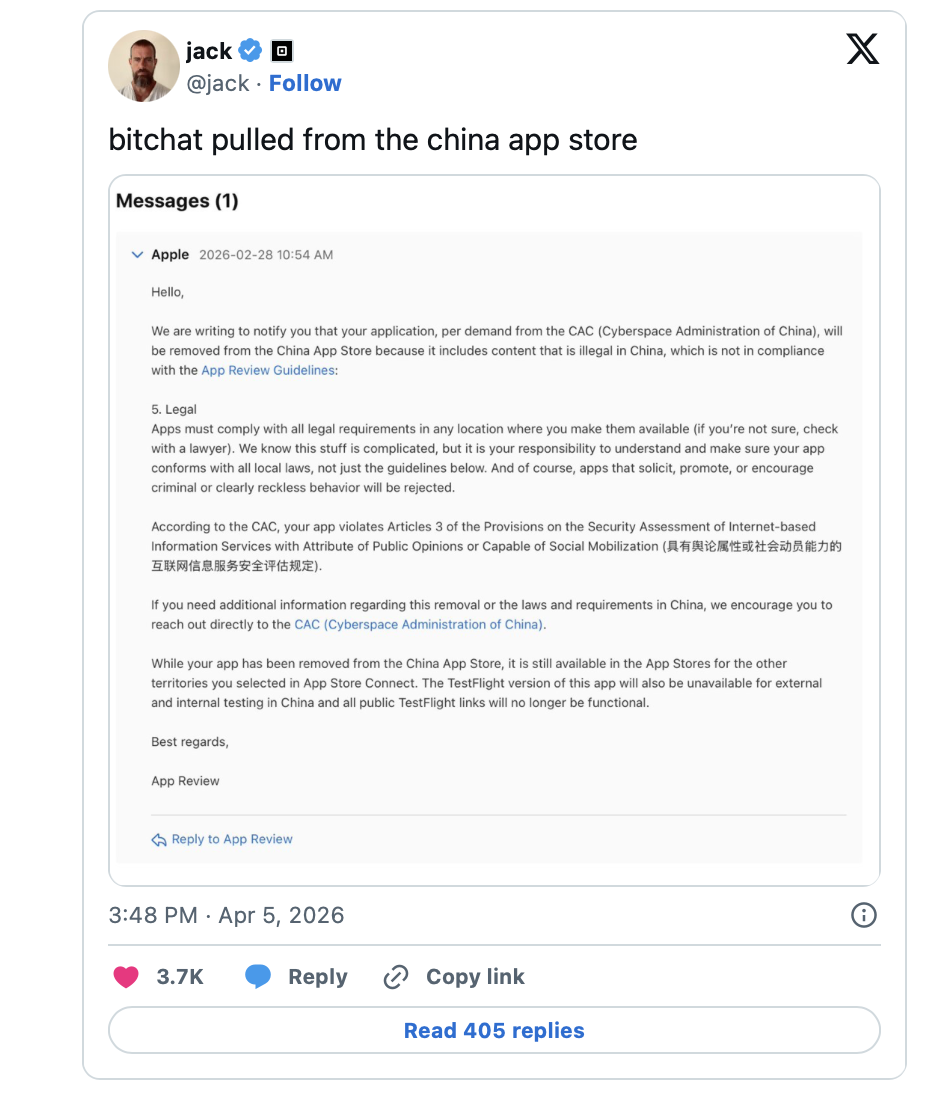
Source: X/@jack
How does Bitchat work?
Bitchat’s technical architecture differs significantly from traditional communication software. The app runs entirely based on Bluetooth and Mesh Network technology. This peer-to-peer communication mode does not rely on telecom carrier infrastructure or an internet connection; users can maintain basic communication within a range of 30 to 100 meters. By forwarding through nodes, it enables propagation over longer distances. For regulators, this design bypasses traditional network firewall filtering and content inspection systems, making it extremely difficult for the government to block it at the technical level using conventional measures such as blocking the internet.
Bitchat is often used in international protests
Because Bitchat does not require an internet connection to operate, it has become a communication tool used in anti-government protests and internet shutdown events across multiple countries. In the past, in countries such as Iran, Madagascar, Uganda, Nepal, and Indonesia, when governments attempted to restrict the spread of information through technical means, Bitchat’s decentralized nature played a role in enabling communication. This ability to keep functioning in special environments has put it in conflict with Beijing’s current network security review mechanisms, leading to its ban in the Chinese market. This is also why, after the decentralized social app Damus, the application supported by Dorsey was again taken down in China.
As of early April 2026, the cumulative number of downloads of Bitchat across global platforms has exceeded 3 million. In just the most recent week, it added more than 92,000 downloads. Public information from the Google Play store also shows that the app has recorded more than 1 million registered downloads. Although detailed download distribution data by regional market is currently lacking, its growth trend indicates that decentralized communication tools are attracting attention in certain markets. At present, the app continues to be normally available in regions outside China, providing offline communication solutions.
- This article has been reprinted with permission from: 《Chain News》
- Original title: 《Jack Dorsey posted to confirm that Apple removed Bitchat decentralized communication software at China’s request》
- Original author: DW
Aviso legal: La información de esta página puede proceder de terceros y no representa los puntos de vista ni las opiniones de Gate. El contenido que aparece en esta página es solo para fines informativos y no constituye ningún tipo de asesoramiento financiero, de inversión o legal. Gate no garantiza la exactitud ni la integridad de la información y no se hace responsable de ninguna pérdida derivada del uso de esta información. Las inversiones en activos virtuales conllevan riesgos elevados y están sujetas a una volatilidad significativa de los precios. Podrías perder todo el capital invertido. Asegúrate de entender completamente los riesgos asociados y toma decisiones prudentes de acuerdo con tu situación financiera y tu tolerancia al riesgo. Para obtener más información, consulta el
Aviso legal.


