Most traditional blockchains run on top of a globally shared state. Every transaction must be placed into a single ordering and confirmed through consensus, even when transactions are completely unrelated, because they still compete within the same state space. This design guarantees consistency, but it creates a built in bottleneck under high concurrency. Sui uses an object centric model to shrink the conflict domain to the level of a single asset, allowing unrelated transactions to run in parallel by default rather than relying on later stage optimizations. Its Narwhal and Bullshark architecture further separates data propagation from the consensus process, improving stability and throughput under heavy load. Meanwhile, Move, originally designed by Meta’s team for the Diem project, strengthens security boundaries through a strict “assets as resources” model, reducing the risk of contract vulnerabilities.
Understand Sui’s architecture from several angles: how blockchain scalability bottlenecks form, how an object oriented model isolates state conflicts, how native parallel execution and a layered consensus structure work in practice, and the role Move plays in designing secure digital assets. In typical scenarios such as on chain games, high frequency trading, and complex interactive applications, these architectural traits increasingly show their potential advantages in large scale Web3 environments. They also help clarify Sui’s technical positioning and growth room in the next generation Layer 1 competition landscape.
Sui Technical Architecture Introduction
 (Source: pixelplex/blog/what-is-sui-blockchain)
Sui is a Layer 1 public blockchain designed around high performance and scalability. Its architecture is built on an object centric model and native parallel execution. Unlike traditional account state based blockchain designs, Sui treats on chain assets as independent objects, so transaction conflicts are limited to the asset level. This enables more efficient parallel processing. At the same time, its consensus mechanism and data propagation flow are optimized to speed up confirmation while preserving security. Paired with the Move smart contract language, which prioritizes asset safety by design, Sui provides a foundational infrastructure for high frequency interactive applications and large scale Web3 use cases.
Where do traditional blockchains hit scalability limits?
Most blockchains operate on a globally shared state. Any transaction that updates the chain must write to the same state space. Even if two transactions are unrelated, they still have to be ordered and confirmed through consensus. This ensures consistency, but it also creates a built in bottleneck. As network load increases, the cost of ordering rises and the probability of state conflicts climbs at the same time. Hardware upgrades can slow the pain, but they do not resolve the core tension: the conflict between shared state and high concurrency demands.
Object oriented model: shrinking conflicts to the asset level
Sui’s central innovation is its object oriented model. Every asset is treated as an independent object with clear ownership and state boundaries. When a transaction touches only a specific object, its validation and update can proceed independently. Only when two transactions involve the same object do they need ordering or coordination.
This design narrows conflicts from the global state down to a single asset. As long as assets in an application are sufficiently distributed, parallel efficiency can improve significantly.
Native parallel transactions: not acceleration, but the default state
On most public chains, parallel execution is an optimization. On Sui, parallelism is the default. Unrelated transactions can be confirmed concurrently, and in certain cases they do not even need to go through the full consensus process. This design sharply reduces latency and eases pressure on global ordering. It is not achieved through complex ordering algorithms, but through natural isolation at the object level. That difference gives Sui a potential edge in high frequency, highly interactive application scenarios.
Separating consensus and the data layer: stability through modular design
Sui uses the Narwhal and Bullshark architecture to separate data propagation from consensus. Even under heavy load, the data layer can maintain high throughput, while the consensus layer focuses on secure finality.
The value of this modular approach is upgrade flexibility and operational stability. When one layer needs improvement, the system does not need to be rewritten end to end. This engineering mindset brings Sui closer to modern distributed systems architecture rather than a monolithic, traditional blockchain design.
Move language: built for digital asset security
 (Source: pixelplex)
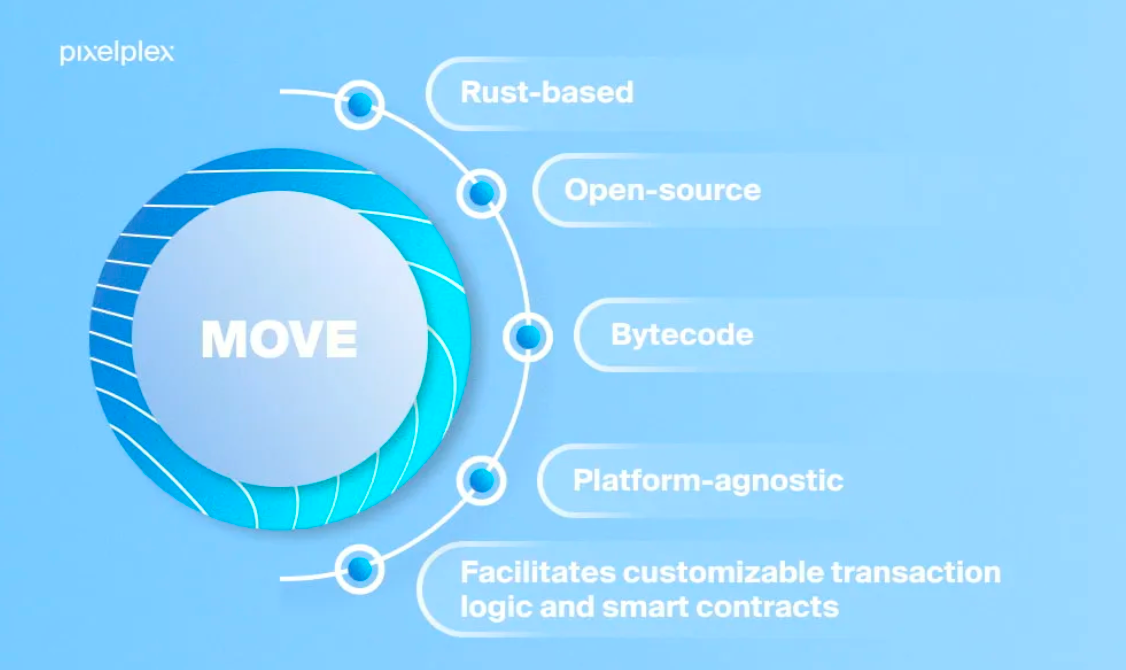
Move is built around a simple but strict idea: assets are resources. Resources cannot be duplicated, must be transferred explicitly, and must follow ownership rules. These language level constraints greatly reduce the risk of incorrect asset operations. For financial protocols and on chain games, that security posture is critical. More than a performance advantage, Move offers logical rigor, and that rigor is a key foundation for long term ecosystem growth.
How do Sui’s architectural advantages translate into real applications?
When on-chain activity involves large numbers of simultaneous interactions, NFT state changes, or high frequency trading, parallel processing becomes decisive. With an object centric model, each role or asset becomes an independent unit. In theory, as long as interactions do not overlap, the system can process a large number of requests at once. If Web3 applications move into a more interactive era, this design could become a meaningful differentiator.
Is Sui’s technical competitive edge sustainable?
In principle, any architecture can be imitated, but in practice the cost of rewriting a foundational model is extremely high. Existing ecosystems, tooling, and developer habits create natural friction. As a result, the true moat is not just the technology itself, but the path dependence created when that technology and its ecosystem grow together. If the Sui ecosystem continues to expand, its architectural differences may translate into long term advantages.
Summary
Sui’s core value is not simply the outcome of high performance, but a redefinition of the transaction model itself. Through an object centric structure and native parallel execution, scalability is embedded as a structural property of the system rather than a performance patch added later. As Web3 shifts toward more interactive, higher frequency applications, this architectural approach may become a key dividing line. Performance is only on the surface, the real boundary is always set by the architecture underneath.