YingYue

vip
Age 0.3 Year
Peak Tier 5
No content yet
#GateSquare$50KRedPacketGiveaway
🎉🔥 #GateSquare$50KRedPacketGiveaway — Don’t Miss the $50,000 Drop!
4
Big rewards are landing on Gate Square — and this time, it’s a $50,000 Red Packet Giveaway 💰
This isn’t just another promo. It’s a community-powered event designed to reward active users, traders, and builders who are shaping the ecosystem.
🎁 What Makes This Special?
• Massive $50K prize pool
• Community-driven participation
• Simple tasks, real rewards
• Limited-time opportunity
The Red Packet culture represents sharing prosperity — and in crypto, timing is everything. The earlier you en
  • Reward
  • Comment
  • Repost
  • Share
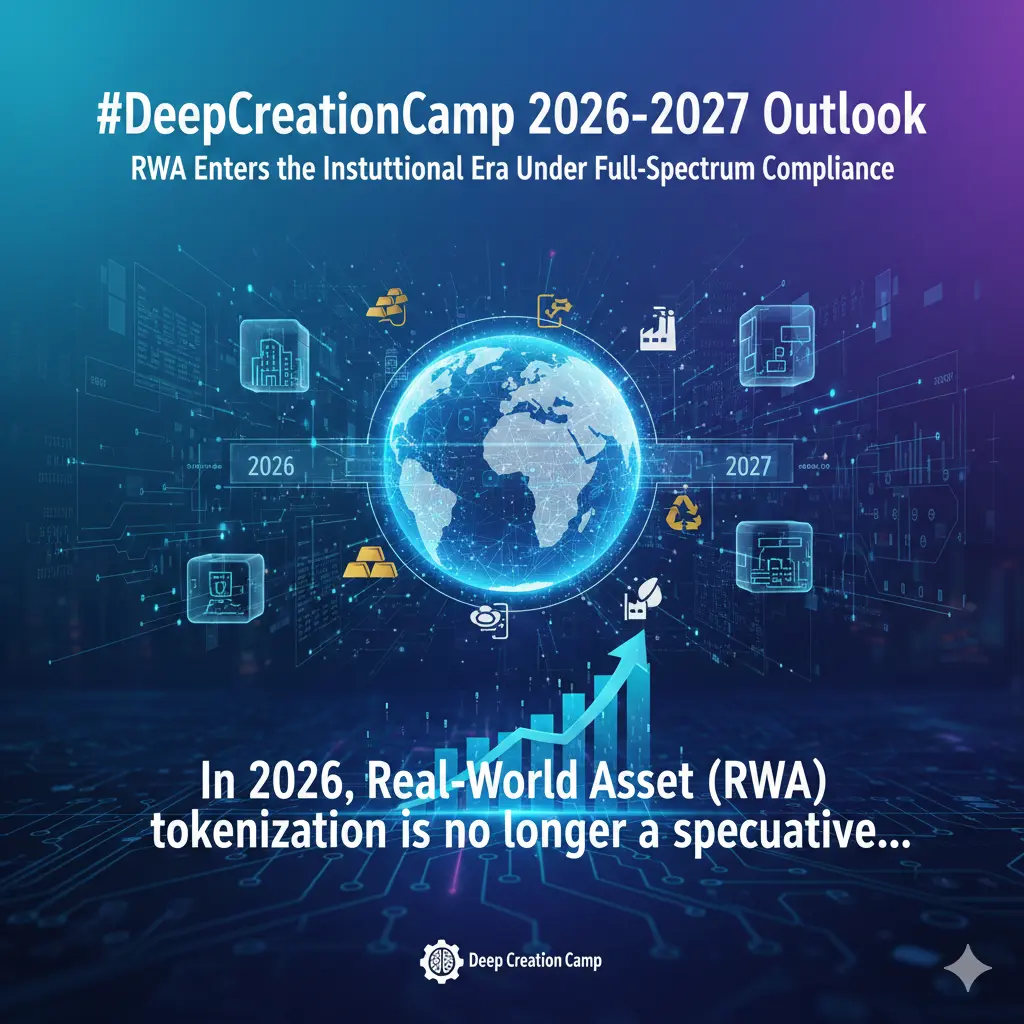
#DeepCreationCamp 2026–2027 Outlook: RWA Enters the Institutional Era Under Full-Spectrum Compliance
In 2026, Real-World Asset (RWA) tokenization is no longer a speculative narrative — it is becoming regulated financial infrastructure. What began as an experimental bridge between traditional finance and Web3 is now evolving into a compliance-first institutional track. Across Asia, the United States, and Europe, regulators have moved from ambiguity to structured oversight, transforming RWA from a “gray-zone innovation” into a licensed financial activity.
The core theme is clear: compliance is n
RWA-1.12%
  • Reward
  • Comment
  • Repost
  • Share
#LatestMarketInsights 📈 Latest Market Insights – February 25, 2026
Markets remain at a critical inflection point as volatility continues across crypto and equities. While stocks are attempting stabilization, digital assets remain under sustained pressure from macro headwinds, tariff uncertainty, and liquidity tightening. With major catalysts ahead, including Nvidia earnings and further tariff developments, risk sentiment could shift rapidly.
Global Equities: Stabilization Attempt, But Fragile
U.S. equity markets staged a notable rebound after earlier heavy selling pressure. The S&P 500, Nasda
BTC-2.57%
ETH-2.49%
MrFlower_XingChenvip
#LatestMarketInsights 📈 Latest Market Insights – February 25, 2026
Markets remain at a critical inflection point as volatility continues across crypto and equities. While stocks are attempting stabilization, digital assets remain under sustained pressure from macro headwinds, tariff uncertainty, and liquidity tightening. With major catalysts ahead, including Nvidia earnings and further tariff developments, risk sentiment could shift rapidly.
Global Equities: Stabilization Attempt, But Fragile
U.S. equity markets staged a notable rebound after earlier heavy selling pressure. The S&P 500, Nasdaq, and Dow Jones all recovered meaningfully, supported by renewed buying in AI-linked technology stocks and dip-buyers stepping in at key technical levels. However, futures suggest a cautious tone heading into the next session, reflecting uncertainty ahead of major earnings releases.
Asian markets also participated in the rebound, led by semiconductor and AI-infrastructure names. Japan’s Nikkei and South Korea’s Kospi showed strength, supported by ongoing enthusiasm surrounding AI hardware demand and global chip supply expansion.
Despite the rebound, market dispersion remains elevated. Large-cap tech continues to drive index movement, while defensive and value sectors show relative resilience. Investors are positioning carefully ahead of upcoming catalysts rather than aggressively chasing upside.
AI Sector Focus: Nvidia Earnings as a Risk Catalyst
The AI infrastructure theme remains the central driver of equity flows. Nvidia’s upcoming Q4 earnings report is viewed as a pivotal event that could influence not only semiconductor stocks but overall market risk appetite.
Expectations remain high for continued revenue growth driven by AI data center demand. However, guidance will be critical. A strong outlook could reignite broader tech momentum and support risk assets globally. Conversely, any sign of slowing AI capex or margin compression could pressure high-multiple tech names and spill into broader markets, including crypto.
Meanwhile, AMD has gained attention following a major multi-year AI GPU supply agreement with Meta Platforms. This deal signals sustained infrastructure build-out and diversification of AI chip suppliers, reinforcing that hardware remains at the center of the AI expansion cycle.
Tariffs and Macro Cross-Currents
Trade policy continues to weigh on sentiment. The newly implemented global tariff rate began at 10%, lower than the originally announced 15%, offering temporary relief. However, the potential escalation to 15% remains an overhang for global supply chains, trade-sensitive sectors, and emerging markets.
Consumer confidence has shown modest improvement from prior lows, but labor sentiment presents caution. More respondents indicate jobs are becoming harder to obtain, raising early concerns about employment stability despite broader economic resilience.
Central bank expectations remain fluid. Markets continue to price in potential rate adjustments later in the year, but policymakers face a delicate balance between inflation management and growth preservation. This uncertainty is contributing to elevated volatility across asset classes.
Cryptocurrency Market: Deep Correction, Testing Structural Support
Crypto markets remain under significant pressure. Bitcoin continues to trade within a critical support zone around the low-to-mid $60,000 range, reflecting a sharp year-to-date decline and nearly 50% drawdown from all-time highs. Ethereum is also struggling near major technical levels, with broader altcoins showing even weaker relative performance.
Heavy liquidations during peak volatility sessions amplified downside moves, reinforcing how sensitive crypto remains to macro-driven risk flows. The correlation between crypto and equities has strengthened during this phase, confirming that digital assets are trading as high-beta risk instruments rather than independent safe havens.
However, technical analysts note that price action is testing February lows. A sustained hold in this region could form the basis of a potential double-bottom structure, allowing for a relief rally if macro conditions stabilize. A breakdown below support would open the door to deeper retracement toward prior consolidation zones.
Sentiment indicators remain in extreme fear territory, historically associated with either capitulation phases or early stages of stabilization.
Market Outlook: What to Watch Next
The immediate focus is Nvidia’s earnings report, which may determine short-term direction for equities and risk appetite globally. Strong AI guidance could lift tech and indirectly support crypto. A disappointment could intensify volatility across markets.
Further tariff clarification will also be critical. Confirmation of escalation to 15% would likely renew risk-off positioning, while expanded exemptions could stabilize sentiment.
Upcoming macro data, labor signals, and central bank commentary will shape expectations for liquidity conditions heading into March.
Overall Market Pulse
Markets are balancing between stabilization and renewed downside risk.
Equities are attempting recovery, led by AI infrastructure stocks.
Crypto remains in a corrective structure, testing key support levels.
Tariff uncertainty and labor market caution continue to cloud the macro backdrop.
Volatility remains elevated, favoring disciplined and patient positioning.
The coming sessions could define whether this phase becomes a base-building consolidation or the prelude to another volatility spike.

repost-content-media
  • Reward
  • Comment
  • Repost
  • Share
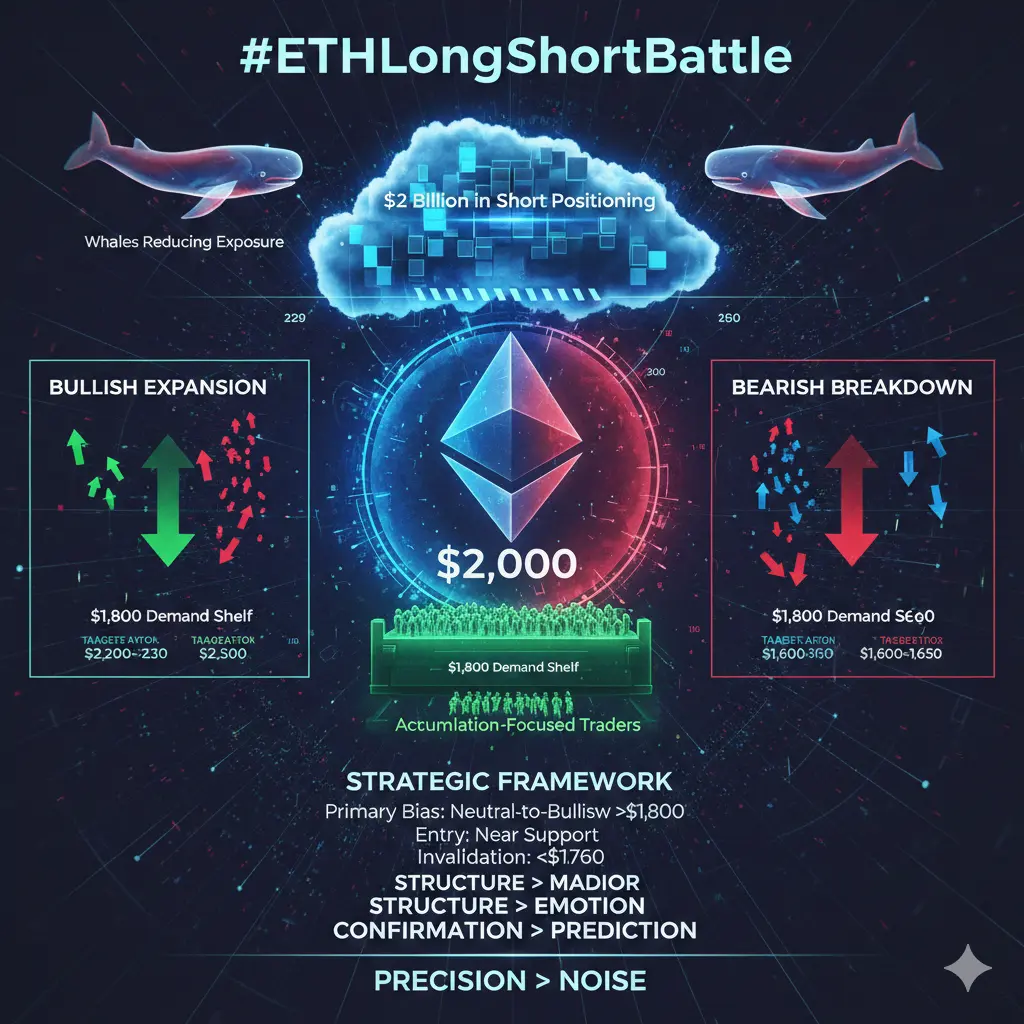
#ETHLongShortBattle
The current behavior of Ethereum (ETH) shows a tightly compressed price structure around the 1900 zone, suggesting that volatility is building beneath the surface rather than disappearing. Market liquidity has been gradually thinning as traders wait for a clear directional catalyst. The 2000–2050 region remains the key psychological and technical battlefield because large short interest is reportedly positioned there. If bullish momentum manages to push ETH above this resistance cluster, a short-squeeze effect could trigger aggressive buy-back pressure, potentially acceler
ETH-2.49%
MrFlower_XingChenvip
#ETHLongShortBattle
The current behavior of Ethereum (ETH) shows a tightly compressed price structure around the 1900 zone, suggesting that volatility is building beneath the surface rather than disappearing. Market liquidity has been gradually thinning as traders wait for a clear directional catalyst. The 2000–2050 region remains the key psychological and technical battlefield because large short interest is reportedly positioned there. If bullish momentum manages to push ETH above this resistance cluster, a short-squeeze effect could trigger aggressive buy-back pressure, potentially accelerating price movement in a sharp upward spike rather than a slow grind.
On the fundamental side, institutional positioning appears cautious. Large holders have been trimming exposure to reduce macro risk, especially amid uncertainty surrounding global liquidity conditions and risk asset sentiment. Some on-chain activity suggests that long-term holders are continuing accumulation in the 1750–1850 region, treating it as a value zone rather than a bearish signal. This divergence between whale distribution and hodler accumulation is creating a tug-of-war structure where short-term capital is exiting while strategic investors are quietly building positions for the next cycle.
The downside risk remains serious if ETH fails to defend the 1600–1700 support corridor. A breakdown below that zone could open the path toward a deeper liquidity vacuum where stop-loss cascades may accelerate selling pressure. Traders should avoid emotional holding during panic expansions and instead focus on capital preservation. The market is currently rewarding disciplined risk management more than aggressive leverage plays, as high leverage positions are increasingly vulnerable to sudden macro-driven volatility shocks.
Looking forward, a sustainable bullish reversal would likely require ETH to stabilize above 2050 first and then consolidate before attempting a move toward the 2300–2500 zone. A rapid vertical surge directly toward 3000 is unlikely under the present liquidity and macro uncertainty environment. Smart positioning strategy would be to partially reduce exposure near 2100 and wait for confirmation bases before re-entering. Overall, the market is approaching a decisive phase where the next major breakout or breakdown will shape Ethereum’s medium-term trajectory.
repost-content-media
  • Reward
  • Comment
  • Repost
  • Share
#ETHLongShortBattle Ethereum Market Structure — Compression Before Expansion (Updated Feb 2026)
Ethereum is not simply ranging — it is sitting inside a high-tension technical zone where volatility is compressing and both supply and demand are coiling for a potential breakout or breakdown. Price behavior has recently been oscillating around the psychologically important $1,900–$2,000 region, and broader crypto sentiment has remained fragile under macro uncertainty.
This compression near the $2,000 level is important because round numbers tend to act as liquidity magnets in derivatives markets.
ETH-2.49%
MrFlower_XingChenvip
#ETHLongShortBattle Ethereum Market Structure — Compression Before Expansion (Updated Feb 2026)
Ethereum is not simply ranging — it is sitting inside a high-tension technical zone where volatility is compressing and both supply and demand are coiling for a potential breakout or breakdown. Price behavior has recently been oscillating around the psychologically important $1,900–$2,000 region, and broader crypto sentiment has remained fragile under macro uncertainty.
This compression near the $2,000 level is important because round numbers tend to act as liquidity magnets in derivatives markets. When price stabilizes around such zones, stop orders and leveraged positioning often cluster on both sides, increasing the probability of a sharp expansion once imbalance resolves.
Liquidity, Positioning & Market Behavior
The current structure shows a divergence between large capital positioning and smaller conviction-style accumulation flows. Some large holders appear to be trimming exposure or hedging risk rather than aggressively distributing assets, while accumulation-focused participants continue defending lower demand zones.
Liquidity stacking is visible above price near resistance clusters, while stop-loss liquidity is believed to be concentrated below support levels. This setup creates a pressure environment where breakout moves are often driven more by forced position adjustments than organic retail momentum.
Exchange flow patterns have also shown signs of cooling selling pressure. Outflow strength that was seen during earlier bullish phases has moderated, suggesting that aggressive panic selling is not dominating current market behavior.
Key Structural Zones to Watch
Liquidity Resistance Zone — $2,000 to $2,050
This is the most critical short-term battlefield. A strong daily close above this region with expanding volume could trigger short-covering cascades and momentum chasing from systematic traders.
If derivatives funding flips strongly positive and bullish positioning accelerates, momentum extensions could push price toward $2,200–$2,300 initially, with volatility overshoots potentially reaching higher extension targets near $2,500 under extreme squeeze conditions.
Demand Defense Zone — $1,800 to $1,850
This area has repeatedly attracted buyers and is acting as a structural floor rather than a temporary bounce point.
As long as price holds above this shelf on meaningful volume, short-term order flow slightly favors bullish stabilization. However, conviction must be confirmed through price structure — not assumed based on historical defense alone.
Scenario Mapping
Bullish Expansion Scenario
Reclaim and sustain above $2,000
Short positioning begins unwinding
Forced liquidation cascade fuels upside momentum
Targets: $2,200 → $2,300 → volatility extension beyond $2,500
In this case, scaling out profits into strength is usually safer than holding full exposure into euphoric spikes.
Bearish Breakdown Scenario
Failure to reclaim $2,000 resistance
Loss of $1,800–$1,780 support with heavy volume
Downside liquidity pocket opens near $1,600–$1,650
If this happens, long liquidation pressure may accelerate price decline velocity.
Whales vs Accumulation Capital
Reduction in whale exposure does not automatically mean bearish distribution. Large capital often hedges risk rather than exiting positions completely.
More important is the behavior near structural support. If accumulation continues around the $1,800 zone while exchange inflows stay muted, it suggests positioning rather than capitulation.
Strategic Bias Under Current Structure
Primary outlook: Neutral-to-slightly bullish while $1,800 holds
Entry philosophy: Prefer scaling near defended support zones rather than chasing breakouts
Invalidation level: Clean breakdown below $1,780–$1,760
Short-term upside cluster: $2,000–$2,050
Momentum extension zone: Above $2,250 if short covering intensifies
Trading Philosophy Reminder
Markets reward patience and structural positioning, not impulsive entries. When liquidity builds on both sides of price, the eventual breakout is often sharp but requires confirmation.
This is a phase where precision matters more than noise. Structure should dominate emotion, and confirmation should always precede aggressive conviction.
repost-content-media
  • Reward
  • Comment
  • Repost
  • Share
#DeepDiveCreatorCamp Macro Liquidity Transition and Global Economic Structure
The 2026 global economy is moving through a structural transition phase where monetary tightening, geopolitical uncertainty, and technological disruption are jointly shaping capital behavior. Central banks in major economies are maintaining cautious interest-rate policies to control inflation while avoiding systemic financial stress. This balancing act is creating a fragmented investment environment where capital does not flow evenly but instead concentrates into high-innovation sectors.
Risk assets remain highly sen
BTC-2.57%
ETH-2.49%
MrFlower_XingChenvip
#DeepDiveCreatorCamp Macro Liquidity Transition and Global Economic Structure
The 2026 global economy is moving through a structural transition phase where monetary tightening, geopolitical uncertainty, and technological disruption are jointly shaping capital behavior. Central banks in major economies are maintaining cautious interest-rate policies to control inflation while avoiding systemic financial stress. This balancing act is creating a fragmented investment environment where capital does not flow evenly but instead concentrates into high-innovation sectors.
Risk assets remain highly sensitive to policy signals and global trade developments. Institutional investors are increasingly adopting adaptive allocation strategies that respond dynamically to macro data releases rather than maintaining fixed long-term exposure. The dominant market philosophy is shifting toward tactical positioning combined with long-term technological conviction.
Digital Asset Market Structure and Institutional Accumulation
The cryptocurrency ecosystem is entering a maturity phase where institutional participation is replacing purely speculative retail momentum. Bitcoin continues to serve as the primary global risk sentiment benchmark within digital finance markets.
Current price structure analysis suggests that Bitcoin is operating inside a large-scale liquidity compression zone. Historical cycle studies indicate that such consolidation phases often precede major directional expansion, although breakout timing depends heavily on macro liquidity conditions and derivative market positioning.
Exchange-traded investment products and corporate treasury allocations are playing an increasingly important role in demand stability. Large capital participants tend to accumulate gradually during low-volatility environments rather than executing aggressive market entries.
Meanwhile, Ethereum is progressing toward becoming a foundational programmable financial infrastructure rather than functioning purely as a digital store of speculative value. Network adoption metrics are being evaluated across multiple dimensions including smart contract deployment frequency, decentralized exchange settlement volume, and institutional staking participation.
Layer-2 scaling ecosystems are expected to dominate transaction throughput expansion. These networks aim to reduce congestion, lower transaction costs, and improve real-time settlement capability for decentralized financial applications.
Artificial Intelligence Capital Revolution
Artificial intelligence infrastructure is becoming the primary engine of technological economic growth.
The semiconductor supply chain is emerging as a strategic geopolitical asset because advanced computation hardware determines AI training capability and cloud intelligence performance. Nvidia Corporation remains one of the central companies driving this transformation due to its dominance in GPU-based parallel processing architecture.
Market analysts are closely monitoring enterprise AI adoption revenue conversion rates. While AI model development is accelerating rapidly, long-term valuation sustainability depends on whether businesses can translate computational intelligence into measurable productivity improvement.
The global competition between private technology corporations and national research programs is intensifying. Autonomous analytics systems, generative knowledge models, and decision-support algorithms are expected to reshape employment structures across finance, healthcare, logistics, and manufacturing.
Regulatory Competition and Digital Sovereignty
Governments are accelerating digital financial governance frameworks to maintain monetary stability in the era of decentralized innovation.
The primary challenge is balancing technological freedom with systemic risk control. Policy makers are studying classification frameworks that separate commodity-like digital assets from securities-like investment instruments.
Several countries are exploring sovereign digital payment architecture designed to enhance cross-border transaction efficiency and strengthen national monetary independence. State-backed digital currency experiments are becoming more common as global trade digitization expands.
Market Microstructure Intelligence and Professional Trading Behavior
Modern trading ecosystems are increasingly dominated by algorithmic execution systems and liquidity-aware strategies.
Derivatives markets play a crucial role in short-term price volatility amplification. Funding rate compression during sideways price movement often indicates overcrowded leverage positioning. When leverage concentration reaches critical thresholds, liquidation cascades can trigger rapid market expansion or contraction.
Professional market participants are now prioritizing order-book depth analysis rather than focusing only on visible price levels. Whale accumulation regions, options open interest clusters, and stop-loss liquidity pools are becoming important predictive signals.
Portfolio risk philosophy is also evolving toward statistical resilience rather than aggressive directional speculation. Institutional funds are diversifying across digital assets, technology equities, commodity exposure, and macro derivatives.
Emerging Technological Convergence: AI + Decentralized Finance
One of the most important long-term structural themes of the 2020s is the convergence of artificial intelligence computing and decentralized financial architecture.
Future financial systems may integrate autonomous trading agents, real-time compliance verification, and tokenized asset settlement layers. Blockchain-based infrastructure could enable programmable economic contracts that operate with minimal human intervention.
The combination of machine learning decision engines and distributed ledger settlement protocols may redefine how value transfer networks operate globally.
Scenario-Based Market Projection
The market outlook for the near term remains catalyst-dependent rather than trending smoothly.
Bullish Expansion Scenario:
This requires sustained institutional capital inflow, improving global liquidity conditions, and strong technology earnings cycles. Positive AI sector performance could indirectly strengthen innovation-driven risk appetite.
Neutral Accumulation Scenario:
Large investors may continue building long-term positions while volatility remains compressed. This phase is historically associated with infrastructure development and ecosystem strengthening.
Risk Correction Scenario:
Unexpected monetary tightening, geopolitical conflict escalation, or derivative market leverage imbalance could trigger sharp downside volatility.
Investment Strategy Framework for the New Cycle
The emerging market structure favors research-based capital deployment rather than momentum speculation.
Assets with strong developer ecosystems, real-world utility integration, and institutional compatibility are statistically more likely to sustain long-term growth.
High-leverage trading during volatility expansion phases is considered risky because liquidity shocks can produce rapid price displacement.
Disciplined multi-timeframe analysis, macro awareness, and probabilistic risk modeling are becoming essential skills for professional participants.
Long-Term Vision of the Digital Economy
The future global economy is likely to be defined by three interconnected forces:
Computational intelligence expansion
Decentralized financial infrastructure
Tokenized real-world economic representation
Market participants who focus on fundamental technological adoption rather than short-term narrative cycles are expected to gain stronger strategic positioning in the evolving 2026 investment landscape.
#DeepDiveCreatorCamp
repost-content-media
  • Reward
  • Comment
  • Repost
  • Share
#DeepDiveCreatorCamp Digital Asset Capital Structure in the 2026 Cycle
The 2026 cryptocurrency market is entering a complex maturity phase where institutional participation is becoming the dominant force behind price discovery. Market liquidity is increasingly controlled by large-scale investment entities rather than retail speculative momentum. Bitcoin continues to function as the primary global risk sentiment barometer, reflecting broader macroeconomic confidence levels.
Current blockchain market behavior suggests that accumulation activity is occurring during extended consolidation zones. H
BTC-2.57%
ETH-2.49%
MrFlower_XingChenvip
#DeepDiveCreatorCamp Digital Asset Capital Structure in the 2026 Cycle
The 2026 cryptocurrency market is entering a complex maturity phase where institutional participation is becoming the dominant force behind price discovery. Market liquidity is increasingly controlled by large-scale investment entities rather than retail speculative momentum. Bitcoin continues to function as the primary global risk sentiment barometer, reflecting broader macroeconomic confidence levels.
Current blockchain market behavior suggests that accumulation activity is occurring during extended consolidation zones. Historical liquidity cycle studies indicate that major bullish expansion phases often follow periods of low volatility compression rather than immediate breakout attempts. Traders are observing mid-range institutional liquidity zones as potential structural turning points rather than focusing on short-term price noise.
Meanwhile, Ethereum is strengthening its position as the core programmable settlement infrastructure of decentralized finance. The network’s strategic value is shifting from speculative price perception toward functional economic utility. Layer-2 rollup ecosystems are expected to dominate transaction scaling because they allow high-speed settlement while maintaining decentralized security architecture.
AI Economy Dominance and Hardware Infrastructure Competition
The global technology investment cycle is increasingly driven by artificial intelligence computation demand. Semiconductor supply capacity is becoming a strategic economic asset because modern AI models require massive parallel processing infrastructure.
The performance trajectory of Nvidia Corporation continues to influence global speculative capital rotation into high-growth technology sectors. GPU architecture is currently the backbone of large-scale neural network training, cloud intelligence processing, and automated decision engine development.
Market analysts are watching enterprise AI monetization efficiency rather than model development speed alone. The sustainability of AI-driven valuation depends on whether businesses can convert computational intelligence into measurable productivity and revenue expansion.
Global Regulatory Competition and Financial Sovereignty
Governments are accelerating digital asset governance frameworks as blockchain technology becomes more integrated into international financial systems.
Regulatory policy trends are moving toward structured classification systems that distinguish between utility-based digital tokens and investment-oriented securities instruments. This clarity is expected to attract pension funds, sovereign wealth capital, and long-term institutional investors into compliant digital markets.
At the same time, several geopolitical economies are researching sovereign digital payment architectures designed to reduce dependency on traditional correspondent banking systems and enhance cross-border trade settlement efficiency.
Market Microstructure Intelligence and Professional Positioning
Modern trading systems are increasingly dominated by quantitative execution algorithms. Order-flow analytics, liquidity heat mapping, and derivative positioning data are becoming essential professional tools.
Funding rate normalization during sideways market structure often indicates that leveraged speculative positioning is reaching equilibrium. When leverage concentration becomes excessive, even small macro triggers can generate cascading liquidation events across derivative platforms.
Professional capital allocators are shifting from aggressive directional speculation toward statistical risk-balanced portfolio engineering. Multi-asset exposure across digital finance, technology equities, and macro commodities is becoming a preferred institutional strategy.
Future Technological Economic Convergence
The long-term global investment narrative is centered on the fusion of artificial intelligence, decentralized finance, and autonomous digital settlement networks.
Future financial ecosystems may rely on machine-assisted economic coordination where intelligent algorithms optimize trading, compliance verification, and capital allocation processes in real time. Tokenized real-world assets are expected to play a significant role in bridging traditional finance with blockchain-based infrastructure.
Strategic Market Outlook
The most probable market environment for the near future is volatility-driven expansion rather than smooth trend continuation.
Three structural paths are being monitored:
Institutional Bull Expansion: Requires sustained liquidity injection and positive technology earnings cycles.
Sideways Accumulation Structure: Large investors gradually build long-term exposure under compressed volatility conditions.
Shock Risk Correction Phase: Triggered by unexpected policy tightening, geopolitical escalation, or derivative market leverage imbalance.
Investment Philosophy for the Emerging Digital Economy
The emerging cycle favors analytical discipline over emotional trading behavior.
Projects with strong developer ecosystems, real-world financial integration, and institutional compliance readiness are statistically more likely to survive long-term market competition.
Excessive leverage during uncertainty phases remains a major wealth destruction factor in high-volatility digital markets. Professional participants are advised to prioritize macro awareness, multi-timeframe confirmation, and probability-based risk management.
#DeepDiveCreatorCamp
repost-content-media
  • Reward
  • Comment
  • Repost
  • Share
#深度创作营 The 2026 global financial landscape is evolving into a highly structured capital environment where liquidity intelligence plays a more important role than simple market speculation. Investors are shifting from momentum chasing toward research-driven positioning and macro-aware portfolio construction. Risk markets are becoming selective, rewarding technological innovation, infrastructure dominance, and long-term utility economics rather than short-term narrative hype. This transformation is redefining how institutional and retail participants interact with modern financial ecosystems.
Mo
BTC-2.57%
ETH-2.49%
MrFlower_XingChenvip
#深度创作营 The 2026 global financial landscape is evolving into a highly structured capital environment where liquidity intelligence plays a more important role than simple market speculation. Investors are shifting from momentum chasing toward research-driven positioning and macro-aware portfolio construction. Risk markets are becoming selective, rewarding technological innovation, infrastructure dominance, and long-term utility economics rather than short-term narrative hype. This transformation is redefining how institutional and retail participants interact with modern financial ecosystems.
Monetary policy remains one of the strongest drivers of global capital flow. Decisions and forward guidance from Federal Reserve continue to influence international risk sentiment. When tightening pressure persists, high-leverage speculative assets tend to experience capital compression while technology infrastructure sectors attract defensive investment positioning. Market participants are now focusing more on policy expectation cycles rather than reacting only to executed policy changes.
The role of digital scarcity assets is also strengthening within institutional portfolios. Bitcoin is gradually being treated as a macro reserve-style asset rather than purely a speculative trading instrument. Accumulation behavior is often observed during low volatility phases when market sentiment is neutral. Large participants prefer building positions quietly inside liquidity zones rather than entering during public breakout excitement.
Artificial intelligence computing power is becoming the central battlefield of technological competition. Semiconductor innovation is driving global productivity transformation, and companies such as NVIDIA are maintaining leadership through advanced GPU architecture and machine learning acceleration hardware. Future economic dominance may depend on the ability to scale neural computation networks while optimizing energy consumption efficiency.
Enterprise-level artificial intelligence integration is expanding rapidly across productivity ecosystems. Platforms developed by Microsoft are demonstrating how AI automation can transform corporate workflow management, cloud intelligence services, and business analytics systems. The next productivity revolution is expected to emerge from cognitive software architecture rather than traditional industrial manufacturing models.
Blockchain network utility is gradually replacing pure speculative token valuation. The development of Ethereum reflects the transition toward application-driven decentralized finance, programmable digital settlement systems, and cross-chain interoperability expansion. Layer-2 scalability protocols are playing a critical role in improving transaction speed while reducing network congestion costs.
Stable digital liquidity channels are becoming the backbone of global crypto trading circulation. Ecosystems supported by Tether are expanding financial accessibility in emerging markets where traditional banking infrastructure is less efficient. Stablecoin liquidity pools also act as transitional risk buffers during high volatility trading periods, allowing capital to move dynamically between market conditions.
Derivative market structures are now dominating price discovery mechanisms in digital asset markets. Futures and options trading create reflexive feedback loops where leveraged positioning influences short-term volatility behavior. Monitoring open interest expansion, funding rate imbalance, and liquidation heatmap clusters has become essential for professional-level market analysis and strategic trade timing.
The rapid expansion of AI-driven computation is creating unprecedented demand for advanced energy infrastructure. Massive data centers require stable electricity supply, efficient cooling architecture, and sustainable power generation systems. Future investment opportunities may emerge in smart grid technology, high-density storage solutions, and renewable energy integration that supports large-scale digital computation.
Cross-border digital financial integration is accelerating global economic connectivity. Blockchain-based settlement channels are reducing remittance costs and transaction settlement delays across international markets. Digital liquidity networks are particularly important for developing economies seeking faster financial participation and improved trade efficiency.
Investor behavior in the current cycle is shifting toward disciplined capital layering strategies. Successful participants are combining long-term structural holdings with tactical volatility exposure rather than relying on aggressive leverage trading. Emotional decision-making is being replaced by research-based positioning models that prioritize survivability and portfolio stability.
Future market expansion could be triggered by global liquidity easing signals or rapid commercialization of artificial intelligence technologies. Regulatory clarity across major economic regions may also encourage institutional capital participation in digital asset ecosystems. The next financial supercycle is likely to emerge from the convergence of intelligent automation, technological infrastructure, and digital finance evolution.
#深度创作营
repost-content-media
  • Reward
  • Comment
  • Repost
  • Share
#深度创作营 The global financial system is entering a new generation of capital evolution where technology-driven productivity and liquidity intelligence are becoming the primary determinants of asset valuation. Markets are transitioning from speculation-centered trading behavior toward infrastructure-oriented investment models. In this environment, capital is flowing toward assets that demonstrate long-term utility, network dominance, and sustainable economic contribution rather than short-term narrative momentum.
Institutional participation continues to reshape digital asset markets. Major assets
BTC-2.57%
ETH-2.49%
MrFlower_XingChenvip
#深度创作营 The global financial system is entering a new generation of capital evolution where technology-driven productivity and liquidity intelligence are becoming the primary determinants of asset valuation. Markets are transitioning from speculation-centered trading behavior toward infrastructure-oriented investment models. In this environment, capital is flowing toward assets that demonstrate long-term utility, network dominance, and sustainable economic contribution rather than short-term narrative momentum.
Institutional participation continues to reshape digital asset markets. Major assets such as Bitcoin are increasingly viewed as strategic macro diversification instruments by financial institutions. Corporate treasury adoption and portfolio hedging integration are reducing extreme volatility patterns while creating compressed price structures. In such conditions, significant breakouts usually require strong liquidity expansion or major macroeconomic catalyst events.
Monetary policy dynamics remain a dominant force in global capital allocation. The forward guidance strategies of the Federal Reserve influence international investment sentiment through expectations about interest rate trajectory and monetary supply circulation. When policy signals lean toward tightening cycles, defensive capital typically migrates toward high-quality technological infrastructure and productivity-driven assets.
The semiconductor industry is becoming the strategic backbone of modern economic competition. Companies such as NVIDIA are not only technology manufacturers but also core enablers of global artificial intelligence computation. The explosive demand for machine learning training, autonomous systems, and large-scale neural architecture processing is driving unprecedented GPU supply chain expansion.
Artificial intelligence commercialization is moving beyond consumer applications into enterprise-scale operational intelligence systems. Platforms developed by Microsoft are leading the transformation of business productivity through generative AI integration, cloud automation, and knowledge processing algorithms. Future economic value creation is expected to emerge from cognitive infrastructure services rather than traditional software licensing models.
Blockchain technology is gradually evolving toward high-efficiency application ecosystems. The development trajectory of Ethereum demonstrates the shift from speculative token trading to functional programmable finance networks. Layer-2 scalability architecture and cross-chain interoperability protocols are expected to play a major role in reducing transaction latency and improving global decentralized application performance.
Stable digital liquidity circulation is becoming essential for international market connectivity. The ecosystem operated by Tether is expanding financial accessibility in regions where traditional banking infrastructure remains fragmented. Stablecoin settlement channels are increasingly used for remittance processing, e-commerce integration, and global trading liquidity movement.
Derivative market dominance is accelerating price discovery reflexivity. Open interest expansion in perpetual futures markets often acts as a precursor to volatility compression breakouts. Professional traders are now analyzing liquidation probability clusters, funding rate imbalance zones, and leveraged position concentration data to anticipate directional momentum shifts.
Energy technology is emerging as a hidden competitive factor in the AI computation revolution. Massive data center networks require advanced cooling systems, optimized electricity distribution, and sustainable power generation solutions. Future investment opportunities may arise in smart grid engineering, high-density energy storage, and low-loss transmission infrastructure.
Cross-border digital economic integration is becoming a major global trend. Blockchain settlement systems are reducing international transaction costs and improving financial transparency across supply chains. Developing economies may experience accelerated financial inclusion through digital payment network adoption and decentralized liquidity channels.
Investor psychology is also undergoing structural transformation. High-performance market participants are shifting from emotion-based trading toward research-driven capital deployment models. Portfolio strategies are increasingly emphasizing survivability, technological moat protection, and adaptive risk exposure management.
Looking forward, the next major market acceleration phase may occur if global liquidity policy transitions toward expansionary guidance or if artificial intelligence monetization reaches large-scale enterprise penetration. The convergence of digital finance, intelligent automation, and infrastructure technology will likely define the next global economic supercycle.
repost-content-media
  • Reward
  • Comment
  • Repost
  • Share
#CryptoMarketRebound Today’s rebound in the crypto market feels significantly different from the short-lived bounces we have seen in recent weeks. Bitcoin reclaiming the 70,000 level is not just a technical breakout — it represents a psychological shift in sentiment. For days, the market was under consistent pressure, particularly the mysterious 10 AM sell-offs that created controlled downside volatility. Interestingly, following the lawsuit against Jane Street, that repeated selling pattern suddenly stopped. Whether coincidence or structural intervention, the timing is difficult to ignore.
At
BTC-2.57%
ETH-2.49%
SOL-4.12%
MrFlower_XingChenvip
#CryptoMarketRebound Today’s rebound in the crypto market feels significantly different from the short-lived bounces we have seen in recent weeks. Bitcoin reclaiming the 70,000 level is not just a technical breakout — it represents a psychological shift in sentiment. For days, the market was under consistent pressure, particularly the mysterious 10 AM sell-offs that created controlled downside volatility. Interestingly, following the lawsuit against Jane Street, that repeated selling pattern suddenly stopped. Whether coincidence or structural intervention, the timing is difficult to ignore.
At the same time, Ethereum and Solana leading the rally with gains exceeding 13% shows that this is not just a defensive Bitcoin move. This is broad risk-on behavior. When high-beta assets outperform, it often signals that liquidity is rotating back into aggressive positioning. Additionally, Nvidia’s strong earnings report reinforces the AI-driven growth narrative that has been indirectly supporting crypto infrastructure plays. Circle’s positive performance further strengthens confidence in stablecoin liquidity, which is a core foundation for sustained market expansion.
The key question now is whether this move is a true reversal or simply a relief rebound fueled by short covering. If Bitcoin can hold above 70,000 and build consolidation rather than immediately retrace, it would suggest real demand absorption instead of temporary squeeze dynamics. Volume confirmation and derivatives positioning over the next few sessions will be critical indicators.
Under the current rhythm, I favor Ethereum for its structural ecosystem strength and institutional alignment. Solana remains attractive for momentum-driven expansion due to its volatility profile. Select AI-related tokens may also outperform if the tech-driven narrative continues gaining traction.
This rebound has shifted sentiment — but sustainability depends on liquidity continuation and macro stability. The next few days will determine whether this is the beginning of a new upward phase or simply a pause before further volatility.
What’s your perspective — reversal or rebound?
repost-content-media
  • Reward
  • Comment
  • Repost
  • Share
#DeepCreationCamp 2026–2027 Outlook: RWA Enters the Institutional Era Under Full-Spectrum Compliance
In 2026, Real-World Asset (RWA) tokenization is no longer a speculative narrative — it is becoming regulated financial infrastructure. What began as an experimental bridge between traditional finance and Web3 is now evolving into a compliance-first institutional track. Across Asia, the United States, and Europe, regulators have moved from ambiguity to structured oversight, transforming RWA from a “gray-zone innovation” into a licensed financial activity.
The core theme is clear: compliance is n
RWA-1.12%
MrFlower_XingChenvip
#DeepCreationCamp 2026–2027 Outlook: RWA Enters the Institutional Era Under Full-Spectrum Compliance
In 2026, Real-World Asset (RWA) tokenization is no longer a speculative narrative — it is becoming regulated financial infrastructure. What began as an experimental bridge between traditional finance and Web3 is now evolving into a compliance-first institutional track. Across Asia, the United States, and Europe, regulators have moved from ambiguity to structured oversight, transforming RWA from a “gray-zone innovation” into a licensed financial activity.
The core theme is clear: compliance is not optional — it is the entry ticket.
Mainland China: Structural Separation with Controlled Global Pathways
In February 2026, the People's Bank of China, together with the China Securities Regulatory Commission, introduced the first comprehensive framework targeting RWA tokenization activities.
The regulatory philosophy can be summarized as:
“Strictly prohibited domestically, strictly managed overseas.”
Domestically:
Issuance and trading of RWA tokens are prohibited.
Financial institutions cannot provide underwriting, custody, or trading services.
Individuals and organizations are barred from participating in domestic RWA token trading.
However, the policy does not close the door entirely. Instead, it defines a compliant outbound structure:
ODI filing + domestic rights confirmation + overseas compliant issuance
This model allows Chinese enterprises to tokenize assets overseas under transparent supervision, ensuring:
Full traceability of fund flows
Legal confirmation of asset ownership
Prevention of cross-border systemic risks
Additionally, regulators clarified that many RWA tokens — particularly equity-type and asset-backed types — possess securities attributes and fall under securities law supervision. This classification aligns RWA more closely with traditional capital market structures.
China’s approach signals a broader macro principle: protect domestic financial stability while allowing structured international participation.
Hong Kong: From Sandbox to Licensed RWA Hub
While mainland China emphasizes restriction, Hong Kong is building an institutional gateway.
In February 2026, Hong Kong announced formal RWA admission standards and stablecoin regulatory rules, marking a transition from experimental sandbox models to licensed operations.
Key pillars include:
1. Strict Stablecoin Controls
100% reserve backing (fiat, sovereign bonds, low-risk assets)
Independent third-party custodianship
One-day redemption requirement
Restricted usage (primarily institutional settlement and cross-border payments)
2. RWA Admission Standards
Dual confirmation of on-chain and off-chain ownership
Mandatory asset authenticity verification
Real-time AI-based risk monitoring
Issuer qualification requirements
Hong Kong’s framework positions it as a regulated tokenization hub for:
Bonds
Green finance assets
Real estate
Private equity
Infrastructure funds
This approach bridges traditional financial institutions and blockchain infrastructure while minimizing retail speculation risk.
United States: Securities Clarity and Institutional Tokenization
In the United States, the U.S. Securities and Exchange Commission clarified that most RWA tokens with profit expectations qualify as securities.
Key developments:
Mandatory SEC registration for securities-type RWA tokens
Stronger disclosure standards
Increased enforcement against unregistered platforms
Enhanced anti-manipulation supervision
At the same time, major U.S. asset managers are accelerating tokenized treasury and money market products. Institutional capital is no longer asking if tokenization will happen — but how to scale it under compliance.
The U.S. model emphasizes investor protection, disclosure transparency, and integration with existing securities infrastructure.
European Union: Harmonization Through MiCA Expansion
The European Union integrated RWA into its regulatory perimeter through refinements to Markets in Crypto-Assets Regulation (MiCA).
The updated framework:
Defines compliance requirements for issuance and custody
Clarifies cross-border passporting rights
Introduces operational resilience standards
Establishes coordinated supervision across member states
The EU’s approach reduces fragmentation, making cross-border RWA issuance more predictable for institutions.
The Structural Shift: From Speculation to Infrastructure
The global regulatory shift signals three irreversible transformations:
1️⃣ Institutional Dominance
Retail-driven speculative tokenization is fading.
Banks, asset managers, and regulated custodians are leading the next wave.
2️⃣ Real Asset Quality Over Narrative
Assets with:
Verified cash flows
Legal enforceability
Transparent collateralization
…will dominate over hype-based token issuance.
3️⃣ Infrastructure Convergence
We are witnessing integration between:
Traditional custody systems
On-chain settlement layers
Regulated stablecoins
Cross-border payment networks
RWA is evolving into digital capital market plumbing rather than a standalone crypto sector.
2027 Outlook: Five Emerging Trends
Looking forward, five macro trends are likely:
1. Tokenized Government Bonds Scale Rapidly
Short-duration treasuries and sovereign bonds will dominate early institutional RWA markets due to regulatory familiarity and liquidity.
2. On-Chain Fund Shares Become Standardized
Private equity and credit funds may increasingly issue blockchain-based share records under securities law compliance.
3. Regulated Stablecoins Power Settlement Layers
Institutional-only stablecoins will function as the liquidity backbone of tokenized asset markets.
4. Cross-Border Capital Efficiency Improves
Structured tokenization reduces settlement friction and increases transparency in global capital flows.
5. Compliance Technology Becomes Core Infrastructure
AI-driven KYC, AML automation, and real-time asset monitoring will be embedded at the protocol layer.
Strategic Implications
For Institutions:
Compliance-first structuring is mandatory. Tokenization must align with securities law, custody regulation, and capital control frameworks.
For Web3 Builders:
The era of “move fast and break rules” is over. Future innovation lies in building regulated middleware, compliance rails, and asset-verification tools.
For Investors:
The key risk is no longer volatility alone — it is regulatory misalignment. Capital should prioritize licensed platforms and legally structured RWA vehicles.
Final Reflection
For years, regulatory ambiguity constrained RWA growth. In 2026, that ambiguity ended.
Regulation is not a barrier — it is a filter.
It removes unsustainable projects, attracts institutional capital, and transforms tokenization into scalable financial infrastructure.
The RWA track is no longer a crypto experiment.
It is becoming a regulated extension of the global capital market.
And in this new era, compliance is not just a requirement —
it is the foundation of survival and scale.
repost-content-media
  • Reward
  • Comment
  • Repost
  • Share
#WhiteHouseTalksStablecoinYields The crypto ecosystem is watching closely — the White House is now discussing stablecoin yields, and this is more than a regulatory update. It could directly shape how stablecoins function in the future financial system.
Stablecoins were originally designed for price stability (1:1 USD peg). Recently, many issuers and platforms have started offering yield opportunities to holders, attracting regulatory attention. The discussion isn’t about stopping innovation — it’s about balancing yield, transparency, and systemic risk.
📊 Key Discussion Points:
Transparency of
DEFI2.84%
  • Reward
  • 3
  • Repost
  • Share
MasterChuTheOldDemonMasterChuvip:
2026 Go Go Go 👊
View More
#BitcoinMarketAnalysis
Bitcoin’s market over the past several months has reflected more than volatility — it illustrates structural evolution. BTC is no longer a purely speculative instrument; it has become macro-sensitive, institutionally relevant, and ecosystem-driven. Understanding its current dynamics requires integrating multiple dimensions: on-chain activity, liquidity flows, macroeconomic indicators, institutional behavior, and market psychology. Short-term charts tell only part of the story — volatility today often reflects transitions in liquidity, capital allocation, and adoption ra
BTC-2.57%
post-image
  • Reward
  • 4
  • Repost
  • Share
MasterChuTheOldDemonMasterChuvip:
Wishing you great wealth in the Year of the Horse 🐴
View More
#HKSFCUnveilsNewDigitalAssetRules The Hong Kong Securities and Futures Commission (SFC) has introduced new digital asset regulations that mark a major step forward in the evolution of regulated crypto markets. These rules are not simply about compliance — they represent a strategic effort to position Hong Kong as a global leader in digital finance.
One of the most significant developments is the approval of margin financing for crypto. Licensed brokers can now offer margin loans backed by assets like Bitcoin and Ethereum, supported by strict risk management frameworks. This brings crypto tradi
BTC-2.57%
ETH-2.49%
post-image
  • Reward
  • 3
  • Repost
  • Share
MasterChuTheOldDemonMasterChuvip:
2026 Go Go Go 👊
View More
#WhiteHouseTalksStablecoinYields The crypto ecosystem is watching closely — the White House is now discussing stablecoin yields, and this is more than a regulatory update. It could directly shape how stablecoins function in the future financial system.
Stablecoins were originally designed for price stability (1:1 USD peg). Recently, many issuers and platforms have started offering yield opportunities to holders, attracting regulatory attention. The discussion isn’t about stopping innovation — it’s about balancing yield, transparency, and systemic risk.
📊 Key Discussion Points:
Transparency of
DEFI2.84%
  • Reward
  • 3
  • Repost
  • Share
MasterChuTheOldDemonMasterChuvip:
Wishing you great wealth in the Year of the Horse 🐴
View More
#BlackRockToBuyUNI 🌟🚀
The news that BlackRock is planning to buy UNI is more than just another crypto headline — it represents a deeper shift in how institutions are engaging with decentralized finance. When the world’s largest asset manager shows interest in a governance token, it signals growing confidence in DeFi as part of the future global financial infrastructure.
This move reflects institutional validation of decentralized protocols. For years, DeFi was viewed as experimental or speculative. BlackRock’s involvement suggests that major financial players now see protocols like Uniswap a
UNI-6.36%
  • Reward
  • 3
  • Repost
  • Share
MasterChuTheOldDemonMasterChuvip:
2026 Go Go Go 👊
View More
#CelebratingNewYearOnGateSquare
2026 DAWNS LIKE A MYSTICAL PROPHECY – THE $50,000 RED PACKET RAIN CARNIVAL IS EXPLODING ON GATE SQUARE RIGHT NOW! 🧧🚀
Crypto warriors & creators, the gates of fortune have opened wide! Imagine a grand square bathed in golden lantern glow, ancient dragons swirling in the night sky, red envelopes cascading like enchanted rain, and the crowd roaring as Inter Milan jerseys and luxury prizes materialize from the ether. That’s not a dream – that’s Gate Square’s New Year Carnival, live and pulsing with energy!
This isn’t your average promo. It’s a full mystical ritua
GT-1.93%
post-image
  • Reward
  • 3
  • Repost
  • Share
Discoveryvip:
2026 GOGOGO 👊
View More
#GateJanTransparencyReport Gate.io January 2026 Transparency Report: 125% Reserves and Explosive TradFi Growth
Gate.io, one of the world’s leading digital asset exchanges, has set a new benchmark for transparency and reliability with its January 2026 Transparency Report. In a market still grappling with volatility and regulatory scrutiny, the report showcases the platform’s financial strength, operational maturity, and strategic expansion into traditional finance (TradFi) assets, reinforcing user confidence in its long-term vision.
One of the most impressive metrics from the report is Gate.io’
BTC-2.57%
ETH-2.49%
GT-1.93%
MrFlower_XingChenvip
#GateJanTransparencyReport Gate.io January 2026 Transparency Report: 125% Reserves and Explosive TradFi Growth
Gate.io, one of the world’s leading digital asset exchanges, has set a new benchmark for transparency and reliability with its January 2026 Transparency Report. In a market still grappling with volatility and regulatory scrutiny, the report showcases the platform’s financial strength, operational maturity, and strategic expansion into traditional finance (TradFi) assets, reinforcing user confidence in its long-term vision.
One of the most impressive metrics from the report is Gate.io’s reserve coverage ratio, which has surged to 125%. With total reserves of $9.478 billion, the platform comfortably exceeds the 100% benchmark typically considered necessary to fully back user assets. Such a buffer is particularly significant in a market prone to rapid sell-offs and liquidity crunches, highlighting Gate.io’s commitment to safeguarding user funds beyond the industry norm.
Breaking it down by asset, Bitcoin (BTC) reserves surpass 140%, while Ethereum (ETH), Tether (USDT), and GateToken (GT) maintain ratios above 100%. This over-collateralization reflects a proactive risk management approach. Even in periods of high market turbulence, Gate.io ensures that user assets remain secure, fostering trust in both retail and institutional clients.
Derivatives trading remains a core strength. Gate.io’s market share in this sector has climbed to 11%, underscoring its growing prominence among centralized exchanges (CEXs). Perpetual contract volumes have remained robust, stabilizing around $1.93 trillion in Q4 2025 after previous quarterly peaks of $2.42 trillion in Q3. This sustained performance illustrates the platform’s appeal to traders seeking advanced leveraged strategies.
A notable highlight is Gate.io’s push into TradFi integration. By enabling multi-asset trading across metals, forex, indices, commodities, and selected equities, the platform has achieved cumulative volumes exceeding $20 billion. Users can now trade crypto and traditional markets within a single account, using USDT as margin. This unified experience not only simplifies access but also positions Gate.io as a bridge between crypto ecosystems and conventional financial markets.
The report also underscores continued innovation in on-chain derivatives and asset management. By expanding yield-generating products, cross-market trading tools, and portfolio diversification options, Gate.io is evolving from a purely crypto-focused exchange into a full-spectrum digital asset hub. Such enhancements attract both short-term traders and long-term investors seeking more sophisticated strategies.
From a strategic perspective, the combination of strong reserves, derivatives growth, and TradFi integration demonstrates Gate.io’s resilience. While competitors have faced liquidity challenges or regulatory hurdles, Gate.io’s proactive disclosure and capital robustness provide reassurance that the platform is prepared for future market shocks.
Transparency is another key takeaway. By publishing detailed reports, Gate.io not only meets compliance expectations but also sets a high standard for accountability in the crypto industry. For users, this level of disclosure reduces uncertainty and fosters trust, which is crucial as cryptocurrencies continue to integrate with mainstream finance.
Looking forward, Gate.io’s January 2026 report signals confidence in long-term growth. The platform is not just reacting to market trends; it is actively shaping the intersection of crypto and TradFi. With continued innovation, robust capital backing, and strategic product expansion, Gate.io is well-positioned to attract new users and strengthen its foothold among institutional players.
In conclusion, the January 2026 Transparency Report illustrates Gate.io as a mature, forward-thinking exchange. Its strong reserves, leading derivatives performance, and successful TradFi integration highlight a platform that prioritizes security, innovation, and user trust. For the broader crypto ecosystem, Gate.io’s example underscores the importance of transparency, financial resilience, and strategic vision—key factors that will likely influence adoption trends and market confidence throughout 2026 and beyond.
repost-content-media
  • Reward
  • 1
  • Repost
  • Share
Discoveryvip:
2026 GOGOGO 👊
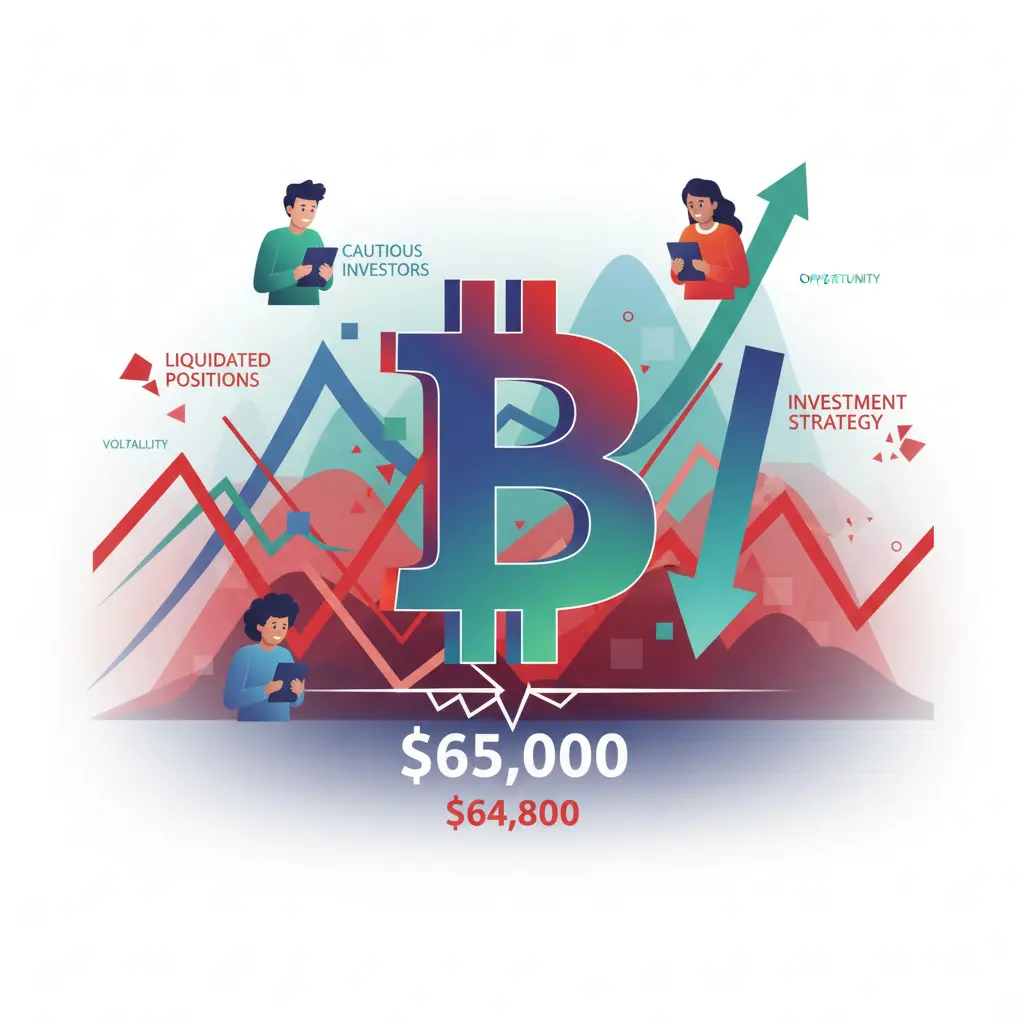
#BitcoinDropsBelow$65K 🔥 Bitcoin Drops Below $65K — February 2026 Deep Dive 🔥
Bitcoin has just broken below the critical $65,000 support level in early February 2026, signaling a significant escalation in the ongoing pullback from the 2025 bull run highs near $126,000. This breach represents not just a psychological blow for traders but a key technical breakdown that could shape short-term market behavior.
Currently, BTC is trading around $69,000 after briefly dipping near $60,000 earlier in the week, with flashes below $61,000 reported on February 5. This reflects a roughly 45-50% drawdown
BTC-2.57%
ETH-2.49%
MrFlower_XingChenvip
#BitcoinDropsBelow$65K 🔥 Bitcoin Drops Below $65K — February 2026 Deep Dive 🔥
Bitcoin has just broken below the critical $65,000 support level in early February 2026, signaling a significant escalation in the ongoing pullback from the 2025 bull run highs near $126,000. This breach represents not just a psychological blow for traders but a key technical breakdown that could shape short-term market behavior.
Currently, BTC is trading around $69,000 after briefly dipping near $60,000 earlier in the week, with flashes below $61,000 reported on February 5. This reflects a roughly 45-50% drawdown from October/November 2025 highs, wiping out most post-election gains and forcing the market into a painful reset phase. The magnitude of this correction reminds everyone that rapid parabolic rallies often face equally sharp pullbacks.
The $65K level was a critical support zone watched by both retail and institutional traders. Its breach triggered cascading stop-loss orders and forced liquidations, amplifying selling pressure. Traders who had long positions relying on this support found themselves squeezed, resulting in further downside acceleration and extreme volatility in intraday sessions.
Several major factors fueled this breakdown. Heavy profit-taking dominated after the euphoric 2025 rally, fueled by pro-crypto policy optimism and high retail enthusiasm. Overextended longs started unwinding aggressively near $70K–$80K, creating a domino effect that cascaded through the market.
Another key driver was the liquidation cascade. Realized losses hit approximately $3.2 billion in a single day, with leveraged positions wiped out en masse. Large stablecoin outflows further drained liquidity, meaning that even small sell orders had outsized impacts on price, creating exaggerated volatility.
Institutional dynamics added pressure. Spot BTC and ETH ETFs experienced heavy outflows over recent weeks and months. Funds that had entered aggressively during the 2025 hype cycle began exiting or hedging amid rising macro uncertainty. This marks one of the first major episodes of ETF-driven bearish pressure, highlighting how traditional financial channels now influence crypto market swings.
Macro headwinds intensified the pullback. A stronger US dollar, geopolitical tension, sharp corrections in gold and silver, tech stock weakness, and hawkish Fed signals all contributed to a broader risk-off sentiment. In such an environment, crypto, being a risk asset, naturally became a primary target for liquidation and portfolio rotation.
Trading liquidity is thin compared to 2025 peaks. Low volume amplifies price swings, making moves appear more violent than they might be in a deeper market. Sentiment has also flipped drastically: the Fear & Greed Index plunged into extreme fear territory (single-digit readings), indicating that most traders are either capitulating or sitting on the sidelines.
Looking ahead, there are two main paths for BTC. In a bullish recovery scenario, stabilization around current levels or a bounce above $70K–$71K could signal that selling exhaustion is over, setting up a healthy consolidation base before the next upward move. Alternatively, in a deeper correction scenario, broken support levels point to $62K, $58K–$60K, and potentially $54K if panic accelerates, extending short-term “crypto winter” sentiment.
Traders and investors are prioritizing capital preservation. Short-term traders are employing tight stops, low or no leverage, and waiting for volume-backed reversal signals such as higher highs or higher lows. Long-term holders may scale in gradually on dips, viewing this as a mid-cycle correction rather than a cycle end. Patience, discipline, and risk management remain the strongest tools in navigating this volatile environment.
repost-content-media
  • Reward
  • 1
  • Repost
  • Share
Discoveryvip:
2026 GOGOGO 👊
#CMEGroupPlansCMEToken 🏦 CME Group Plans Proprietary Digital Token — “CME Token” Could Power 24/7 Crypto Trading & Tokenized Collateral
In a major signal of traditional finance embracing blockchain infrastructure, CME Group, the world’s largest derivatives marketplace, is exploring the launch of a proprietary digital token, informally dubbed the “CME Token”. The news emerged during CME’s Q4 2025 earnings call in early February 2026, where Chairman and CEO Terrence Duffy highlighted initiatives to modernize post-trade processes through tokenized cash and decentralized settlement systems.
Duffy
BTC-2.57%
ETH-2.49%
SOL-4.12%
XRP-5.18%
MrFlower_XingChenvip
#CMEGroupPlansCMEToken 🏦 CME Group Plans Proprietary Digital Token — “CME Token” Could Power 24/7 Crypto Trading & Tokenized Collateral
In a major signal of traditional finance embracing blockchain infrastructure, CME Group, the world’s largest derivatives marketplace, is exploring the launch of a proprietary digital token, informally dubbed the “CME Token”. The news emerged during CME’s Q4 2025 earnings call in early February 2026, where Chairman and CEO Terrence Duffy highlighted initiatives to modernize post-trade processes through tokenized cash and decentralized settlement systems.
Duffy explained that CME’s research is focused on creating a digital asset to support margin, collateral management, and settlement for institutional participants. The token would likely operate on a decentralized or distributed ledger, enabling faster and more capital-efficient processing of high-value derivatives transactions compared with traditional banking rails. While specifics remain preliminary, the concept signals CME’s broader push to modernize infrastructure and improve liquidity efficiency in highly regulated markets.
🏦 Tokenized Cash and Google Cloud Partnership
The CME Token initiative runs alongside CME’s ongoing collaboration with Google Cloud, which began in March 2025. The partnership focuses on a tokenized cash solution scheduled for rollout later in 2026, leveraging Google Cloud’s Universal Ledger technology to digitize bank deposits and cash equivalents for use as trading collateral. This would allow near-instant settlement, reduce counterparty friction, and support continuous market operations—capabilities increasingly critical as markets move toward 24/7 trading models.
📈 Crypto Derivatives Expansion and 24/7 Trading
CME’s token plans coincide with a major expansion of its cryptocurrency derivatives products. The exchange intends to offer round-the-clock trading for major crypto futures and options — including BTC, ETH, SOL, XRP, ADA, LINK, and XLM — pending regulatory approval. Crypto derivatives volumes have surged dramatically, with Q4 2025 daily averages rising over 90% YoY to $13 billion, underscoring growing institutional demand and the need for efficient collateral and settlement solutions.
🏛️ Strategic Implications for Institutional Finance
A CME-issued token would represent a significant strategic step in attracting institutional participants. Unlike retail-focused stablecoins, a CME token would prioritize systemic stability, collateral mobility, and regulatory compliance, integrating seamlessly with CME’s multi-trillion-dollar derivatives ecosystem. It could streamline margin calls, reduce settlement risk, and enhance capital efficiency, while positioning CME as a key player in bridging traditional finance and blockchain infrastructure.
⚖️ Regulatory and Technical Challenges
Despite the promise, significant hurdles remain. Oversight from regulators such as the CFTC will be critical in shaping the token’s structure, permissible uses, and risk controls. Technical challenges include integration with existing clearing systems, cybersecurity safeguards, and cross-platform interoperability. Maintaining price stability, operational reliability, and institutional trust will be essential for large-scale adoption.
🔮 Broader Implications for Crypto Markets
CME’s move reflects a wider trend toward tokenized real-world assets and digital settlement layers. A successful CME token could set a benchmark for regulated digital collateral, encouraging adoption among exchanges, custodians, and clearinghouses worldwide. It demonstrates that blockchain is no longer treated solely as an experimental technology, but increasingly as a core component of financial infrastructure.
📌 Impact on Derivatives and Institutional Adoption
By linking digital collateral, tokenized cash, and 24/7 trading, CME could transform how derivatives markets operate. Institutional investors may gain a more seamless, efficient, and compliant path to crypto exposure. The token could also reduce reliance on traditional banking rails for margin and settlement, shortening transaction cycles and increasing capital efficiency for high-frequency and large-volume participants.
💡 Market Perspective
For crypto markets, a CME token could drive broader adoption and credibility. Integrating regulated digital collateral with major exchange infrastructure may increase institutional confidence in trading and holding digital assets. It may also create a bridge between traditional finance and decentralized protocols, further blurring the lines between legacy markets and the emerging crypto ecosystem.
📊 Bottom Line
If realized, a CME-issued token could become one of the most impactful institutional blockchain initiatives to date. By enabling tokenized collateral, faster settlement, and continuous market operations within a regulated framework, CME has the potential to accelerate institutional crypto adoption, reshape derivatives settlement, and reinforce its role as a trusted gateway between traditional finance and digital assets in 2026 and beyond.
repost-content-media
  • Reward
  • 3
  • Repost
  • Share
CryptoSelfvip:
Buy To Earn 💎
View More
  • Pin

Trade Crypto Anywhere Anytime
qrCode
Scan to download Gate App
Community
English
  • 简体中文
  • English
  • Tiếng Việt
  • 繁體中文
  • Español
  • Русский язык
  • Français
  • Deutsch
  • Português (Portugal)
  • ภาษาไทย
  • Indonesia
  • 日本語
  • بالعربية
  • Українська
  • Português (Brasil)