Futures
Access hundreds of perpetual contracts
TradFi
Gold
One platform for global traditional assets
Options
Hot
Trade European-style vanilla options
Unified Account
Maximize your capital efficiency
Demo Trading
Introduction to Futures Trading
Learn the basics of futures trading
Futures Events
Join events to earn rewards
Demo Trading
Use virtual funds to practice risk-free trading
Launch
CandyDrop
Collect candies to earn airdrops
Launchpool
Quick staking, earn potential new tokens
HODLer Airdrop
Hold GT and get massive airdrops for free
Launchpad
Be early to the next big token project
Alpha Points
Trade on-chain assets and earn airdrops
Futures Points
Earn futures points and claim airdrop rewards


More






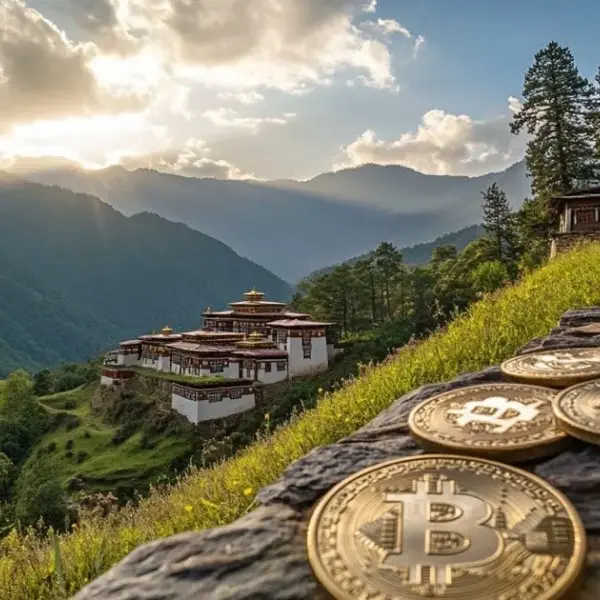
Comparing MicroStrategy and El Salvador: Why is Bhutan the only one earning the most steadily?
I’m sure everyone has seen the news about Bhutan cashing out Bitcoin, wondering why sovereign nations do not hold Bitcoin like MicroStrategy and El Salvador in a faith-based manner.
However, in reality, Bhutan’s Bitcoin holdings are almost at zero cost.
As early as during the pandemic from 2019 to 2020, the King of Bhutan issued an order for DHI to seek new economic engines for the country. Thus, the CEO of DHI led a team to research and propose a specific plan to mine using surplus hydropower, which received unanimous approval from the King, Prime Minister, and senior government officials.
This officially marked the start of Bhutan’s Bitcoin mining journey.
What is DHI?
DHI stands for Druk Holding & Investments, the only and largest state-owned holding group in Bhutan, and also Bhutan’s sovereign wealth fund, responsible for executing the national investment strategy set by the King and the government.
DHI was established in 2007 by the Ministry of Finance of Bhutan as a wholly government-owned commercial investment platform, a national-level operator, headquartered in the capital Thimphu.
As of now, DHI holds shares in 22–25 core state-owned enterprises, covering almost all key sectors such as energy, finance, telecommunications, aviation, infrastructure, and manufacturing, with an asset management scale of approximately 4 billion.
Why did DHI propose to mine using surplus hydropower?
This is thanks to Bhutan being one of the countries with the highest proportion of hydropower and the most extreme power surplus globally.
Over 90% of Bhutan’s electricity flows to India, settled at a long-term low price, far below international market rates and domestic prices in India, because India is the only major buyer, forcing Bhutan to sell at low prices or face idle electricity.
Bitcoin mining requires a substantial amount of electricity to meet daily consumption needs, making Bhutan’s resources a perfect match for Bitcoin mining. Thus, starting in 2019, Bhutan began its zero-cost mining model.
From 2019 to 2024, Bhutan continuously mined without selling.
By the end of 2024, Bhutan’s Bitcoin holdings reached their peak, with 13,000 Bitcoins, accounting for about 40% of Bhutan’s GDP.
In October 2024, Bhutan began its first large-scale reduction, when Bitcoin prices were around $60,000 to $70,000, just near the peak of the previous bull market.
As of March 2026, Bhutan’s Bitcoin holdings had dropped to 4,453 BTC, a 66% decrease from the peak, and the pace of reduction had noticeably accelerated.
From a technical analysis perspective, this indeed represents an exceptionally attractive investment, accumulating Bitcoin at zero cost during the economic downturn from 2019 to 2024 and beginning to gradually sell for profit when the bull market was established.
The funds obtained from the sales were then used for civil servant salary increases, hydropower infrastructure and maintenance, foreign exchange reserve replenishment, and also deploying 10,000 Bitcoins to create a trillion-yen infrastructure special zone in the city of Grelinpu.
A perfect process has been brilliantly enacted: low-cost mining → high-position reduction → reinvestment into the real economy → national wealth.
So why, compared to MicroStrategy and El Salvador, is Bhutan the one profiting the most securely?
In the end, MicroStrategy relies on leveraged financing to stubbornly hold faith, betting on Bitcoin’s perpetual rise, speculating on the future.
El Salvador relies on the national currency narrative, enduring for the long-term value to materialize, embracing the future.
Only Bhutan, from the very beginning, has not treated Bitcoin as a faith but as a resource business for monetizing surplus hydropower and enriching the national treasury.
While others talk about ideals, national fortunes, and shouting to hold forever, Bhutan quietly completed the zero-cost accumulation of Bitcoin, high-position cashing out, and reinvesting funds into people’s livelihoods and infrastructure in a complete closed loop.
It neither greedily seeks extreme surges in profits nor bears the risks of deep declines. Instead, it only earns certain, tangible, and stable profits.
While cashing in, Bhutan is also creating the future.