As decentralized systems expanded, traditional governance approaches struggled with low participation, fragmented coordination, and disproportionate influence from large token holders. These limitations highlighted the need for governance systems that could balance decentralization with efficiency and expertise.
DeXe DAO structures governance as a programmable and participatory system that integrates token-based voting with delegation, configurable rules, and automated execution. It functions as the governance layer of the DeXe ecosystem, where token holders and delegates collectively manage protocol decisions, treasury allocation, and system upgrades through smart contracts.
This integrated design enables decentralized organizations to operate with clearer governance processes, higher participation, and more consistent and structured coordination.
What is DeXe DAO?
DeXe DAO functions as a decentralized governance organization that enables participants to collectively make decisions, manage shared resources, and coordinate protocol development through on-chain mechanisms.
It exists to solve key challenges in earlier DAO models, including low voter engagement, governance fragmentation, and over-reliance on simple token-weighted voting systems. By introducing structured governance frameworks, DeXe DAO creates an environment where decisions are transparent, rules are predefined, and execution is automated.
A defining aspect of DeXe DAO is its shift toward meritocratic governance, where influence is not solely determined by token holdings but can also reflect expertise, delegation, and participation patterns.
DeXe DAO operates as a governance system where token holders and delegates coordinate decisions through structured voting, delegation, and programmable execution.
How does DeXe DAO work?
DeXe DAO operates through a structured governance lifecycle supported by smart contracts and configurable parameters. This lifecycle connects proposal creation, voting, validation, and execution into a continuous coordination process.
The governance process typically follows these stages:
-
Proposal creation Participants submit proposals defining actions such as protocol updates, treasury allocations, or governance changes. Proposal eligibility is controlled by predefined thresholds.
-
Discussion and signaling Proposals may go through discussion phases and off-chain signaling to gather feedback and refine ideas before binding decisions.
-
Voting and delegation Participants vote using token-based or delegated governance. Delegation allows users to assign voting power to experts or representatives, improving decision quality.
-
On-chain validation Proposals are evaluated based on quorum and approval thresholds. Voting power may follow linear or nonlinear logic depending on governance settings.
-
Execution Approved proposals are executed automatically through smart contracts, ensuring decisions are implemented without intermediaries.
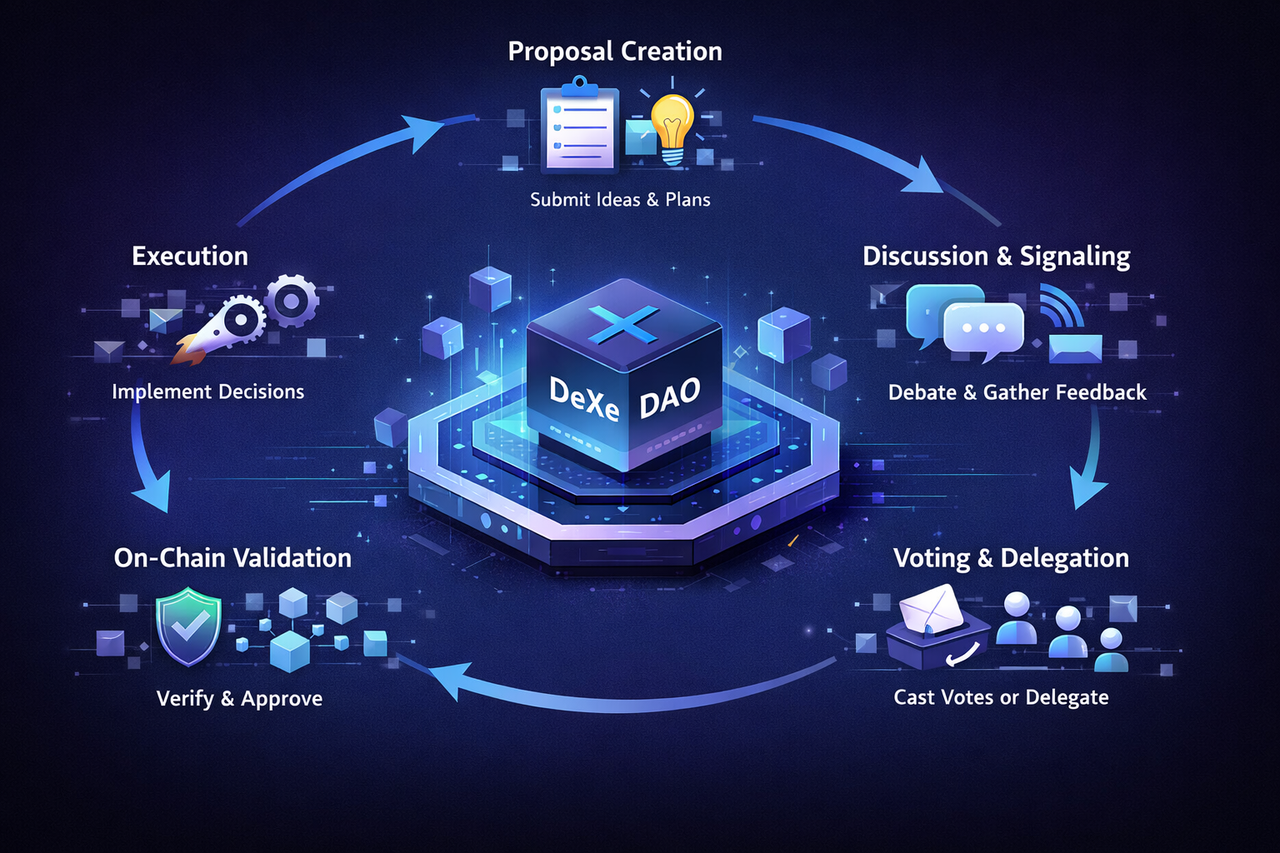
This governance lifecycle operates on top of modular architecture that defines how proposals, voting, and execution are coordinated across the system.
DeXe DAO manages governance through a step-based lifecycle that integrates proposal submission, voting, validation, and automated execution.
Core components and key features of DeXe DAO
DeXe DAO combines multiple components to create a cohesive governance system, where governance participation and voting power are closely tied to the DEXE token, influencing how incentives are distributed and how treasury resources are coordinated within the framework.
| Component |
Description |
Function |
| Governance module |
Defines voting rules and proposal logic |
Enables structured decision-making |
| Delegation system |
Allows transfer of voting power |
Supports expertise-driven governance |
| Treasury system |
Manages shared assets |
Enables collective resource allocation |
| Voting engine |
Handles vote calculation and validation |
Ensures accurate and transparent outcomes |
These components interact to form a unified governance framework where decisions, incentives, and execution are interconnected.
Key features include:
-
Meritocratic governance models Voting power can incorporate expertise and delegation, reducing reliance on pure token weight.
-
Flexible voting logic Supports linear, nonlinear, and custom voting mechanisms tailored to different governance needs.
-
Delegation as a core mechanism Participants can delegate voting power while retaining ownership, improving efficiency and participation.
-
Programmable execution Decisions are automatically executed through smart contracts, ensuring consistency and transparency.
DeXe DAO integrates governance modules, delegation systems, and treasury coordination into a unified framework for decentralized decision-making.
Main uses and applications of DeXe DAO
DeXe DAO is applied in scenarios where structured decentralized governance is required:
-
Protocol governance Manages upgrades, parameter changes, and strategic decisions within decentralized systems.
-
Treasury management Enables collective control over shared funds, including grants, investments, and operational spending.
-
Delegated decision-making systems Supports governance models where participants rely on experts or representatives for decision-making.
-
Ecosystem coordination Facilitates collaboration across contributors, developers, and stakeholders within decentralized networks.
These applications highlight its role as a governance infrastructure for coordinating complex decentralized systems.
DeXe DAO is used to manage protocol decisions, allocate resources, and coordinate decentralized ecosystems through structured governance processes.
What are the Advantages and Risks of DeXe DAO?
DeXe DAO introduces a governance model that balances flexibility, participation, and complexity.
Advantages
-
Higher governance participation Delegation and incentives can increase active voting and improve quorum levels.
-
Expert-driven decision-making Meritocratic elements allow experienced participants to contribute more effectively.
-
Integrated governance system Combines voting, treasury management, and execution within one framework.
-
Transparency and automation Smart contracts ensure that decisions are visible and executed consistently.
Risks
-
Delegation concentration Voting power may accumulate among a small group of delegates or experts.
-
Governance complexity Advanced voting models and configurations may be difficult for some users to understand.
-
Parameter misconfiguration Incorrect quorum or threshold settings can lead to inefficiencies or governance issues.
-
Participation dependency The system relies on active engagement; low participation can weaken governance effectiveness.
DeXe DAO provides a flexible and structured governance system, but its effectiveness depends on participation quality and proper configuration.
Summary
DeXe DAO functions as a governance framework that integrates delegation, voting, and execution into a unified system. By combining token-based participation with expertise-driven mechanisms, it enables decentralized organizations to coordinate decisions more effectively.
Its modular architecture and programmable workflows allow governance to operate as a continuous process rather than isolated events.
DeXe DAO represents an evolution in DAO design, where governance becomes a structured system for managing resources, coordinating participants, and executing decisions in decentralized environments.
FAQs
What is DeXe DAO used for?
It is used to manage governance, treasury decisions, and protocol upgrades in the DeXe ecosystem.
How is DeXe DAO different from traditional DAOs?
It incorporates delegation, meritocratic voting, and programmable execution rather than relying solely on token-weighted voting.
Can users delegate their voting power in DeXe DAO?
Yes, users can delegate voting power to other participants while retaining ownership of their tokens.
How are decisions executed in DeXe DAO?
Approved proposals are executed automatically through smart contracts.
What is the main risk of DeXe DAO?
Key risks include delegation concentration, governance complexity, and dependence on active participation.